 Politics & Law
Senior Party leader calls for urgent, decisive implementation of key tasks by year-end
1.
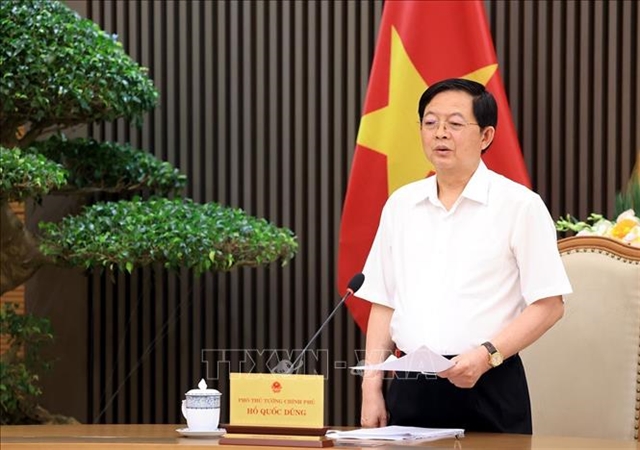 |
| Deputy Prime Minister Hồ Quốc Dũng speaks at the meeting with ministries and agencies on the development of the national innovation ecosystem in Hà Nội on Wednesday. VNA/VNS Photo |
HÀ NỘI — Deputy Prime Minister Hồ Quốc Dũng has called for the development of a national innovation ecosystem focused on practical outcomes and market needs, setting a target for at least 50 per cent of research projects to be linked with businesses and deliver tangible products and results by 2030.
Speaking at a meeting with ministries and agencies on the development of the national innovation ecosystem in Hà Nội on Wednesday, Deputy PM Dũng said innovation must become a genuine driver of economic development and growth, boosting productivity and added value while creating new products, industries and markets.
The ecosystem should be assessed by its tangible contributions to productivity, quality, competitiveness and economic growth, he said.
Deputy PM Dũng called for a coordinated, practical and effective national innovation ecosystem, with businesses at its centre and technology commercialisation and the development of innovative enterprises serving as key breakthroughs.
Regarding institutional reform, he tasked the Ministry of Science and Technology with urgently reviewing shortcomings in the regulatory framework, mechanisms and policies in coordination with the ministries of Finance, Education and Training, Industry and Trade, and Agriculture and Environment, as well as relevant agencies.
The Ministry of Science and Technology was also asked to conduct a comprehensive assessment of the national innovation system and propose development orientations for 2026-30, with a vision to 2045.
The ministry should also develop a network of innovation centres and intermediary organisations aligned with the strengths of specific industries, sectors and localities.
Regarding science, technology and innovation development funds, the Deputy PM directed the ministry to urgently formulate and issue guidelines for their establishment and effective operation. Ministries, sectors and localities were asked to complete the establishment of their funds and ensure they operate effectively.
He called for research activities to be driven by practical demand, with businesses serving as partners throughout the process. Links among the State, scientists and businesses should be strengthened from the identification of research priorities through research, testing, application and commercialisation.
To achieve these goals, he called for the study of mechanisms for commissioning research and developing technological products, as well as support programmes for innovative enterprises with strong growth potential and the capacity to master technologies.
He also stressed the need to develop enterprises with sufficient scale and capabilities to participate more deeply in global value chains, while strengthening cooperation with technology corporations and international innovation centres.
Deputy PM Dũng assigned the Ministry of Finance to study and propose mechanisms to attract experts and highly skilled workers. The Ministry of Science and Technology was asked to coordinate with other ministries and sectors to organise meetings among state management agencies, research institutes, universities and businesses to identify obstacles and propose measures to improve collaboration.
He also urged ministries and agencies responsible for component indicators of the Global Innovation Index (GII) to proactively identify measures to improve their respective indicators.
Localities were asked to continue implementing measures to improve their Provincial Innovation Index (PII), linking assessment results with socio-economic development performance.
Reporting at the meeting, Deputy Minister of Science and Technology Hoàng Minh said Việt Nam ranked 43rd among 139 economies in the 2026 GII published by the World Intellectual Property Organisation (WIPO), up one place from 2025 and ranking third in ASEAN.
Notably, Việt Nam's innovation output ranking rose two places to 35th, while its innovation input ranking fell four places to 54th. Since 2022, the country has climbed five places in the GII, from 48th to 43rd.
WIPO continued to recognise Việt Nam as one of seven middle-income economies that had made the greatest improvements in innovation rankings since 2013. The country has also maintained a record of innovation performance exceeding expectations relative to its level of development for 16 consecutive years.
According to the Ministry of Science and Technology, Việt Nam has strengths in trade, market scale, high-tech exports, creative goods and digital technology adoption.
Its ranking in knowledge and technology outputs has improved particularly strongly, rising from 44th in 2024 to 39th in 2025 and 35th in 2026.
However, Minh said, the national innovation ecosystem still faces challenges related to institutional quality, policy implementation, investment in research and development, highly skilled human resources and venture capital.
Businesses also have limited capacity to absorb and master technologies, generate new knowledge and turn research findings into marketable products, the ministry said.
The ministry identified addressing bottlenecks in institutions, human resources, infrastructure and research and development investment as key priorities, alongside strengthening businesses' technological capabilities and translating knowledge into high-value products and services, he said. — VNS
Politics & Law
 Politics & Law
 Politics & Law
 Politics & Law
 Politics & Law
 Politics & Law
 Politics & Law
 Politics & Law
 Politics & Law
 Politics & Law
 Politics & Law
 Politics & Law
 Politics & Law
 Politics & Law
 Politics & Law