 Politics & Law
Senior Party leader calls for urgent, decisive implementation of key tasks by year-end
1.
|
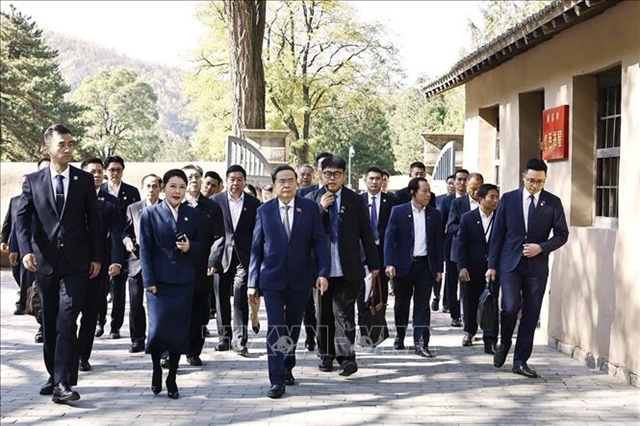
| NA President Trần Thanh Mẫn arrives at Zaoyuan revolutionary site, China’s Shaanxi province, on Wednesday. VNA/.VNS Photo |
BEIJING — National Assembly (NA) President Trần Thanh Mẫn on Wednesday visited the Yangjialing and Zaoyuan revolutionary sites in Yan’an city, northwest China’s Shaanxi province during his official visit to China.
He was accompanied by Chairman of the Standing Committee of the Yan’an municipal People’s Congress Wang Junying, and Secretary-General of the Standing Committee of the municipal People’s Congress Ren Gaofei.
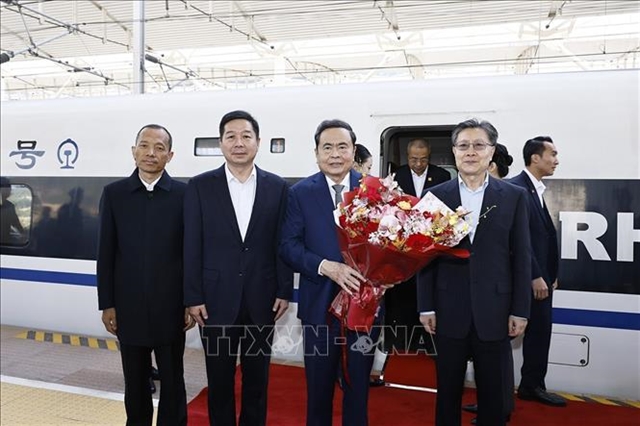
NA President Mẫn and his delegation travelled to Yan’an by high-speed train. The city is regarded as the cradle of China’s revolution and a symbol of resilience, solidarity and self-reliance. It also bears the imprint of Nguyễn Ái Quốc, or President Hồ Chí Minh, whose revolutionary activities during his time in China contributed to the Chinese revolution and the international communist movement.
Zaoyuan lies about 8km northwest of the city centre. Together with Yangjialing, Wangjiaping, Baota Mountain and the Yan’an Revolutionary Memorial Museum, it forms a prominent complex of revolutionary sites from the period when the Central Committee of the Communist Party of China (CPC) was based in the city. President Mao Zedong and other Chinese revolutionary leaders lived and worked there.
|
| NA President Trần Thanh Mẫn is welcomed by leaders of Yan’an city at Yan’an station on Wednesday. VNA/VNS Photo |
Zaoyuan carries particular significance for Việt Nam because President Hồ Chí Minh stayed there. According to the CPC history section of China’s People’s Daily, he returned to China from the Soviet Union in the winter of 1938, travelling through Xinjiang and Xi’an before reaching Yan’an, then the CPC’s hub.
At Zaoyuan, President Hồ Chí Minh was hosted by Wang Jiaxiang, Secretary of the CPC Central Committee. He also met Mao and other Chinese leaders to discuss the revolutions in both countries.
The site is therefore significant to the history of both revolutions, particularly the period before President Hồ Chí Minh returned to lead Việt Nam’s. It reflects the close ties between the two countries’ leaders and revolutionary movements. President Hồ Chí Minh revisited the house in 1959 and had his pho taken there.
NA President Mẫn also toured Yangjialing, which has been preserved as a venue for teaching the public about CPC history and China’s revolutionary traditions.
Yangjialing is linked to a pivotal period when the CPC consolidated its ideological, political and organisational foundations during the war of resistance against Japan, while preparing for the post-war period. It remains a prominent site for political and Party history education in China.
Welcoming the visit, member of the Standing Committee of the Shaanxi provincial Party Committee and Secretary of the Yan’an municipal Party Committee Wang Haipeng said it offers a special opportunity to boost exchanges between Vietnamese localities and Yan’an.
Wang said the city has a strong revolutionary tradition and ample potential, particularly in energy, agriculture and tourism. Yan’an has followed the guidance of China’s and Shaanxi’s leaders in attaching importance to friendly cooperation with Việt Nam and staying ready to work with Vietnamese localities to effectively follow high-level common understandings.
The Vietnamese guest lauded Yan’an’s development and its efforts to preserve its “red address” sites. He called on the city and Vietnamese localities to foster connectivity and people-to-people exchanges, push tourism cooperation, particularly “red tourism” that follows in the footsteps of both countries’ revolutionary leaders, and work together to preserve historical and cultural sites. — VNA/VNS
Politics & Law
 Politics & Law
 Politics & Law
 Politics & Law
 Politics & Law
 Politics & Law
 Politics & Law
 Politics & Law
 Politics & Law
 Politics & Law
 Politics & Law
 Politics & Law
 Politics & Law
 Politics & Law
 Politics & Law