 Politics & Law
PM’s Laos visit to help deepen bilateral relations
1.
|
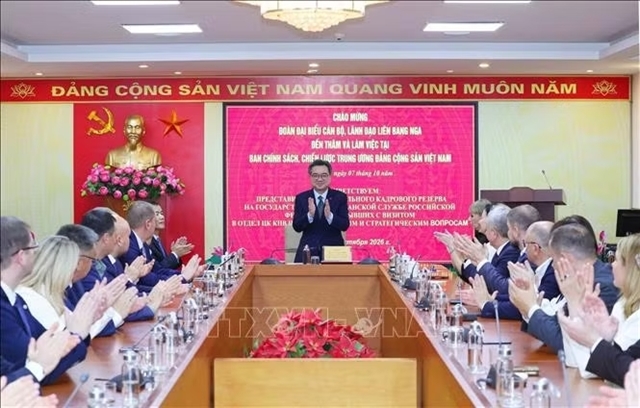
| Head of the Central Committee's Policy and Strategy Department, Nguyễn Thanh Nghị, works with a delegation of officials and leaders from the Russian Federation. — VNA/VNS Photo |
HÀ NỘI — Politburo member, Secretary of the Party Central Committee and Chairman of the committee’s Commission for Policy and Strategy Nguyễn Thanh Nghị held a working session in Hà Nội on October 7 with a delegation of Russian leaders and officials.
Welcoming the delegation to Việt Nam for study and research, Nghị said the visit was a practical manifestation of the two countries’ growing cooperation in training.
Briefing the delegation on Việt Nam’s socio-economic development, he said that after 40 years of Đổi Mới (Renewal), Việt Nam has made remarkable progress, with GDP rising more than 60-fold from US$8 billion in 1986 to over $514 billion in 2025.
People’s living standards have improved, while infrastructure, education, healthcare and social welfare systems have expanded.
Việt Nam’s international standing and reputation have also continued to grow. Despite global volatility over the past five years, Việt Nam has maintained one of the highest economic growth rates in the region and the world, emerging as an important manufacturing and export hub, an attractive destination for foreign investment and an increasingly integrated participant in global production and trade chains.
Regarding Việt Nam’s development orientations, Nghị said the 14th National Party Congress set the goal of making Việt Nam a developing country with modern industry and upper-middle income by 2030, and a developed, high-income country by 2045. During 2026–2030, it aims to achieve average annual GDP growth of around 10 per cent or higher.
He said Việt Nam is shifting from a growth model heavily reliant on capital, resources and low-cost labour towards one driven by productivity, knowledge and innovation, and from a management-oriented approach to one focused on creating conditions for development and putting people at the centre.
Nghị also briefed the delegation on Việt Nam’s efforts to streamline the political system and state apparatus, as well as the functions and responsibilities of the Commission for Policy and Strategy.
The Russian delegation expressed its impression of Việt Nam’s development achievements and spoke highly of the commission’s role in strategic research and policy advice.
The two sides discussed the potential to combine Russia’s strengths in high technology with Việt Nam’s development needs, as well as mechanisms for cooperation in human resource training and joint research, aiming to lay a foundation for long-term, substantive and effective cooperation.
Nghị affirmed that Việt Nam regards strengthening relations with Russia as a top priority in its foreign policy. He identified science and technology, innovation, human resource training, energy and oil and gas as areas with significant potential for cooperation.
He called for stronger exchanges between educational and training institutions of the two countries, the selection of strategic technology fields for long-term cooperation programmes, greater training of engineers, increased expert exchanges and the implementation of joint research programmes.
He expressed his hope that members of the delegation would serve as bridges between the two countries in their respective positions, helping further nurture the traditional friendship between Việt Nam and Russia for the prosperity and development of both countries. — VNA/VNS
Politics & Law
 Politics & Law
 Politics & Law
 Politics & Law
 Politics & Law
 Politics & Law
 Politics & Law
 Politics & Law
 Politics & Law
 Politics & Law
 Politics & Law
 Politics & Law
 Politics & Law
 Politics & Law
 Politics & Law