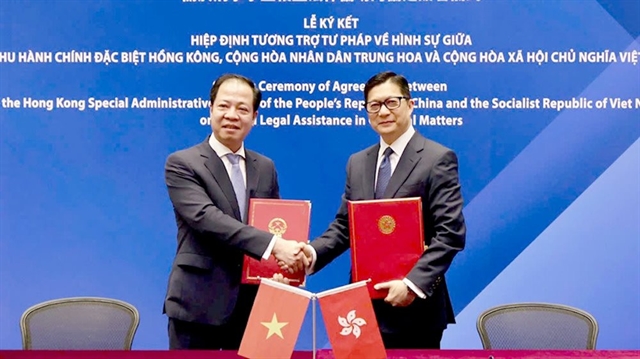
 |
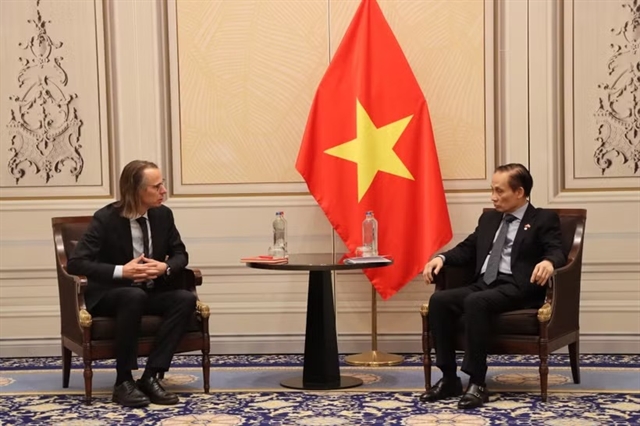
| The signing ceremony of the Agreement on Mutual Legal Assistance in Criminal Matters between the Socialist Republic of Việt Nam and the Hong Kong Special Administrative Region of the People’s Republic of China. — Photo: kiemsat.vn |
Law No. 103/2025/QH15 on Mutual Legal Assistance in Criminal Matters
Pursuant to the Constitution of the Socialist Republic of Vietnam, which has a number of articles amended and supplemented under Resolution No. 203/2025/QH15;
The National Assembly promulgates the Law on Mutual Legal Assistance in Criminal Matters.
Chapter I
GENERAL PROVISIONS
Article 1. Scope of regulation
This Law provides principles, competence, order and procedures for the provision of mutual legal assistance in criminal matters between Vietnam and foreign countries; and responsibilities of Vietnamese state authorities in mutual legal assistance in criminal matters.
Article 2. Subjects of application
This Law applies to Vietnamese authorities, organisations and individuals, and foreign authorities, organisations and individuals involved in mutual legal assistance in criminal matters between Vietnam and foreign countries.
Article 3. Interpretation of terms
In this Law, the terms below are construed as follows:
1. Mutual legal assistance in criminal matters means the provision of mutual support between Vietnam and foreign countries, through competent state authorities, in the verification, investigation, and collection of evidence, or in carrying out other activities to serve the settlement of criminal matters or cases and the enforcement of judgments.
2. Requesting country means a country that sends a letter of request for mutual legal assistance in criminal matters to a requested country for the latter to consider providing support.
3. Requested country means a country that is requested to provide mutual legal assistance in criminal matters.
4. Request-preparing authority means a competent authority as defined by law that requests a foreign country to provide mutual legal assistance in criminal matters for the settlement of criminal matters or cases or the enforcement of judgments.
5. Request-executing authority means a competent authority as defined by law that is assigned to provide mutual legal assistance in criminal matters in Vietnam or abroad.
Article 4. Application of law
1. Mutual legal assistance in criminal matters must comply with this Law; where this Law does not provide this issue, the relevant provisions of the criminal procedure law and other relevant laws of Vietnam shall apply.
2. Foreign law may only be applied in accordance with treaties to which the Socialist Republic of Vietnam is a contracting party.
Article 5. Principles of mutual legal assistance in criminal matters
1. Mutual legal assistance in criminal matters shall be provided on the principles of respect for independence, sovereignty and territorial integrity, non-interference in one another’s internal affairs, equality and mutual benefit, and in compliance with the Constitution and laws of Vietnam and the treaties to which the Socialist Republic of Vietnam is a contracting party.
2. In case Vietnam and a foreign country are not both contracting parties to a treaty on mutual legal assistance in criminal matters, mutual legal assistance in criminal matters shall be provided on the principle of reciprocity but must not contravene Vietnam’s law and must comply with international law and international practices.
Article 6. Central authority of the Socialist Republic of Vietnam in mutual legal assistance in criminal matters
1. The Supreme People’s Procuracy is the central authority of the Socialist Republic of Viet Nam in mutual legal assistance in criminal matters.
2. The central authority of the Socialist Republic of Viet Nam in mutual legal assistance in criminal matters shall act as the focal point in exchanging information, and receiving, transferring, monitoring and urging the provision of mutual legal assistance in criminal matters; refuse or postpone the execution of requests for mutual legal assistance in criminal matters according to its competence; coordinate with related authorities in considering and settling requests for mutual legal assistance in criminal matters; propose the conclusion of, or accession to, and implementation of, treaties on mutual legal assistance in criminal matters, and perform/exercise other obligations/powers in accordance with the law on mutual legal assistance in criminal matters and the treaties to which the Socialist Republic of Vietnam is a contracting party.
Article 7. Application of the principle of reciprocity in mutual legal assistance in criminal matters
1. The Supreme People’s Procuracy shall decide on the receipt and processing of requests of foreign countries for mutual legal assistance in criminal matters and the sending of Vietnam’s requests for mutual legal assistance in criminal matters on the principle of reciprocity.
2. When necessary, the Supreme People’s Procuracy shall consult the Ministry of Foreign Affairs and related authorities before making its decision.
Article 8. Languages in dossiers of request for mutual legal assistance in criminal matters
1. If Vietnam and a foreign country are both contracting parties to a treaty on mutual legal assistance in criminal matters, the language in dossiers of request for mutual legal assistance in criminal matters is the language used in such treaty.
2. If Vietnam and a foreign country are not both contracting parties to a treaty on mutual legal assistance in criminal matters, dossiers of request mutual legal assistance in criminal matters shall be accompanied by translations into the language of the requested country or another language accepted by the requested country.
3. Vietnam’s request-preparing authorities shall have the documents and materials specified in Clause 1, Article 19 of this Law translated into the language specified in Clauses 1 and 2 of this Article.
Article 9. Scope of mutual legal assistance in criminal matters
The scope of mutual legal assistance in criminal matters covers:
1. Service, delivery or sending of procedural documents;
2. Search and seizure;
3. Confiscation, return and handling of material evidences and assets;
4. Arrangement of travel of persons in the requested country to the requesting country to assist in investigation and provide evidence;
5. Arrangement of travel of competent persons in the requesting country to the requested country to appear in the course of the provision of mutual legal assistance in criminal matters;
6. Temporary transfer of temporarily detained persons or persons currently serving sentences in the requested country to the requesting country to assist in investigation and provide evidence;
7. Direct or online taking of testimonies and other forms of evidence collection and provision;
8. Transfer serving examination for penal liability;
9. Exchange of information;
10. Other forms of mutual assistance.
Article 10. Exemption from consular legalisation
Dossiers of request and results of the execution of requests for mutual legal assistance in criminal matters are exempt from consular legalisation if they are signed and sealed by foreign competent persons or authorities, unless otherwise provided by the treaties to which the Socialist Republic of Vietnam is contracting party.
Article 11. Safeguards
1. When requesting a person’s attendance in the territory of the requesting country to assist in investigation and provide evidence, the requesting country shall make a written commitment that:
a/ Such person will not be examined for penal liability in the territory of the requesting country for an act committed before he/she leaves the requested country;
b/ Such person will neither be arrested nor be subject to any restriction of personal liberty in the territory of the requesting country for an act committed before he/she leaves the requested country, except the cases specified in Clause 1, Article 35 and Clause 1, Article 37 of this Law;
c/ Such person will not have to provide evidence or assist any criminal investigation activities beyond the scope stated in the request for mutual legal assistance without his/her consent.
2. A person who refuses to travel to the requesting country to assist in investigation and provide evidence will not be subject to any penalty or coercive measure.
3. A person who agrees to travel to the requesting country to assist in investigation and provide evidence will not be examined for penal liability for their statements, unless he/she makes false statements.
4. The immunity of a person from being examined for penal liability, arrested or subject to restriction of personal liberty as specified in Points a and b, Clause 1 of this Article will be terminated if he/she fails to leave the requesting country beyond 15 days after being notified in writing by the competent authority of the requesting country that his/her attendance in the territory of the requesting country is no longer needed. This time limit does not count the duration in which such person cannot leave the requesting country for force majeure events.
Article 12. Information confidentiality and use limitation
1. Information, documents and evidence provided by the competent authority of a country may only be used for proper purposes stated in requests for mutual legal assistance in criminal matters and may not be disclosed or transferred to a third party. In case of use of information, documents and evidence for purposes other than those stated in requests for mutual legal assistance in criminal matters, prior written consent of the competent authority of the other country is required.
2. Information, documents and evidence provided by the competent authority of the requested country must be protected from falsification, alteration or unauthorised disclosure. When requested by the requesting country or in case of necessity, the competent authority of the requested country may decide to apply appropriate measures to ensure information confidentiality.
3. If it is impossible to execute the information confidentiality request, the competent authority of the requested country shall notify such and clearly state the reasons, and exchange opinions with the competent authority of the requesting country on alternative measures (if any).
Article 13. Delivery and receipt of documents, material evidences and assets related to mutual legal assistance in criminal matters
1. The delivery and receipt of documents, material evidences and assets related to mutual legal assistance in criminal matters between the Supreme People’s Procuracy and the request-preparing authority or the request-executing authority in Vietnam must comply with Vietnam’s law.
2. The delivery and receipt of documents, material evidences and assets related to mutual legal assistance in criminal matters between the Supreme People’s Procuracy and a foreign competent authority shall be agreed by the two sides in accordance with the treaty to which the two countries are contracting parties, and relevant laws of Vietnam and the foreign country.
Article 14. Consideration of requests related to the death penalty
1. In case a foreign country requests Vietnam not to apply the death penalty or not to enforce a death sentence in order to execute a request for mutual legal assistance in criminal matters, the Supreme People’s Procuracy shall assume the prime responsibility for, and coordinate with related authorities in, issuing:
a/ A notice of non-application of the death penalty or non-enforcement of the death sentence against the person involved in the request for mutual legal assistance in criminal matters, if that person is eligible for non-application of the death penalty or non-enforcement of the death sentence specified in the Penal Code; or,
b/ A notice of non-enforcement of the death sentence against the person involved in the request for mutual legal assistance in criminal matters who does not fall into the case specified in Point a, Clause 1 of this Article after consulting the President of the Socialist Republic of Vietnam.
2. In case Vietnam requests a foreign country not to apply the death penalty or not to enforce a death sentence in order to execute a request for mutual legal assistance in criminal matters, the Supreme People’s Procuracy shall request the foreign country to make a written commitment regarding this issue.
3. The Procurator General of the Supreme People’s Procuracy shall assume the prime responsibility for, and coordinate with the Chief Justice of the Supreme People’s Court, the Minister of Public Security, the Ministry of National Defence, the Minister of Justice, and the Minister of Foreign Affairs in, detailing this Article.
Article 15. Expenses for execution of requests for mutual legal assistance in criminal matters
1. In case Vietnam and a foreign country are both contracting parties to a treaty on mutual legal assistance in criminal matters, expenses for the provision of mutual legal assistance in criminal matters must comply with such treaty.
2. In case Vietnam and a foreign country are not both contracting parties to any treaty on mutual legal assistance in criminal matters, unless otherwise agreed, expenses for the provision of mutual legal assistance in criminal matters shall be paid by the requested country, except the following expenses that are payable by the requesting country:
a/ Expense for transportation of a person to/from a country and any allowance such person is entitled to during the execution of the request for mutual legal assistance in criminal matters as specified in Clauses 4, 5 and 6, Article 9 of this Law;
b/ Expense for officers in charge of escorting or guarding sentenced persons;
c/ Expense for expert examination;
d/ Expense for interpretation, translation, and reproduction of documents;
dd/ Expense for collection of evidence via live television links or other technical means;
e/ Other expenses payable by the requesting country pursuant to a request made by the requested country.
3. The Government shall detail this Article.
Article 16. Funding for mutual legal assistance in criminal matters
Funding for mutual legal assistance in criminal matters shall be covered by the state budget in accordance with the law on the state budget and relevant regulations.
Article 17. Provision of mutual legal assistance in criminal matters between Vietnam and the neighbouring countries
1. Request-preparing authorities and request-executing authorities of provinces and cities sharing the borderline between Vietnam and foreign countries may directly provide mutual legal assistance in criminal matters in the cases specified in treaties between Vietnam and those foreign countries.
Provincial-level People’s Procuracies of provinces and cities sharing the borderline between Vietnam and foreign countries shall send and receive requests for mutual legal assistance in criminal matters sent by request-preparing authorities of those provinces and cities; and at the same time, report such to the Supreme People’s Procuracy for monitoring, coordinating, urging, and managing mutual legal assistance in criminal matters.
2. The order and procedures for providing mutual legal assistance in criminal matters between Vietnam and the neighbouring countries specified in this Article are similar to those specified in Chapters II and III of this Law.
Article 18. Responsibilities of state authorities in mutual legal assistance in criminal matters
1. The Supreme People’s Procuracy shall uniformly manage mutual legal assistance in criminal matters nationwide; include the content on mutual legal assistance in criminal matters in its annual work reports for submission to the National Assembly; guide competent authorities in providing mutual legal assistance in criminal matters; and perform/exercise other tasks/powers of the central authority of the Socialist Republic of Vietnam in mutual legal assistance in criminal matters.
2. The Government shall coordinate with the Supreme People’s Procuracy in managing mutual legal assistance in criminal matters; and direct ministries, ministerial-level agencies and government-attached agencies in mutual legal assistance in criminal matters activities.
3. Procuracies shall exercise the right to prosecute and supervise mutual legal assistance in criminal matters; other competent proceedings-conducting authorities, judgment enforcement authorities, and other related authorities shall, within the ambit of their tasks and powers, provide mutual legal assistance in criminal matters in accordance with this Law and relevant regulations.
The Procurator General of the Supreme People’s Procuracy shall assume the prime responsibility for, and coordinate with the Chief Justice of the Supreme People’s Court, the Minister of Public Security, the Minister of National Defence, the Minister of Justice and the Minister of Foreign Affairs in, providing the coordination in performing/exercising the tasks, rights and responsibilities of procuracies and other authorities regarding the exercise of the right to prosecute and supervise mutual legal assistance in criminal matters activities.
4. The Supreme People’s Court, ministries, ministerial-level agencies and government-attached agencies shall, within the ambit of their tasks and powers, coordinate with the Supreme People’s Procuracy in managing mutual legal assistance in criminal matters.
...
(To be continued)
<Source: Official Gazette, Issue No 31/2026>
 Politics & Law