 Politics & Law
Việt Nam, EU and Belgium seek deeper, practical cooperation
1.
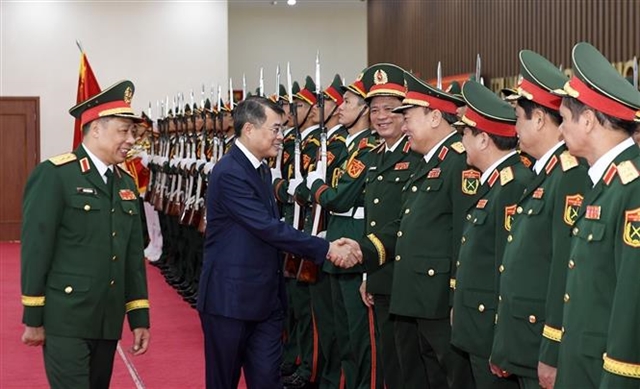 |
| PM Lê Minh Hưng attends the ceremony marking the new 2026-2027 school year of the National Defence Academy on Tuesday. VNA/VNS Photos Thống Nhất |
HÀ NỘI —Prime Minister Lê Minh Hưng has urged breakthroughs in the quality of training and fostering campaign, strategic and senior officials of the Party, State, and armed forces, tied to further improving scientific research, turning the National Defence Academy into a leading strategic advisory centre on military and national defence.
The Government leader was speaking at the ceremony marking the new 2026-2027 school year of the National Defence Academy on Tuesday. The year also marks the 50th anniversary of the Academy’s Traditional Day (1977-2027).
He emphasised that the global situation continued to evolve rapidly, complexly and unpredictably; the international landscape was undergoing profound changes toward multipolarity and multi-centers, with fierce competition among major powers increasing divisions, polarisation, pressures to choose sides and risks of conflict; economic, trade, investment and technology wars were intensifying.
“The boundaries between traditional and non-traditional security, between military and non-military activities, are increasingly blurred; science and technology, especially artificial intelligence, are profoundly impacting military, defence, and security fields, fundamentally changing the methods of warfare,” said PM Hưng.
In that context, the Prime Minister said that the task of safeguarding the Fatherland would face new, more difficult and heavier requirements, demanding the maintenance of a peaceful, stable environment for development; firmly protecting national interests; and absolutely avoiding strategic passivity or surprise.
“Defending the Fatherland is not only about protecting territory, borders, seas and islands, protecting the Party, State and People; but also about safeguarding political, economic, cultural, ideological, and data security, digital sovereignty and the country’s strategic autonomy,” said PM Hưng.
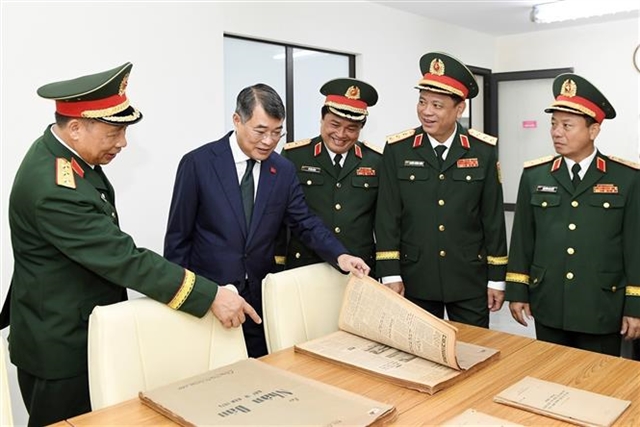 |
| PM Lê Minh Hưng visits the Archives of the National Defence Academy's Library. |
The Prime Minister affirmed that this must be treated as an urgent requirement for military and defence work, and for the mission of training campaign and strategic officials and conducting military and defence scientific research at the National Defence Academy.
He said: “The Academy must not only study what has happened, but also accurately assess the situation, proactively forecast, and detect risks early to advise the Central Military Commission and Ministry of National Defence on military and defence policies, while improving training quality and preparing a cadre team capable for both present and future.
“The Academy needs to closely monitor global and regional developments, correctly assess adversaries and partners; promptly identify the international security environment; research and produce highly practical outputs such as strategic forecasts, early warnings and policy recommendations; integrate scientific and technological achievements; absorb global military art without copying foreign models, while avoiding insularity, conservatism and sluggishness in innovation.”
Additionally, PM Hưng urged the Academy to strengthen its role as a research hub on people’s national defence, linking defence with socio-economic development, enhancing the country’s strategic autonomy. The Academy should study and contribute to building theoretical systems, criteria and organisational models for a modern people’s national defence suited to new development models, two-tier local government structures, and the new national development space.
It should proactively propose methods to integrate defence and security requirements into regional, local, urban and strategic infrastructure development strategies and plans; combine marine economic development with safeguarding maritime sovereignty.
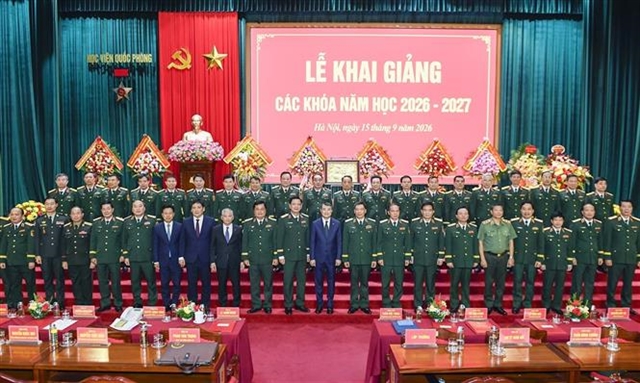 |
| PM Lê Minh Hưng (centre) and delegates attend the ceremony marking the new 2026-2027 school year of the National Defence Academy on Tuesday. |
Furthermore, the Prime Minister stressed the need to boost science, technology, innovation and digital transformation.
He said: “The National Defence Academy should evolve into a smart, modern institution exemplary in digital transformation and scientific application; a strategic knowledge and innovation hub; building a modern ecosystem for training and research, simulation models, decision-support systems, synchronised digital infrastructure, databases, and military-defence knowledge repositories; intensifying AI applications in research and strategic forecasting, creating realistic practice environments to hone capabilities.
“It should actively engage in research and propose solutions for developing autonomous, resilient, dual-use, modern and competitive defence industries; focusing on defence economy and industry issues, mobilising scientific and technological resources, building innovation ecosystems and establishing mechanisms linking the military with research institutes, universities and enterprises.”
Also, he called for enhancing the effectiveness of defence diplomacy and international cooperation in training and scientific research. International cooperation must truly bring new knowledge, more friends, greater trust, and additional resources for safeguarding the Fatherland; contributing to upholding principles, independence, autonomy, and protecting national interests.
The PM added: “Relations should continue to expand with focus and priority toward reputable defence academies, research institutes and training institutions abroad; further improving the quality of training senior military officers and international defence officials; strengthening faculty exchanges, joint research, international seminars and forums.” VNS
Politics & Law
 Politics & Law
 Politics & Law
 Politics & Law
 Politics & Law
 Politics & Law
 Politics & Law
 Politics & Law
 Politics & Law
 Politics & Law
 Politics & Law
 Politics & Law
 Politics & Law
 Politics & Law
 Politics & Law