 Politics & Law

HKSTP Partners with Leading Science and Technology Company Merck to Open a New Chapter in I&T Collaboration
1.
|
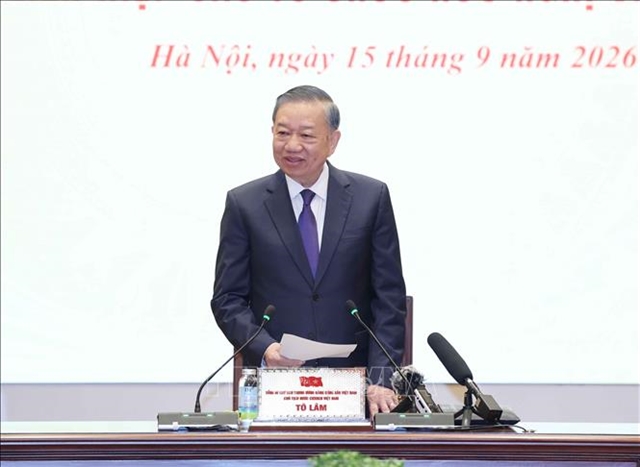
| Party General Secretary and State President Tô Lâm delivers a speech at a meeting with representatives of the 7th-term Presidium of the Việt Nam Union of Friendship Organisations (VUFO) in Hà Nội on Tuesday morning. — VNA/VNS Photo Thống Nhất |
HÀ NỘI — As Việt Nam enters a new phase of development, people-to-people diplomacy must move from cultivating goodwill to building trust, and from establishing relationships and networks to generating concrete resources for national development.
People-to-people diplomacy must gradually build deeper networks capable of connecting partners and mobilising resources instead of simply expanding relations.
Party General Secretary and State President Tô Lâm made the request while chairing a meeting with representatives of the 7th-term Presidium of the Việt Nam Union of Friendship Organisations (VUFO) in Hà Nội on Tuesday morning.
The meeting was held to brief the Party chief and State President on the outcomes of the union's 7th National Congress and propose major orientations for the 2026–2031 term.
The top leader said people-to-people diplomacy must shift from simply forming relationships to developing “substantive and effective ties” that contribute to strengthening Việt Nam's national power.
It should create opportunities for Vietnamese organisations, experts and communities, together with international partners, to participate in initiatives that deliver mutual benefits.
Lâm said people-to-people diplomacy could open “supplementary and flexible channels of dialogue” and work alongside Party-to-Party and State diplomacy to address complex issues in relations with other countries.
It should make better use of its access to diverse sources of information, verifying and analysing them to identify emerging trends and provide timely advice to the Party and State, helping safeguard national interests from an early stage and from afar.
While expanding ties with international parliamentarians, academics and CEOs, people-to-people diplomacy must also nurture bonds in other areas, particularly younger generations.
Conditions should be created to allow overseas Vietnamese intellectuals and businesspeople to contribute to the country and become its goodwill ambassadors.
“Closer links among international elites, overseas Vietnamese and friends around the world will provide a solid foundation for people-to-people diplomacy,” he said.
The top leader also called for a deeper understanding of the role, mission and responsibility of people-to-people diplomacy among all officials, civil servants, members and member organisations at both central and local levels.
Officials working in people-to-people diplomacy in the new era must have strong political resolve, professional expertise, good foreign language skills and a keen awareness of global developments, he said.
The VUFO must play a core role by advising the Việt Nam Fatherland Front Central Committee on bringing together the external relations activities of socio-political organisations, mass associations and localities, Lâm added.
He asked the 7th-term VUFO Presidium to translate its action programme into concrete measures immediately after the congress, stating that tasks that are ready to be carried out should be undertaken without delay.
Each major task must have clearly defined outputs, results and responsibilities, with regular monitoring and follow-up, he said.
|
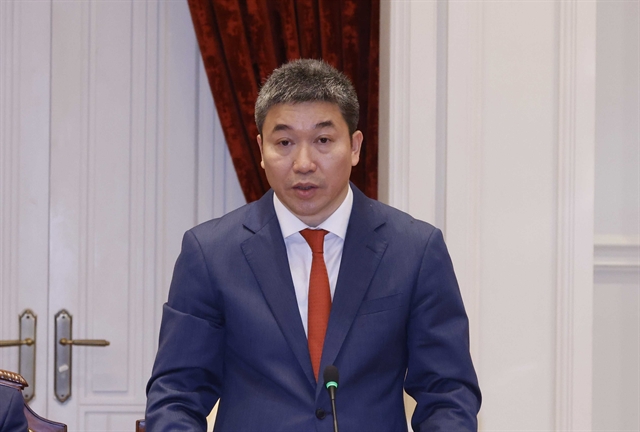
| VUFO President Phan Anh Sơn at the meeting. — VNA/VNS Photo Thống Nhát |
Report
VUFO President Phan Anh Sơn had previously briefed the top leader on the union’s achievements during the prior term, highlighting its shift from purely exchange-based activities towards creating political content.
The network integrated people-to-people diplomacy into high-level external activities, helping deepen diplomatic engagement, strengthen political trust and reinforce friendship between Việt Nam and other countries.
Its international friendship network also expanded and became more diverse, substantive and in-depth, contributing to a favourable social foundation for Việt Nam’s external relations.
Sơn, however, acknowledged shortcomings, including limited measurable contributions to economic, scientific and technological development, along with an uneven partner network, slow engagement with intellectuals, young entrepreneurs and influential figures and uneven performance among member organisations.
He also outlined five priorities for the 2026-2031 term.
The VUFO will first strengthen its core role in people-to-people diplomacy and advise the Việt Nam Fatherland Front’s Central Committee on strategies and programmes to make it a genuine pillar of Vietnamese diplomacy.
It will also renew its approaches and methods, focusing on concrete, measurable results that directly support national and local development.
Next, the VUFO will build a “new-generation partner network”, linking people-to-people diplomacy more closely with Việt Nam’s economic, security and technological interests. It will promote 'heart-winning' diplomacy, engage influential figures abroad and connect young people globally through specific cooperation projects.
The network will also help mobilise resources, protect Việt Nam’s interests in international forums and address complex issues at an early stage and from afar.
After that, it will work to turn soft power into development resources by shifting from short-term mobilisation to long-term partnerships. The VUFO will diversify financial, technological, knowledge and expert resources from foreign NGOs and international partners, aligning resource mobilisation with development priorities, local needs and national interests.
Finally, the VUFO will build a streamlined, effective organisation from central to local levels and develop officials with strong political commitment, expertise in new technologies, foreign languages, international law and the economies and cultures of partner countries. — VNS
Politics & Law
 Politics & Law
 Politics & Law
 Politics & Law
 Politics & Law
 Politics & Law
 Politics & Law
 Politics & Law
 Politics & Law
 Politics & Law
 Politics & Law
 Politics & Law
 Politics & Law
 Politics & Law
 Politics & Law