 Politics & Law

HIIVE by fusion brings business and golf closer in Bình Dương
1.
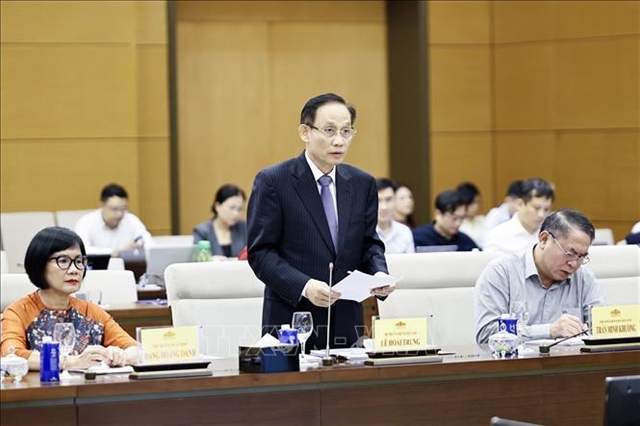 |
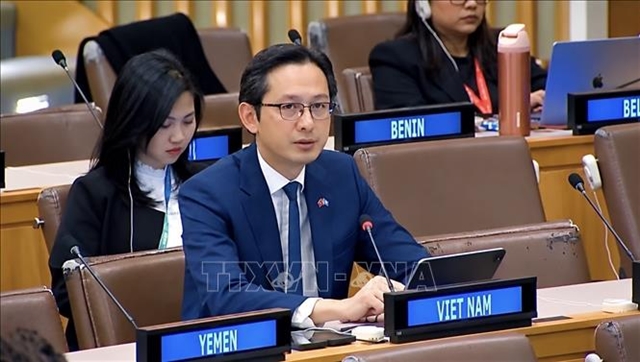
| Minister of Foreign Affairs Lê Hoài Trung speaks at the fifth session of the 16th NA Standing Committee on Friday. VNA/VNS Photo |
HÀ NỘI — The National Assembly (NA) Standing Committee on Friday called for tighter oversight and clearer rules as Việt Nam moves to expand the range of entities authorised to conclude international agreements.
Presenting a summary of the Government’s submission on the draft amended Law on International Agreements at the fifth session of the 16th NA Standing Committee on Friday, Minister of Foreign Affairs Lê Hoài Trung said the draft law comprises six chapters and 48 articles.
Among its key new provisions are clearer rules distinguishing international agreements from treaties, including a provision stating that an international agreement does not give rise to, alter or terminate Việt Nam’s rights and obligations under international law.
The draft law also adds several Vietnamese entities eligible to conclude international agreements, including management boards of industrial parks, export processing zones and economic zones under provincial-level People’s Committees; public non-business units under ministries, ministerial-level agencies and provincial-level People’s Committees; and People’s Committees of special administrative zones.
At the same time, it removes several entities, including ministerial general departments, district-level People’s Committees, the NA General Secretary, agencies under the NA Standing Committee and agencies under the Government, in line with the ongoing streamlining of the State apparatus.
The draft also stipulates that the Prime Minister will submit international agreements concluded in the name of the State to the President for a decision.
It introduces simplified procedures for urgent situations involving national defence and security, emergency relief and response to natural disasters and epidemics. It also provides for electronic signing, the application of digital transformation and the establishment of a national database on international commitments.
The Government proposed that the NA consider and pass the bill to replace the existing law at its second session under a one-session legislative procedure.
Presenting a preliminary verification report, Lieutenant General Lê Tấn Tới, chairman of the NA Committee on Defence, Security and External Relations, confirmed the necessity of promulgating the law.
However, the verifying agency asked the Government to accurately quantify the demand and assess the availability of financial and human resources and digital infrastructure for the newly eligible entities.
In light of practical needs and the reorganisation of local administration following the removal of the district level, the committee’s Standing Committee proposed studying the addition of commune-level People’s Committees outside border areas as entities eligible to conclude international agreements.
The verifying agency also called for a mechanism to inspect and authenticate electronic signatures of foreign partners and asked the Government to clarify why electronic signing would not be permitted for agreements concluded in the name of the State, the NA or the Government.
Speaking at the session, NA President Trần Thanh Mẫn agreed with the proposal to expand the range of entities eligible to conclude international agreements in a controlled and selective manner.
However, to prevent fragmentation and a lack of unified oversight of external relations, he stressed the need for strict supervision mechanisms, with detailed provisions to be set out in implementing decrees.
The NA President requested clearer delineation between international agreements and treaties, ensuring consistency with the 2025 Law on Treaties to avoid overlaps.
Regarding decentralisation and delegation of authority, he stressed that greater authority must go hand in hand with adequate capacity and clear accountability.
The draft law should therefore clearly define the responsibilities of the lead agencies, establish mechanisms to withdraw from or terminate ineffective agreements and strengthen the Ministry of Foreign Affairs’ role in inspection and supervision, he said.
Mẫn said that the law should not be viewed merely as a technical instrument governing signing procedures, but as a tool for managing external relations, where international commitments may not be highly binding but can directly affect Việt Nam’s reputation and the effectiveness of its international cooperation.
NA Vice President Nguyễn Doãn Anh asked the Government to direct the Ministry of Foreign Affairs to urgently study and fully incorporate the feedback to finalise the bill’s dossier, ensuring its quality and timely submission to the National Assembly.
Also on Friday, the NA Standing Committee adopted a resolution on the functions, duties, powers and organisational structure of the National Assembly Office, with 100 per cent of committee members voting in favour.
The resolution replaces Resolution 74/2025/UBTVQH15 on the functions, duties, powers and organisational structure of the NA Office and takes effect from August 28. — VNS
Politics & Law
 Politics & Law
 Politics & Law
 Politics & Law
 Politics & Law
 Politics & Law
 Politics & Law
 Politics & Law
 Politics & Law
 Politics & Law
 Politics & Law
 Politics & Law
 Politics & Law
 Politics & Law
 Politics & Law