 Politics & Law

HIIVE by fusion brings business and golf closer in Bình Dương
1.
|
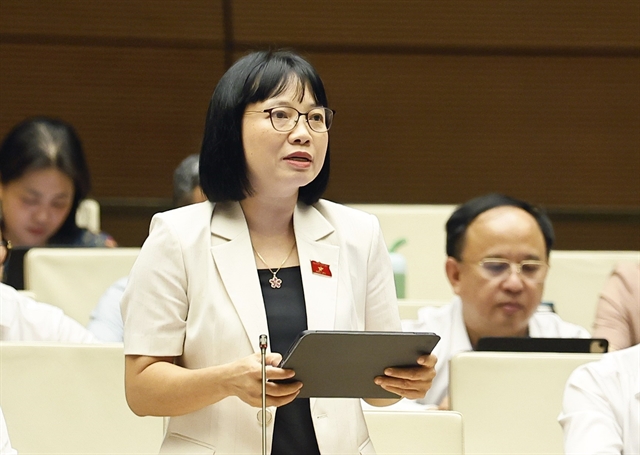
| Deputy Nguyễn Thị Việt Nga of Hải Phòng City gives her opinion at the session. — VNA/VNS Photo Doãn Tấn |
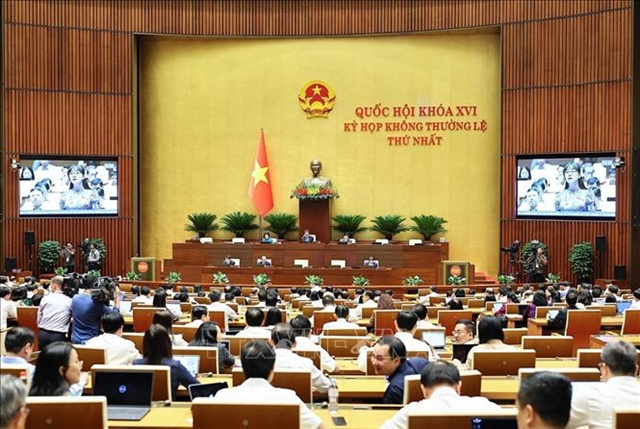
HÀ NỘI — Lawmakers on Friday discussed in groups a draft law amending and supplementing a number of articles of the Law on Radio Frequencies, the Law on Telecommunications, the Law on Electronic Transactions and the Law on Technology Transfer as part of the first extraordinary sitting of the 16th National Assembly.
Commenting on the bill, deputy Lê Thành Đông of Hà Tĩnh Province proposed adding a provision requiring telecommunications enterprises to share technical infrastructure data with local state management agencies in accordance with regulations issued by the relevant ministry.
He said there is currently no clear legal basis for such data sharing, creating difficulties in managing and exploiting information for state management. While the issue may be less apparent under normal circumstances, it could hamper local coordination and response during storms, floods and other disasters when detailed infrastructure data is not readily available.
Regarding conditions for participating in auctions and examinations for the rights to use radio frequencies, Đông proposed a provision requiring state management agencies to verify enterprises’ fulfilment of financial obligations by connecting to and exploiting data from the National Public Service Portal and relevant databases.
On telecom infrastructure sharing, he suggested specifying the state agency authorised to make decisions.
Deputy Nguyễn Thị Việt Nga of Hải Phòng City broadly agreed with the draft and praised its approach. Although it amends four laws simultaneously, she noted, the draft focuses on three key policy areas: cutting and simplifying administrative procedures and investment and business conditions; promoting decentralisation and delegation of authority; and improving management mechanisms to ensure consistency in the legal system.
According to the draft, two administrative procedures would be abolished, 47 investment and business conditions cut, four simplified and three amended or supplemented. In the field of radio frequencies alone, 33 of 41 investment and business conditions would be removed.
Nga said the measures represent a significant reform and demonstrate a shift from pre-licensing to post-licensing inspection, helping reduce compliance costs. She also stressed the need to strengthen post-licensing inspection capacity once pre-licensing inspection requirements are removed.
The draft reflects a shift towards management through standards, technical regulations, data and enforcement monitoring rather than licences, conditions and paperwork, she said.
She proposed that guiding decrees clearly define alternative management tools, agencies responsible for each area, databases and sanctions for each group of conditions removed, along with stronger connectivity between national and sectoral databases, and an end to requiring people and businesses to resubmit information already held by state agencies.
Deputy Nguyễn Minh Tâm of Quảng Trị Province proposed clarifying provisions on frequency-band allocation for national defence and security purposes.
The draft allows, in special cases, frequency bands to be allocated for up to five years to State-owned enterprises directly serving national defence and security to develop economic activities in combination with performing defence and security tasks.
Tâm said the concepts of “special cases” and “economic development combined with national defence and security tasks” remain qualitative and lack specific criteria, potentially leading to inconsistent application. He proposed authorising the Government to set detailed criteria for special cases, eligibility conditions and assessment of such activities to ensure consistent and transparent implementation. — VNA/VNS
Politics & Law
 Politics & Law
 Politics & Law
 Politics & Law
 Politics & Law
 Politics & Law
 Politics & Law
 Politics & Law
 Politics & Law
 Politics & Law
 Politics & Law
 Politics & Law
 Politics & Law
 Politics & Law
 Politics & Law