 Politics & Law

Việt Nam national youth ice skating championships attract record 112 athletes
1.
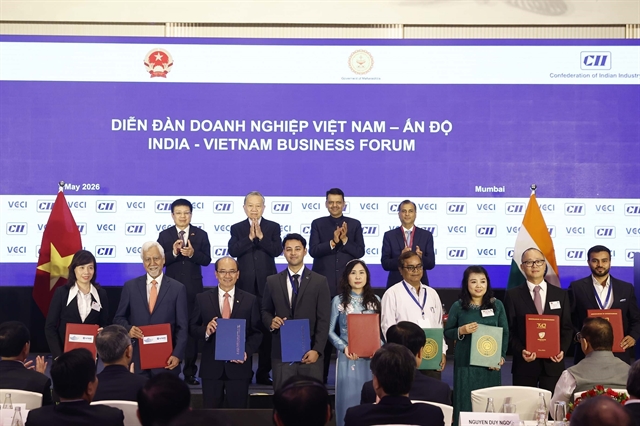 |
| Party General Secretary, State President Tô Lâm and Chief Minister of Maharashtra state Devendra Fadnavis witness the signing of MoUs at the India – Việt Nam Business Forum. — VNA/VNS Photo |
MUMBAI — General Secretary of the Communist Party of Việt Nam Central Committee and State President Tô Lâm on Thursday underscored that Việt Nam–India cooperation should be positioned within the broader context of the world’s most dynamic growth centres and leading trends, including digital technology, artificial intelligence (AI), semiconductors and green transition.
He made the remarks at the India – Việt Nam Business Forum, jointly organised by the Vietnam Chamber of Commerce and Industry and the Confederation of Indian Industry in Mumbai, Maharashtra, during his state visit to India.
The forum served not only as a platform for information exchange but also as a venue for direct meetings among hundreds of enterprises from both countries across sectors including information technology, automobile manufacturing, pharmaceuticals, tourism, agriculture, investment, medical equipment, food processing, aviation, logistics, and electronics.
General Secretary and President Lâm stressed that Việt Nam–India relations, built not only on the deep historical foundations laid by Vietnamese President Hồ Chí Minh and Indian Prime Minister Jawaharlal Nehru, are entering a historic phase with opportunities to be elevated into strategic connectivity within emerging global value chains.
He affirmed that Việt Nam remains committed to a development path based on stability, integration and innovation, while entering a new stage of development with the goal of becoming a high-income developed country by 2045.
Việt Nam is not only an attractive investment destination but also a reliable and long-term partner for international businesses, the leader stressed.
He noted that amid the reshaping regional economic architecture, Việt Nam and India are not merely two dynamic developing economies, but also key pillars linking Southeast Asia and South Asia within the Indo-Pacific space. While Việt Nam serves as a gateway to the Association of Southeast Asian Nations (ASEAN) through its extensive network of next-generation free trade agreements, India acts as a central hub in South Asia with an increasingly important role in global supply chains.
Enhanced connectivity between the two economies therefore carries significance not only bilaterally but also in opening access to broader markets and emerging value chains, he said.
Economic relations between Việt Nam and India have achieved encouraging results in recent years, the leader observed. Practical cooperation has shown positive signs, with several Vietnamese firms expanding investment in India in sectors such as electric vehicles, charging infrastructure and technology services. Meanwhile, Indian companies operating in Việt Nam have increased their presence in manufacturing, energy and processing industries. Although still modest in scale, these developments signal a shift from transactional ties towards deeper engagement, from trade towards investment and joint development.
General Secretary and President Lâm stressed that the time has come for bilateral cooperation to reach a higher level, not only in scale, but more importantly in quality, depth and strategic value.
He called on the business communities of both countries to focus on breakthrough areas of cooperation, including expanding trade in a more balanced and sustainable manner, making better use of the complementary strengths of the two economies, and boosting investment in future-oriented sectors such as information technology, AI, semiconductors, pharmaceuticals, biotechnology, clean energy, logistics, data centres and research and development.
The leader also urged stronger connectivity in infrastructure, logistics, aviation and tourism to facilitate the smoother flow of goods, capital and human resources, while promoting cooperation in high-quality workforce training and knowledge transfer.
Việt Nam, he affirmed, remains committed to safeguarding the legitimate rights and interests of investors, strengthening dialogue and fostering a transparent and competitive business environment. The country aspires not only to be a destination for investment, but also a place where businesses can grow sustainably over the long term.
General Secretary and President Lâm expressed hope that Vietnamese and Indian enterprises would become more proactive and ambitious in investment, partnerships, technology sharing and market expansion, transforming meetings and exchanges into concrete agreements, contracts and projects.
The Party and State of Việt Nam will continue to accompany the business community in turning cooperation projects and agreements into new success stories in Vietnam–India relations, he pledged. — VNA/VNS
Politics & Law
 Politics & Law
 Politics & Law
 Politics & Law
 Politics & Law
 Politics & Law
 Politics & Law
 Politics & Law
 Politics & Law
 Politics & Law
 Politics & Law
 Politics & Law
 Politics & Law
 Politics & Law
 Politics & Law