 Politics & Law
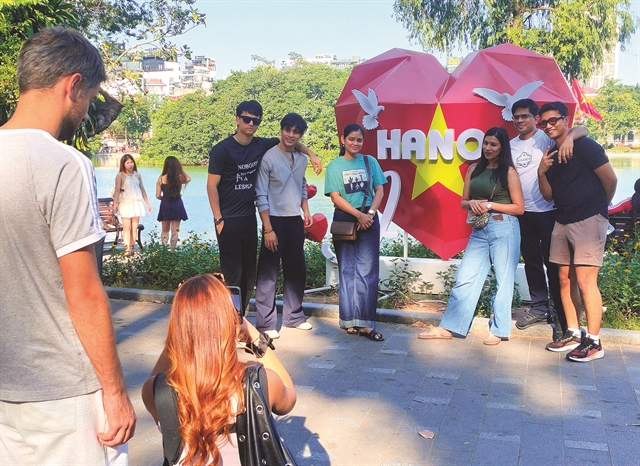
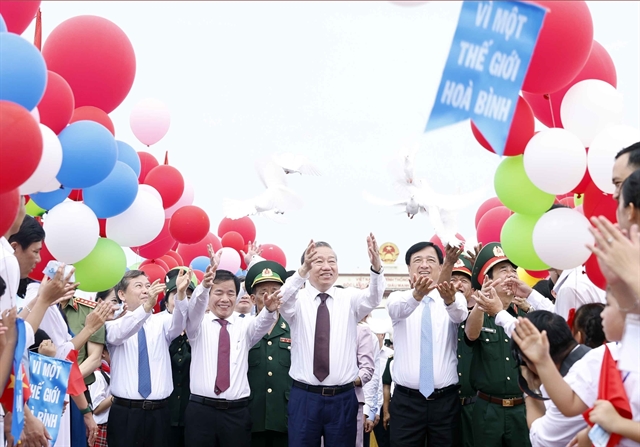
Hà Nội adorned in red ahead of Liberation Day
1.
|
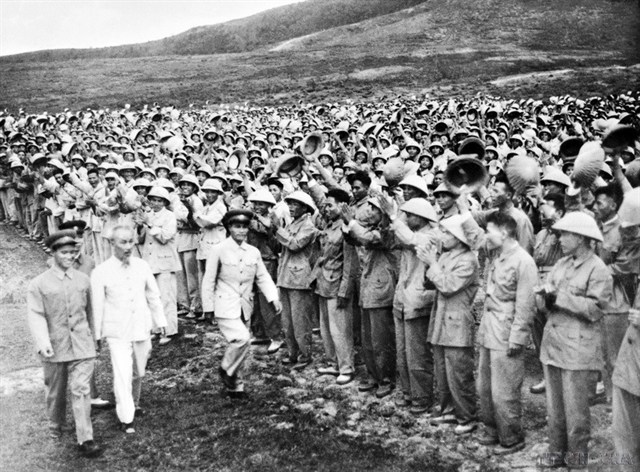
| President Hồ Chí Minh visits a southern unit regrouped in the North during a training exercise before returning to the southern battlefield in 1957. — VNA/VNS Photo |
HÀ NỘI — As Việt Nam marks the 51st anniversary of the liberation of the South and national reunification on April 30, wartime predictions by President Hồ Chí Minh about how and when the conflict would end are once again central to official commemorations.
His forecasts on the trajectory of the resistance war against the US and his insistence that the country would ultimately be made whole are remembered as a guiding force behind the spring 1975 victory.
After the 1954 defeat of French colonial forces, Việt Nam was temporarily divided. As Washington expanded its involvement in the South, President Hồ Chí Minh framed reunification not as an aspiration but as a historical inevitability and a matter of national survival.
"Việt Nam is one. The Vietnamese people are one," he declared, vowing that the country could not be permanently split.
In a July 6, 1956 letter to the Vietnamese people, he described reunification as "the path of life for our people," presenting it as the central goal of the revolution in its new phase.
He closely followed developments in the South, working with the Communist Party’s Central Committee to adjust strategy as the war evolved. Resistance to the US, he told compatriots, was "the most sacred duty of every patriotic Vietnamese."
On July 17, 1966, in one of his best-known wartime statements, President Hồ Chí Minh warned that the war could last five years, 10 years, 20 years or longer and that Hà Nội, Hải Phòng and other cities might be reduced to rubble. However, he stressed that the Vietnamese people would never yield.
"Nothing is more precious than independence and freedom," he said.
When victory came, he said, the nation would be rebuilt grander and more beautiful than before. His words became a rallying cry for generations who fought in the war.
In speeches at home and in interviews with foreign journalists and politicians, President Hồ Chí Minh repeatedly emphasised a single message: independence, sovereignty and territorial integrity were non-negotiable.
"The South is the blood of Việt Nam's blood, the flesh of Việt Nam's flesh," he said. "Rivers may run dry and mountains may erode but that truth will never change."
His attachment to the South was both personal and political. The country’s division, he said, weighed on him constantly.
"As long as the country is not unified and the South is not liberated, I cannot eat well or sleep soundly," he said during the years of partition.
|
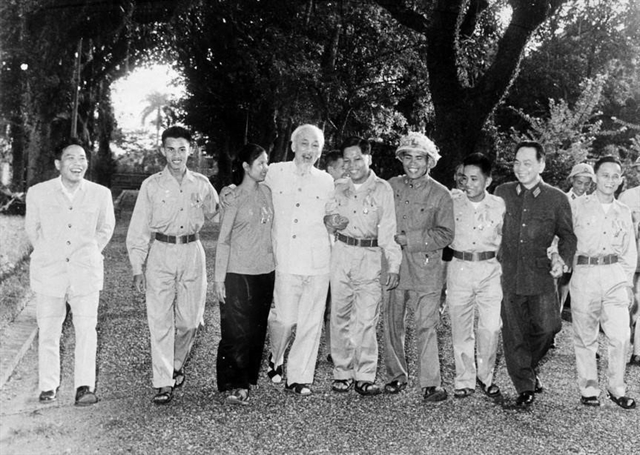
| President Hồ Chí Minh and General Võ Nguyên Giáp with a delegation of heroic soldiers and fighters from the southern liberation armed forces in 1965. |
He insisted on meeting every delegation from the South that travelled North and followed developments on the battlefield closely, sending letters and telegrams to praise victories and mourn losses.
"My heart and the hearts of 17 million compatriots in the North always beat as one with the hearts of our compatriots in the South," he said, a line intended both as a personal expression and a declaration of national unity.
In October 1962, upon receiving a volume of poetry sent north by a National Liberation Front delegation, President Hồ Chí Minh replied with a phrase that has been widely cited since: "I have nothing to give in return, only this: the beloved South is always in my heart."
Beyond his words and vision were his predictions and the precision with which they were later borne out.
In a September 2, 1960 speech marking 15 years of independence, President Hồ Chí Minh pledged to the people of the South that with united effort, "at the latest 15 years from now, our nation will be reunified and North and South will be reunited under one roof."
In the original document, he underlined the phrase "at the latest 15 years," pointing to 1975.
In his testament dated May 15, 1965, he wrote that no matter the hardship, the Vietnamese people would prevail, the US would have to withdraw and the country would be made whole again.
Late in 1967, during a meeting with the command of the Air Defence and Air Force, he made another prediction that would prove strikingly accurate. Sooner or later, he said, American B-52 bombers would strike Hà Nội and only then, after defeat in the skies over the capital, would Washington accept that it had lost the war.
|
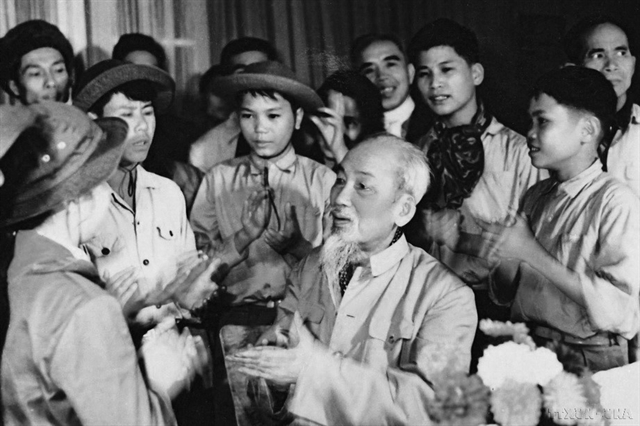
| President Hồ Chí Minh meets young southern fighters at the Presidential Palace in 1968. |
In a revised version of his testament dated May 10, 1969, at one of the bleakest moments of the war, he again expressed his certainty that the resistance war would end in total victory.
"That is a certainty," he wrote.
History proved him right on both counts. In December 1972, North Vietnamese forces shot down American B-52s over the capital in a 12-day campaign that Việt Nam celebrates as Hà Nội-Điện Biên Phủ in the Air. Within weeks, the US returned to the negotiating table in Paris.
Almost exactly 15 years after President Hồ Chí Minh’s 1960 prediction, on April 30, 1975, North Vietnamese forces entered Sài Gòn, then the capital of the US-backed southern administration, bringing the war to an end and reunifying the country.
More than half a century later, his vision of an independent and unified Việt Nam remains a touchstone for the country’s leaders as they chart its course in a new era. — VNS
Politics & Law
 Politics & Law
 Politics & Law
 Politics & Law
 Politics & Law
 Politics & Law
 Politics & Law
 Politics & Law
 Politics & Law
 Politics & Law
 Politics & Law
 Politics & Law
 Politics & Law
 Politics & Law
 Politics & Law