 Politics & Law
Việt Nam, Laos firms sign deals on property, smart farming projects
1.
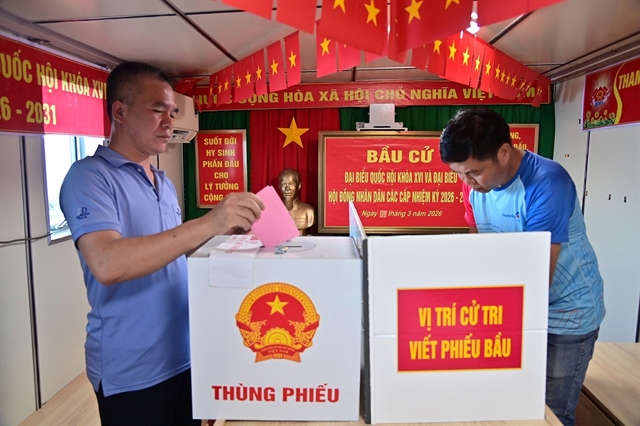 |
| EARLY BALLOTS: Crew members of the Hải An 68 cast early ballots aboard the 'Trường Sa 04' on March 1. Under the law, early voting may be organised for voters working at sea, on islands or in other special circumstances. VNA/VNS Photo |
Compiled by Lê Việt Dũng
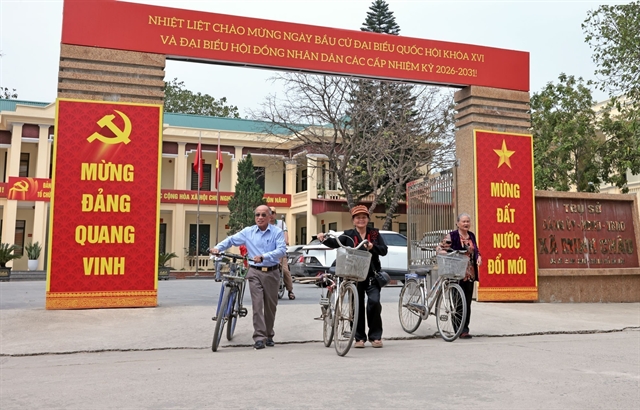
On Sunday, March 15, 2026, voters across Việt Nam will head to polling stations to elect deputies to the 16th National Assembly and members of local People’s Councils for the 2026–2031 term.
For most citizens, election day is a single moment: a ballot cast, candidates selected. Yet the event is shaped by a detailed constitutional framework that defines representation, candidate selection and the distribution of seats nationwide.
What offices are elected?
At the national level, voters will elect deputies to the National Assembly, defined in law as the highest representative body of the people and the highest organ of state power.
The National Assembly exercises constitutional and legislative authority, decides major national policies and conducts supreme oversight of state institutions.
Each National Assembly term lasts five years. The upcoming legislature is expected to comprise 500 deputies elected from 182 electoral units nationwide. By law, at least two-fifths must serve on a full-time basis.
The Standing Committee of the National Assembly determines seat allocation. Every province and centrally governed city is guaranteed at least three deputies who reside and work locally, with additional seats distributed according to population size and local characteristics, while ensuring the national total does not exceed 500.
On the same day, voters will also elect representatives to People’s Councils at provincial and commune levels.
These councils function as local state power bodies, deciding important matters within their jurisdictions and supervising implementation of law and policy. Their five-year terms align with those of the National Assembly.
At each level, People’s Councils elect their executive bodies, known as People’s Committees.
The size of local councils varies by population. Provincial councils in smaller provinces begin with 50 deputies, with additional seats added in proportion to population up to a statutory cap of 85.
Hà Nội and HCM City each elect 125 municipal-level deputies.
Commune-level councils follow similar population-based formulas, capped at 30 deputies.
In the previous term, more than 266,000 People’s Council deputies were elected nationwide.
Who can vote?
The election law rests on four stated principles: universal, equal and direct suffrage conducted by secret ballot.
All Vietnamese citizens aged 18 or older, except where voting rights are restricted by law, have the right to vote. Citizens aged 21 or older may stand as candidates.
Voting takes place in person at designated polling stations, though mobile ballot boxes may be brought to voters who are ill, elderly or unable to travel, and to eligible voters in detention or compulsory education and rehabilitation facilities where no polling station is established.
Vietnamese citizens living abroad retain the right to vote, but must be physically present in Việt Nam on election day to exercise that right, as the law does not provide for remote voting.
The election must be held on a Sunday and publicly announced at least 115 days in advance. The state budget covers the costs of organising the vote.
The law also sets representation targets in the candidate list: at least 18 per cent of official candidates must be from ethnic minority groups and at least 35 per cent must be women.
These thresholds apply when the final list of candidates is confirmed.
The 2026 candidate field
For the 2026–2031 term, 864 candidates are standing for 500 National Assembly seats.
The candidate pool includes 472 men and 392 women. Nearly 190 candidates belong to ethnic minority communities and 65 are not members of the Communist Party of Việt Nam.
Most candidates hold university or postgraduate qualifications. A majority are standing for the first time, while several hundred are seeking re-election.
The largest share of candidates is in their 40s and 50s, reflecting a concentration in mid-career age groups.
Candidates reach the ballot through nominations at the local or central level or through self-nomination. Most were nominated locally, with a smaller number put forward by central bodies and four self-nominated.
From nomination to ballot
The path from nomination to official candidacy follows a structured consultation process defined in law.
The Standing Committee of the National Assembly first determines the projected structure and composition of the upcoming legislature.
The Việt Nam Fatherland Front then convenes consultation conferences to agree on the number, structure and final list of candidates.
For the 2026 cycle, the first central consultation conference was held in December 2025. A second conference in early February 2026 produced the preliminary candidate list and initiated voter feedback procedures at candidates’ places of residence.
Only after these steps are completed is the official candidate list finalised.
Organising the vote
Oversight of the election is coordinated through a layered structure.
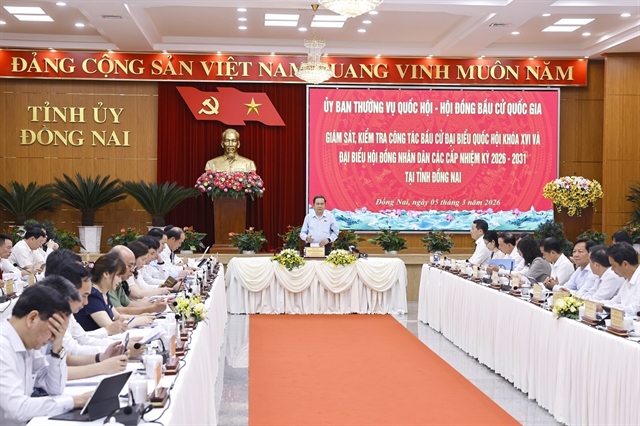
At the top is the National Election Council, established by resolution of the National Assembly. It organises the election of National Assembly deputies and directs and guides the election of People’s Councils nationwide.
Election committees are formed at provincial and commune levels to manage the process locally. The Government is responsible for funding, communication and security.
Before election day, local authorities compile and publicly post voter lists so residents can verify their information and request corrections within a legally specified time frame.
Campaign activities are regulated by law and conducted within a defined period. Candidates may present action programmes and participate in voter meetings organised under the coordination of the Fatherland Front.
Election day and counting
Voting is conducted by secret ballot. Polling stations operate throughout the day under the supervision of local election teams.
After polling closes, votes are counted at the polling stations under supervision. Results are compiled and transmitted through the election committees to the National Election Council.
A candidate is elected if they receive more than half of the valid votes cast in their constituency, subject to legal requirements.
If more candidates surpass that threshold than there are seats, the highest vote-getters are elected. Where tied candidates exceed the remaining seats, the older candidates are elected.
If fewer candidates meet the required threshold than there are seats to be filled, a supplementary election is conducted within seven days, limited to candidates from the original ballot who were not elected.
Candidates must again secure more than half of the valid votes and obtain a higher total than their competitors. No second supplementary election is held if seats remain unfilled.
The National Election Council releases the official election results. Successful candidates formally assume their mandates at the first sitting of the new National Assembly and People’s Councils, where the five-year terms begin.
Participation and scale
In the 2021 general election, more than 69.5 million voters were registered nationwide and 99.60 per cent cast ballots.
That election produced 499 deputies in the 15th National Assembly, alongside 266,022 People’s Council deputies nationwide at provincial and district levels for the 2021–2026 term.
The upcoming 2026 election is expected to involve nearly 73.5 million voters nationwide, casting ballots at 72,195 polling stations.
Held once every five years, the general election is a constitutionally defined procedure. In scale, it is one of Việt Nam’s largest coordinated civic exercises, spanning hundreds of electoral units, thousands of polling stations and millions of voters on a single day.
On March 15, the visible act will be simple: a ballot cast in private. Behind that moment lies a legal and administrative process months in the making. — VNS
Politics & Law
 Politics & Law
 Politics & Law
 Politics & Law
 Politics & Law
 Politics & Law
 Politics & Law
 Politics & Law
 Politics & Law
 Politics & Law
 Politics & Law
 Politics & Law
 Politics & Law
 Politics & Law
 Politics & Law