 Politics & Law
Better Choice Awards 2026 honours innovation delivering real value to consumers
1.
|
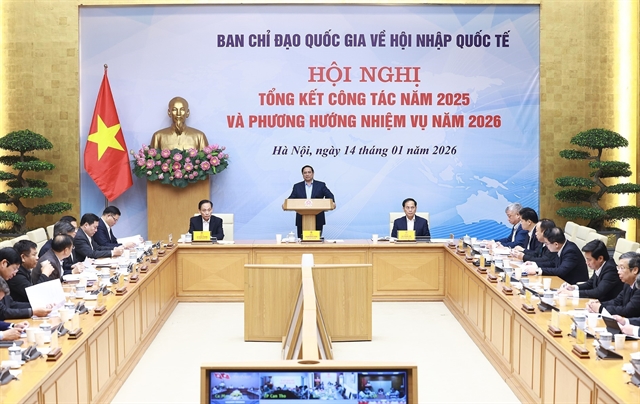
| Prime Minister Phạm Minh Chính chairs a conference reviewing work in 2025 of the National Steering Committee for International Integration. — VNA/VNS Photo Dương Giang |
HÀ NỘI — Prime Minister Phạm Minh Chính has called for a decisive shift in Việt Nam’s international integration from expanding foreign relations to improving their quality and depth, as 2026 marks the start of a new phase of integration in line with the foreign policy orientation of the upcoming 14th National Party Congress.
International cooperation in the coming period must be comprehensive, substantive and effective, closely linked with the country's development and self-reliance goals, with a clear transition from participation to proactive leadership and agenda-setting, the PM said.
He made the remarks while chairing a national conference reviewing international integration work in 2025 and setting tasks for 2026, held online on January 14 with the participation of leaders from 34 provinces and cities nationwide.
According to PM Chính, international integration aims to enhance Việt Nam’s strength, standing and prestige globally, bolster strategic proactiveness in foreign relations and improve the material and spiritual well-being of the people.
Reviewing results in 2025, the conference noted that the Party’s timely and effective leadership has shaped new thinking on international integration amid changing global conditions. Export-import turnover is estimated to have exceeded US$920 billion, a record high, with a trade surplus of more than $21 billion. Foreign direct investment also recorded strong growth, with disbursed capital reaching a historic high of around $28–29 billion.
International integration in political, defence and security affairs has been implemented in a comprehensive and coordinated manner. Việt Nam has increasingly played a proactive and leading role at major international and regional forums such as the United Nations, ASEAN, APEC, the World Economic Forum, expanded BRICS and the G20, earning positive assessments from international partners.
Over the past year, Việt Nam successfully hosted several major international events, including the ASEAN Future Forum, the Partnering for Green Growth and the Global Goals 2025 Summit (P4G), the United Nations Day of Vesak, the Autumn Economic Forum 2025 and the signing ceremony for the United Nations Convention against Cybercrime in Hà Nội.
Bilateral exchanges, participation in United Nations peacekeeping operations and engagement in multilateral defence forums such as the Shangri-La Dialogue and the Xiangshan Forum, together with cooperation through mechanisms combating transnational crime, including INTERPOL and ASEANPOL, have helped enhance the country’s international standing and mobilise resources for national defence and security.
International integration in science and technology has continued to play a key role in mobilising external knowledge and resources for economic growth and restructuring. Integration in culture, education, health care and social affairs has also been promoted more actively, contributing to sustainable development, social security and human security.
Ministries, sectors and localities have taken a more proactive approach, signing numerous international commitments, agreements and treaties that deliver tangible benefits. Border provinces neighbouring China, Laos and Cambodia have stepped up the development of border and border-gate economies, strengthened infrastructure and logistics connectivity, and expanded trade in goods and services, helping to consolidate peaceful and friendly borders and support local socio-economic development.
The capacity to negotiate and implement international commitments has improved, creating momentum for reforms in domestic institutions, policies and laws. The number of international agreements signed during high-level diplomatic activities has continued to rise, with a stronger focus on strategic priorities such as science and technology, innovation and sustainable development.
Concluding the conference, PM Chính noted that 2025 was marked by growing global and regional uncertainties. In response, the Politburo issued Resolution No. 59-NQ/TW on international integration in the new situation, identifying integration as a key pillar in the country’s overall development strategy for the new era.
The Government has swiftly translated the resolution into action, while the National Assembly adopted Resolution No. 250/2025/QH15 on specific mechanisms and policies to enhance integration effectiveness. Ministries, sectors and localities have also rolled out their own action plans aligned with the needs of citizens and businesses.
Emphasising that international integration is the shared endeavour of the entire political system and society, the PM called for renewed thinking and action to improve the quality of economic integration, strengthen coordination between diplomacy, defence and security, and accelerate integration in science and technology, innovation and digital transformation.
Despite the heavy workload ahead, he expressed confidence that international integration would continue to serve as a strong driver for national development, helping Việt Nam advance steadily into a new era of prosperity and well-being for its people. — VNS
Politics & Law
 Politics & Law
 Politics & Law
 Politics & Law
 Politics & Law
 Politics & Law
 Politics & Law
 Politics & Law
 Politics & Law
 Politics & Law
 Politics & Law
 Politics & Law
 Politics & Law
 Politics & Law
 Politics & Law