 Politics & Law

42 people hospitalised over suspected gas leak in Hà Nội
1.
 |
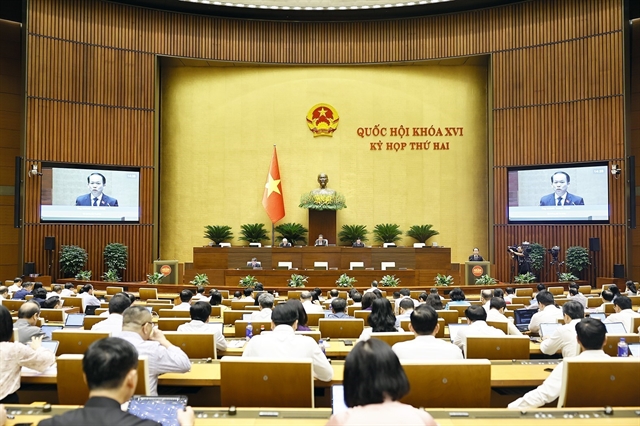
| Minister of Public Security Lương Tam Quang speaks at the ongoing 10th sitting of the 15th National Assembly on Friday. VNA/VNS Photo |
HÀ NỘI — The National Assembly’s Committee for National Defence, Security and External Relations has proposed adding a provision to the draft Law on Cybersecurity to prohibit the use of artificial intelligence (AI) to fabricate, edit or spread false information, impersonate others, or commit acts of defamation or fraud that threaten national security and social order.
The proposal was made on Friday during the ongoing 10th sitting of the 15th National Assembly.
Minister of Public Security Lương Tam Quang presented a summary report on several draft laws, including amendments to the Law on National Defence and Security Industry and Industrial Mobilisation; the Law on Cybersecurity; the revised Law on Protection of State Secrets; and amendments to 10 laws related to public security. These cover the Law on Guards; Law on Exit and Entry of Vietnamese Citizens; Law on Residence; Law on Identity; Law on Forces Participating in the Protection of Security and Order at the Grassroots Level; Law on Road Traffic Order and Safety; Law on Roads; Law on Management and Use of Weapons, Explosives and Supporting Tools; and the Law on Fire Prevention, Fighting and Rescue.
Quang said the Government had reviewed and proposed these four draft laws to ensure consistency with the reorganisation of the State apparatus and two-tier local government system. The revisions are also intended to address urgent practical needs, align with the country’s strategic priorities for scientific and technological innovation and digital transformation, and facilitate administrative simplification, decentralisation and reform in line with the national legal framework.
Regarding the draft amendments to the Law on National Defence and Security Industry and Industrial Mobilisation, which consists of two articles, the proposal separates the Defence and Security Industry Fund into two independent funds: the Security Industry Development Investment Fund, to be managed by the Ministry of Public Security, and the Defence Industry Fund, to be managed by the Ministry of National Defence.
As for the draft Law on Cybersecurity, Quang said it includes nine chapters and 58 articles, comprising 30 inherited provisions from the 2018 Cybersecurity Law (21 retained and nine revised), 16 inherited from the 2015 Law on Cyberinformation Security (12 retained and four amended), nine consolidated articles and three new ones.
The proposed revisions focus on ensuring data security; assigning responsibility for IP address identification and provision to cybersecurity authorities; funding mechanisms for cybersecurity protection in State agencies, enterprises and political organisations; promoting the use of Vietnamese-made cybersecurity products and services; and issuing cybersecurity certification.
The revised draft Law on Protection of State Secrets introduces several new provisions. It allows the drafting and storage of State secrets on an independent LAN system within agency premises without requiring encryption using classified ciphers, addressing previous obstacles in the 2018 Law.
It also prohibits the use of AI systems to infringe upon State secrets, expands the authority and responsibilities of commune-level governments and certain central agencies organised by region, and refines procedures for handling classified documents in digital environments. Several internal administrative procedures related to state secret protection are also proposed for removal.
The draft law further strengthens decentralisation, assigning greater authority and responsibility to ministries, provincial and commune-level governments in State secret protection activities.
In its verification report, Chairman of the NA's Committee for National Defence, Security and External Relations, Lê Tấn Tới, recommended that the draft Cybersecurity Law be reviewed to add specific prohibited acts, especially those involving AI-generated false information, identity impersonation, defamation or fraud threatening national security and social order, while avoiding duplication with offences already covered by the Penal Code.
Regarding cybersecurity product and service businesses, the verifying body suggested shifting from pre-licensing to post-audit management, based on compliance with cybersecurity standards, except in special cases, to reduce compliance costs and improve flexibility in line with the Politburo’s Resolution No 66-NQ/TW.
Tới also called for maximum administrative simplification, removal of redundant licensing conditions and professional certification requirements, or alternatively, providing a legal framework for the Government to specify details later.
He proposed that the implementation clauses include suitable transitional periods to ensure businesses can adapt after having invested in or deployed cybersecurity and information safety solutions under current regulations.
For the revised Law on Protection of State Secrets, the verifying committee suggested clarifying several general provisions to provide a clear basis for defining the list of state secrets and ensuring feasibility. It also proposed adding regulations on the responsibilities of entities receiving classified materials, criteria for extending protection terms, maximum extension periods, and procedures for classifying and marking confidentiality levels on digital documents.
The committee further recommended simplifying the destruction process for classified materials, empowering agency heads or their deputies to make such decisions directly. — VNS
Politics & Law
 Politics & Law
 Politics & Law
 Politics & Law
 Politics & Law
 Politics & Law
 Politics & Law
 Politics & Law
 Politics & Law
 Politics & Law
.jpg) Politics & Law
Politics & Law
 Politics & Law
 Politics & Law
 Politics & Law
 Politics & Law




