 Opinion
Vietnamese dancesport wants to dance on higher after Rome success
1.
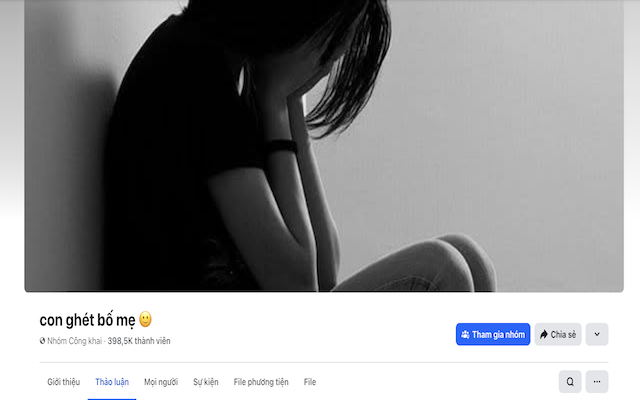 |
| A screenshot of the Facebook public group name "I hate my parents" with nearly 400,000 members before its name was asked to be changed. Photo vtv.vn |
Ngọc Bích
One evening, scrolling through Facebook after a long day at work, I came across a public group called “Con ghét bố mẹ” – “I Hate My Parents.”
My first instinct was to look away. I assumed a group like that could only bring negativity, and I feared it would reopen an old wound. Two years ago, in my teenage son’s room, I had found a drawing of myself as a monster – literally, a frightening monster. I was shocked and heartbroken. It had never occurred to me that, in my son’s eyes, I was such a bad mother.
A day later, once I had calmed down, I went back to the group. I was not looking for my son’s name among its members. I wanted to read what children were sharing and to see how adults responded.
Most members are minors, posting anonymously about things they cannot say openly at home: being controlled, being compared with other children, being scolded – and, in some cases, being subjected to physical and emotional violence.
Parents have swelled in the group's numbers too. Some arrived with harsh words, convinced that pampered children are simply ungrateful, and turned a fragile space into a two-sided confrontation.
That view deserves to be taken seriously, because it comes from somewhere real. "Gen Z has it too easy," many say. Children who grow up in material comfort, with parents who worry over their every need, should naturally be dutiful and obedient. In a culture that prizes moral standards, family discipline and filial piety as its foundation, this is easy to understand.
Still, some adults in the group chose a different path. They shared stories from their own childhoods and the lessons they drew from them, showing empathy so that young people could see things in a healthier light. I believe that is the right approach. Read closely, most of the children’s posts do not express extreme hatred. They express an age-old need – to be heard – from children who cannot find anyone at home to listen.
In truth, the sentiment 'I hate my parents' is nothing new. From my generation going way back, children kept their resentment to themselves or confided in siblings and close friends. Few people knew about it, but it was there. Now that the Internet has become a common way for people to connect, it is only natural that children pour out their feelings online to voice their thoughts and find someone to share them with.
Meanwhile, under the pressure of earning a living, many parents come home with no energy left to ask their children a single caring question. Some grew up in an era when love was measured by material sacrifice rather than spoken words, and so they never learned another way to express it beyond saying: “I only want what is best for you.”
Communities like this reflect a simple reality: online relationships can help young people receive support, express themselves and feel less isolated.
But the risks are serious. Online groups are miniature societies, with both good and bad people. Young members who join them may encounter individuals who exploit their pain, inciting them to do wrong, to break the law and to harm themselves.
That is why children's rights expert Lê Thị Thu Hà, founder of the Center for Children and Development (CCD), cautions against rushing to label the words 'I hate my parents' as a sign of misbehaviour or ingratitude. “It can be a cry for help when a child fells trapped, hurt, or powerless to find a common voice with the family,” she was quoted by VnExpress as saying.
The group’s own administrator tells a similar story. At a meeting with police in Hưng Yên province, she admitted that she had created the group because of disagreements, resentment and differences of opinion with her parents and other family members, with no intention of affecting local security and order.
As a mother of the 8X generation and after the conflicts I have been through with my son as he entered a stage of profound mental and physical change, I now understand young people better. Their 'hatred' is not truly hostility or loathing. It is simply a wish to speak from the heart and to have their parents understand what they are thinking – and the pain of not receiving a reply from the very people they most want to confide in.
Looking back honestly, I was absent for two years of my son’s childhood while I pursued a master’s degree abroad. When I returned to Việt Nam, I poured most of my time into work. That was when I lost my connection with him. It took that drawing to make me realise I had to change how I communicate with him. I believe it is never too late to talk openly with your son or daughter, to listen to their stories from school, and to share in their feelings.
Parents and children who do not truly understand each other, who do not put themselves in each other’s shoes, can all too easily hurt one another.
What we need now are open spaces for dialogue, where parents and children can sit down together, share their real hurts and resolve them so that understanding becomes a shield, and no child is pulled into the dark corners that lurk behind some online groups.
I was glad to learn that the group was not forced to close. It has been renamed, and its administrator has promised to moderate posts strictly, to keep out negative content that could foster agreement with distorted thinking and harm public opinion, especially among the young. That means there is still a place where young people can share their stories, and where parents can look in, reflect on themselves, and find a common voice with their children.
The next time a child says, 'I hate you,' perhaps we should hear what is really being said. 'Please listen to me!'
Opinion
 Opinion
 Opinion
 Opinion
 Opinion
 Opinion
 Opinion
 Opinion
 Opinion
 Opinion
 Opinion
 Opinion
 Opinion
 Opinion
 Opinion