 Opinion
Goat meat offers a feast of choice for every diner
1.
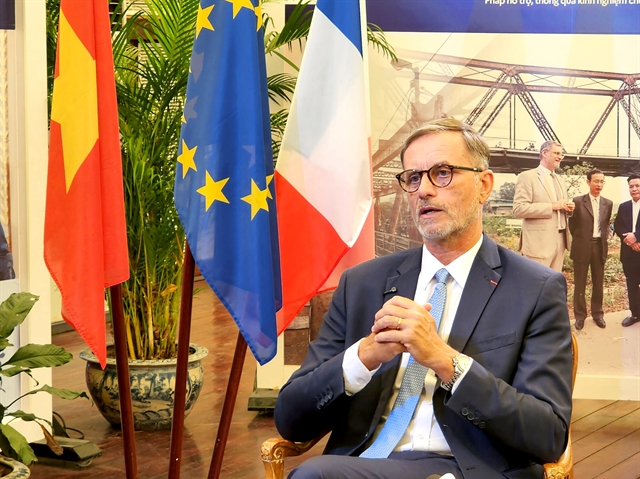 |
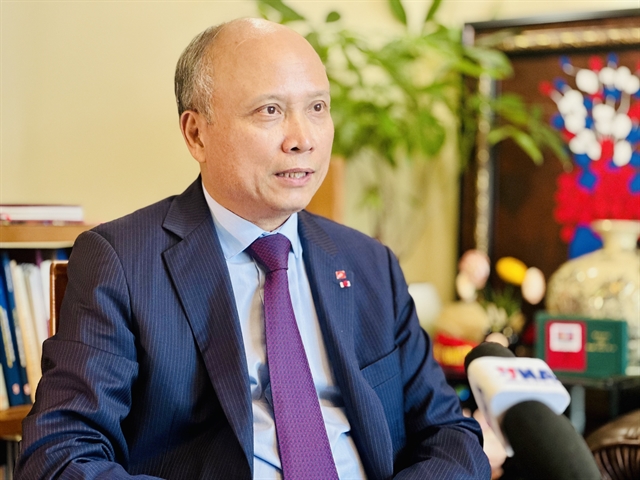
| French Ambassador Olivier Brochet in his final weeks in Việt Nam. — VNS Photo Lê Việt Dũng |
On the eve of Party General Secretary and State President Tô Lâm's visit to France – and near the end of his own three-year posting – French Ambassador Olivier Brochet spoke with with Việt Nam News reporters Lê Việt Dũng and Nguyễn Khánh Chi to discuss the France-Việt Nam Comprehensive Strategic Partnership, the Paris Space Summit and his reflections on three years in Hà Nội.
What is your assessment of these three years, and of the relationship's elevation to a Comprehensive Strategic Partnership?
These past three years have been especially intense for our bilateral relationship – intense because Việt Nam itself moves at a fast pace in its development and international standing; intense because the world is unstable, even dangerous, which makes exchanges between our countries more important than ever; and intense because leaders on both sides wanted our cooperation to become livelier, richer, and broader in practice.
The clearest symbol of that is the level of contact between Party General Secretary and State President Tô Lâm and President Macron. They first met in October 2024, weeks after Mr. Tô Lâm took office. They met again in May 2025 for a highly successful, I'd say historic, state visit by President Macron.
And they'll meet a third time in under two years, in Paris from September 9 to 11, both for the Summit on Space and for an official visit that will deepen our relationship further.
I should also mention former Prime Minister Phạm Minh Chính's visit to France for the UN Ocean Summit, and here in Việt Nam, the deeply symbolic visit by Minister of the Armed Forces Sébastien Lecornu (now France's Prime Minister) for the 70th anniversary of Điện Biên Phủ.
If I had to sum up these three years in one sentence: we haven't just strengthened and broadened cooperation across every field, we've strengthened trust – between our countries and our leaders. That gives us an even stronger desire to work together, in the interest of both nations and, we believe, of global peace and stability. That's a great source of satisfaction for me.
What are the most emblematic projects showing the diversification of our cooperation?
Health has long been a strong area of cooperation. Việt Nam's healthcare needs create opportunities not just to export more French pharmaceuticals here, but to build partnerships that help Việt Nam gain real autonomy in new technologies – like the VNVC-Sanofi partnership building a major vaccine plant in HCM City, which will eventually produce high-quality vaccines in the country starting with those for childhood diseases.
Transport is a second example. Airbus has long supplied most aircraft here, but behind that lies a partnership that has trained many Vietnamese engineers, now capable of maintaining these aircraft and, we're confident, eventually be able to work with Airbus on factories that plug into the value chain.
Rail is another sector taking off: for the past year, with SNCF, the French Development Agency (AFD), and Alstom, we've shown our Vietnamese partners not just technology but how to master it – including missions to Morocco, where we helped build Africa's first high-speed rail line, now fully run by Moroccans themselves.
Finally, decarbonised energy. French companies already established here are eager to deepen cooperation on wind, solar and hydropower, as well as newer areas – last year the President proposed that Việt Nam and France work together on nuclear energy, and those discussions will continue in Paris.
How can French companies contribute more to Việt Nam's development ambitions?
French companies have had a long presence in Việt Nam, and France is the second-largest European investor here. There's strong mutual understanding and real appetite to work together more, and we believe Việt Nam's major development programmes, particularly in infrastructure, offer significant opportunities to deepen our economic cooperation.
What are the prospects for scientific, university, and health cooperation, and for exchanges between younger generations?
For 35 to 40 years, people-to-people exchanges, especially youth education and training, have been the first pillar of our partnership, and neither side has ever scaled back its commitment to it.
Over the past 30 years, somewhere between 150,000 and 200,000 young Vietnamese have studied in France; around 6,000 to 7,000 are there now, and we hope to welcome more. We've also built exceptional partnerships here in Việt Nam, through three Franco-Vietnamese institutions.
The University of Science and Technology of Hà Nội (USTH) draws the most attention: it's highly dynamic, will soon pass 5,000 students, and will keep expanding – notably by joining the Hòa Lạc campus for larger facilities. It's now ranked sixth among Vietnamese universities for quality.
The Centre Franco-Vietnamien de Gestion (CFVG), in Hà Nội and HCM City, continues to grow in management training and may broaden its offerings, perhaps opening a branch in Đà Nẵng.
The third programme, the Programme de Formation d'Ingénieurs d'Excellence au Vietnam (PFIEV), partners top French engineering schools with the polytechnic institutes of Hà Nội, Đà Nẵng and HCM City, allowing students to earn a French engineering degree while studying here.
These are solid foundations we intend to keep building on, alongside cooperation between our research institutions. During Mr. Tô Lâm's visit to France, for example, we'll sign an implementation agreement for the Franco-Vietnamese Hubert Curien Partnership, which supports long-term exchanges between French and Vietnamese researchers.
How can the Comprehensive Strategic Partnership strengthen our cooperation on major international issues?
It should mean more exchanges in international forums, to find common ground with our partners. There are many issues to work on together.
Last year, when Việt Nam chaired the Nuclear Non-Proliferation Treaty Review Conference, we worked closely with the Vietnamese presidency to help find compromises – it didn't fully succeed, given how complicated the subject is, but the quality of that cooperation is something of a model for other international settings.
A second example is regional stability in the East Sea: France regularly reaffirms the importance of international maritime law and freedom of navigation, and a French frigate makes at least one port call in the region each year as part of that effort.
A third is the crisis in the Middle East and the blockage of the Strait of Hormuz – a major concern for the whole world, including ASEAN and the EU. France and the UK have taken initiatives to guarantee freedom of navigation there, and support from Việt Nam and ASEAN is welcome. This will also be discussed in Paris.
What new stage should this visit mark and what concrete progress do you expect?
Both consolidation and a look ahead. On consolidation: the past three years have opened new avenues, including French support for Việt Nam's major strategic programmes and a proposal to help Việt Nam build a sovereign defence industrial base – this visit should help cement that progress.
One example is the Just Energy Transition Partnership (JETP), where the AFD has now committed more than two-thirds of the funds France pledged four years ago. Several other major economic and industrial projects are progressing well, and the summit will bring a few symbolic but significant announcements.
Looking ahead, we'll explore new areas: space, decarbonised energy development in Việt Nam, and Việt Nam's strategic minerals, along with strengthening research and training cooperation generally.
We're delighted that Party General Secretary and State President Tô Lâm will visit Paris-Saclay during his stay – France's largest university and research hub, arguably the most modern in Europe.
How important is Party General Secretary and State President Tô Lâm's participation in the Space Summit, and what are the prospects for cooperation in this field?
It's very good news, and we're delighted about it. This summit was championed by President Macron because managing outer space is a real challenge that isn't truly governed by states or the international community.
Space is a common good of humanity, but today it's being appropriated by a handful of states and now also private companies – often to the detriment of the sovereignty and interests of other peoples.
France is proposing that heads of state and government, alongside business and scientific representatives, reflect together on how to manage this common good, so those ideas can be brought to the United Nations to help redefine an international legal framework for space – one that still dates back to the 1960s, when only three or four countries had access to space and satellites played very different roles than they do now.
We're delighted Việt Nam is taking part to make its voice heard. We need to hear from Việt Nam, and the Global South more broadly, about their needs and how to guarantee their access to this common good. France wants to work with everyone – established space powers like ourselves, and countries not yet there but with every right to access space.
At the end of your mission, what personal memories and highlights will stay with you?
I've been deeply struck by the friendship, kindness and hospitality of the Vietnamese people. Like every foreigner who gets to live here a few years, I'll leave carrying a piece of Việt Nam in my heart. I traveled widely – not just to cities for institutional visits, but into the countryside, to meet ethnic communities in the mountains – and all of that has left a lasting impression on me.
I was also struck by the country's dynamism; it hits me the moment I arrive. A country that has been through a particularly tragic history is today one that inspires hope, with ambition, energy, and a genuinely positive vision for its future.
For an observer, that's an encouraging lesson: history is never a straight line, there are ups and downs and right now Việt Nam is unmistakably in a dynamic, positive period. It's fascinating not just to watch that, but to take part in it.
Is there one moment that especially symbolises, for you, the evolution of the Franco-Vietnamese relationship?
Beyond the meetings between our heads of state, the visit to Điện Biên Phủ for its 70th anniversary was especially moving for me.
I will always remember three French army veterans, all over 90, supported by young Vietnamese soldiers under the sun at Điện Biên Phủ – mourning comrades lost there when they themselves were 20, sent to fight by France – while at the same time so happy to see what Việt Nam and its youth have become. That's certainly one of the memories that will stay with me most.
I leave with deep gratitude toward Việt Nam and its people, and tremendous confidence in the future of our relationship. I'm convinced that our two countries still have many beautiful chapters of history left to write together – because our shared history is so strong and so distinctive that it allows us to be imaginative and to be a driving force for new ideas. — VNS
Opinion
 Opinion
 Opinion
 Opinion
 Opinion
 Opinion
 Opinion
 Opinion
 Opinion
 Opinion
 Opinion
 Opinion
 Opinion
 Opinion
 Opinion