 Opinion

Việt Nam fosters comprehensive cooperation with Uruguay
1.
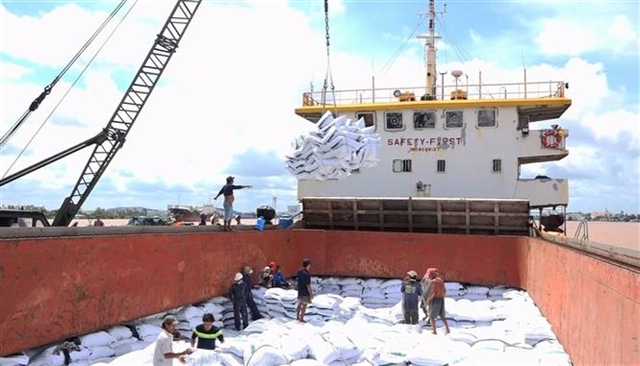 |
| Loading rice for export in the Mekong Delta province of An Giang. — VNA/VNS Photo:Công Mạo |
Arnaud Leveau (Paris Dauphine University, Asia Centre), Trần Thị Mai Thành (VNU University of Economics and Business), Nguyễn Cảnh Cường (VNU University of Economics and Business)
The era of hyper-globalisation, defined by efficiency and cost-cutting, is over. A new paradigm is emerging, one defined by the "securitisation of economics," where national security, sovereignty, and resilience have become the primary drivers of global trade, technology, and energy policy.
This structural shift is not a passing trend but a response to deep-seated vulnerabilities and an "anti-globalisation trend" (Chen & Xing, 2022) exposed in recent years. The previous model, while efficient, created complex interdependencies that often obscured the "invisible consequences of social actions" (Sommer, 2017), leading to social and political backlash. This backlash, fueled by a sense of disconnect, directly fed the domestic political pressures that are now reshaping global policy. The assumption that economic interdependence would always foster stability has been replaced by a more cautious consensus.
The Engines of Change
Three main forces are propelling this new era. First, domestic politics: Across the world, domestic political pressures are forcing governments to prioritise national interests and protect their economies from perceived external risks. Second, geopolitical rivalry: Systemic competition between major powers has fused economics with security. Trade and technology are no longer just areas for cooperation but are now arenas for strategic positioning. Third, supply chain shocks: The "just-in-time" model proved fragile during the COVID-19 pandemic. Subsequent disruptions from geopolitical flashpoints demonstrated how easily food and energy supplies could be "weaponised." The intricate web of "domestic-regional linkages" (Meng & Yamano, 2017), once celebrated for efficiency, was revealed as a network of opaque risks, where a single failure in one region could halt production globally. This transformed abstract concerns about "external dependency" and "structural economic vulnerabilities" (Amaral et al., 2011) into tangible security threats, forcing policymakers to shift focus from "just-in-time" efficiency to "just-in-case" resilience.
The New Face of Global Trade
This trend is creating a new vocabulary for global trade. Instead of prioritising pure cost efficiency, the focus is now on managing dependencies. This aligns with classic strategic theory on "managing external dependence" (Kotter, 1979), where nations actively try to reduce over-reliance on any single country for critical goods. This involves diversifying supply chains, finding or building new "niche markets," and fostering relationships with a wider array of "favorable" partners. This represents a fundamental inversion of the hyper-globalisation logic: strategic resilience is now valued alongside, or even above, pure cost-efficiency.
This also involves controlling knowledge, as technology and know-how are now seen as strategic assets to be protected. In GVCs, multinational firms and their affiliates act as key "knowledge diffusers" (Oliver et al., 2008). Nations are now working to secure their positions in these global knowledge networks, fostering domestic industrial clusters to absorb technology, enhance innovation, and reduce domestic "knowledge asymmetries." This is both a defensive and offensive strategy, securing domestic capabilities while also positioning the nation to compete in high-value sectors.
Finally, there is a growing awareness of addressing asymmetric dependencies. This moves beyond goods to the human element. Analysis of "asymmetric labour dependence" (Cresti & Virgillito, 2024) suggests that being in a weak position regarding the net provision of labor and skills can result in an "overall weakening of the capabilities" of a nation's productive structure. It suggests that a national strategy reliant on just deploying a large workforce, without capturing the value of their skills, is unsustainable and creates a new and subtle form of structural vulnerability.
Implications for Việt Nam
For a nation like Việt Nam, deeply integrated into global value chains, these shifts present both clear risks and significant opportunities.
The primary opportunity comes from the "China + 1" diversification strategy, as multinational firms seek to de-risk their supply chains. This directly aligns with strategies of "managing external dependence" through diversification (Kotter, 1979). Việt Nam's balanced foreign policy has positioned it as a key destination for this redirected investment. This influx provides the capital and, crucially, the "external ties" needed to accelerate technology transfer and reduce domestic "knowledge asymmetries" (Oliver et al., 2008).
However, this path carries inherent risks. A rapid, unmanaged influx of investment focused only on low-tech assembly could entrench the nation in a vulnerable position. This includes the risk of "low value added generation" (Amaral et al., 2011), where the economy becomes highly dependent on imported intermediate goods for its exports, capturing only a small fraction of the final value. This creates a high-dependency, low-resilience model. Furthermore, it could lead to a state of "asymmetric labour dependence" (Cresti & Virgillito, 2024), where Việt Nam provides the labor but does not capture the high-value knowledge embodied in the product, ultimately "weakening the capabilities" of its domestic productive structure.
The strategic imperative for Việt Nam, therefore, is twofold: First, to attract but also guide investment consciously, managing this influx toward high-value "niche markets" such as semiconductors, green technology, and digital infrastructure. Second, to upgrade capabilities by leveraging new investments to move up the value chain, fostering innovation and strengthening domestic supplier networks. This requires addressing "domestic regional heterogeneity" (Meng & Yamano, 2017) to ensure that development is balanced and that domestic suppliers across all regions are integrated into these new, high-value chains, not just isolated export zones.
A New Order
The re-evaluation of global value chains has reset global priorities. This new era of managed globalisation is characterised by strategic fragmentation, state-led industrial policy, and a focus on managing asymmetric dependencies.
While this shift carries risks of inefficiency, it is also a necessary correction to the vulnerabilities and "invisible consequences" (Sommer, 2017) of the previous model. The emerging order places a new emphasis on how agile economies can manage their external dependencies and avoid the pitfalls of low-value generation. The challenge for leaders is to balance the legitimate demands of national security with the enduring benefits of global economic cooperation, navigating a far more complex map of "domestic-regional linkages" (Meng & Yamano, 2017) to build a truly resilient national economy. The new order will not be one of isolation, but of strategic, managed, and multipolar interdependence.
References
Amaral, D., Lopes, J. C., & Dias, J. (2011). External dependency, value added generation and structural changes: An inter-industry approach. Notas Económicas, 33. https://doi.org/10.14195/2183-203X_33_1
Chen, W., & Xing, L. (2022). Measuring the Intermediate Goods’ External Dependency on the Global Value Chain: A Case Study of China. Sustainability, 14(7), 4360. https://doi.org/10.3390/su14074360
Cresti, L., & Virgillito, M. E. (2024). Weak sectors and weak ties? Labour dependence and asymmetric positioning in GVCs. In Review. https://doi.org/10.21203/rs.3.rs-4132236/v1
Kotter, J. P. (1979). Managing External Dependence. The Academy of Management Review, 4(1), 87. https://doi.org/10.2307/257406
Meng, B., & Yamano, N. (2017). Compilation of a regionally extended inter-country input–output table and its application to global value chain analyses. Journal of Economic Structures, 6(1), 23. https://doi.org/10.1186/s40008-017-0081-z
Oliver, J. L. H., Garrigós, J. A., & Porta, J. I. D. (2008). External Ties and the Reduction of Knowledge Asymmetries among Clusters within Global Value Chains: The Case of the Ceramic Tile District of Castellon. European Planning Studies, 16(4), 507–520. https://doi.org/10.1080/09654310801983308
Sommer, B. (2017). Externalisation, Globalised Value Chains and the Invisible Consequences of Social Actions. Historical Social Research, 42, 114132. https://doi.org/10.12759/HSR.42.2017.4.114-132
Opinion
 Opinion
.jpg) Opinion
Opinion
 Opinion
 Opinion
 Opinion
 Opinion
 Opinion
 Opinion
 Opinion
 Opinion
 Opinion
 Opinion
 Opinion
 Opinion