 Life & Style
Cambodian PM Hun Manet chairs welcome ceremony for Vietnamese counterpart Lê Minh Hưng in Phnom Penh
1.
|
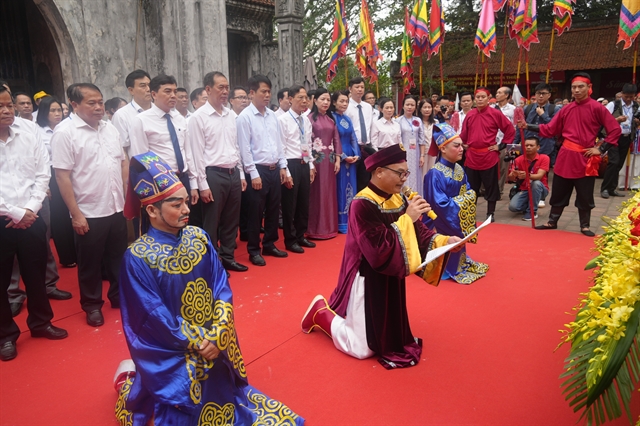
| A ritual is conducted within Bà Triệu Temple Festival. — VNA/VNS Photo Việt Hoàng |
THANH HÓA — Embracing Resolution No. 80-NQ/TW of the Politburo on developing Vietnamese culture, the north-central province of Thanh Hoá is leveraging modern technology to enhance tourism appeal, shifting from the mindset of “preservation” to managing heritage as a special endogenous resource for sustainable socio-economic development.
With 28 nationally-recognised intangible cultural heritage elements, the province has prioritised integrating conservation with tourism development. Digital transformation, in particular, is seen as a crucial bridge connecting tradition with innovation, helping heritage sites become more accessible and engaging.
Increasing destinations’ appeal
The Bà Triệu national special relic site, dedicated to national heroine Triệu Thị Trinh, is among Thanh Hoá’s most prominent attractions. Housing nearly 300 artefacts dating from the late 17th to early 20th centuries, the site serves not only as a cultural destination but also as a venue for educating young people about patriotism and history.
Closely associated with the site, the Bà Triệu Temple Festival has long been a hallmark cultural event in the province, drawing large numbers of visitors seeking spiritual experiences and traditional cultural activities.
At the 2026 festival, organisers have incorporated modern technologies to deepen visitor engagement. At exhibition spaces, tourists can use 3D glasses to explore national treasures related to Triệu Thị Trinh, creating more interactive and immersive experiences.
Digital transformation drives tourism development
Digitalisation is viewed as an inevitable trend and a vital tool for preserving and promoting heritage sustainably. For a national special site like Bà Triệu Temple, the application of digital technology is essential to both conservation and development.
The provincial People’s Committee is implementing a project to innovate management and tourism development at the Bà Triệu relic site for the 2021–2030 period, with a focus on strengthening IT application in promotion and visitor services.
Infrastructure has been improved with the installation of Wi-Fi and 4G systems across the site and surrounding areas, ensuring seamless connectivity for visitors. At the same time, heritage content has been standardised and digitised, allowing accurate and user-friendly dissemination of information.
Through official fanpages and social media channels such as YouTube, Facebook and TikTok, visitors can access images, audio guides and videos introducing the site and its related activities before arrival.
These efforts have helped the Bà Triệu relic site overcome spatial and temporal limitations, presenting heritage in a vivid and intuitive manner. In 2025, the site welcomed more than 75,000 visitors, including tens of thousands of students participating in educational tours to learn about history and traditional culture.
Trương Hoài Nam, Deputy Director of the Management Board of the Hồ Dynasty Citadel World Heritage Site and key historical relic sites of Thanh Hoá, said future priorities include further restoration, gradual digitalisation of heritage management, enhanced training for guides, and stronger cooperation with travel agencies to expand tour connections.
Greater emphasis will also be placed on data standardisation and engaging youths in heritage promotion, seen as key to bringing cultural values closer to contemporary life while fostering new creative spaces in the digital era, he added.
The upcoming Bà Triệu Temple Festival, opening on April 9, is expected to highlight these innovations. By harmonising digital technology with cultural heritage, Thanh Hoá aims to not only preserve historical memory but also transform it into a dynamic resource, contributing to promoting modern, professional and sustainable tourism development in line with Resolution 80-NQ/TW. — VNA/VNS
Life & Style
 Life & Style
 Life & Style
 Life & Style
 Life & Style
 Life & Style
 Life & Style
 Life & Style
 Life & Style
 Life & Style
 Life & Style
 Life & Style
 Life & Style
 Life & Style
 Life & Style