 Life & Style

Việt Nam–EFTA trade deal creates opportunities to upgrade supply chains: Nestle Việt Nam
1.
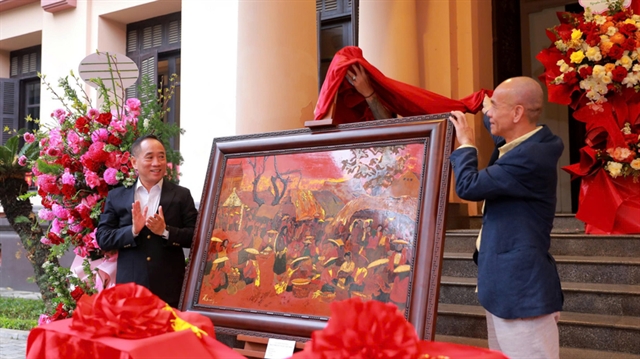 |
| Late painter Hoàng Sùng's son Hoàng Anh Tuấn (right) hands over the lacquer painting Chợ Phùng (Phùng Market) to Việt Nam Fine Arts Museum director Nguyễn Anh Minh. Photo courtesy of the museum |
HÀ NỘI — The family of late artist Hoàng Sùng has donated his lacquer painting Chợ Phùng (Phùng Market) to the Việt Nam Fine Arts Museum, marking the 100th anniversary of his birth and celebrating his enduring artistic legacy.
The handover ceremony took place earlier this week at the museum, attended by the artist’s family, representatives of the Ministry of Culture, Sports and Tourism, and the Việt Nam Fine Arts Association, as well as a number of prominent artists.
The donation not only honours Hoàng Sùng’s centenary but also brings renewed attention to his enduring artistic legacy, particularly his evocative portrayals of rural markets — a defining theme in his work.
Rendered in a rich brown tonal palette, Chợ Phùng captures the quiet beauty of the Vietnamese countryside and reflects the artist’s deep engagement with everyday life and cultural identity.
“The museum will put this work on display for the public, enabling both domestic and international audiences to gain a deeper understanding of Vietnamese market culture,” museum director Nguyễn Anh Minh said at the event.
"Hoàng Sùng explored a wide range of subjects, producing numerous works of lasting artistic value during his career. Most notably, however, it was the theme of markets that defined his legacy and established his artistic identity.
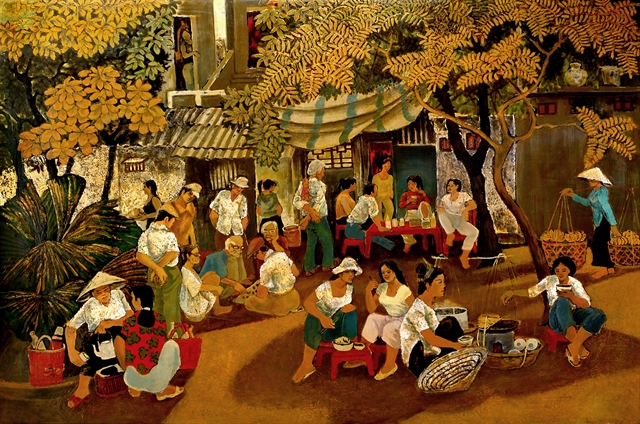 |
| One of Hoàng Sùng's paintings on display at the museum exhibition. Photo courtesy of the museum |
"He closely studied various cultural spaces of traditional markets, capturing them with remarkable success in his works."
Market legacy
In Sùng’s paintings, rural markets and everyday Vietnamese life are portrayed as rustic, bustling and intimate, while also remaining refined, harmonious and imbued with depth.
Artist Thành Chương said: “The lives of ordinary people can be vividly seen through markets like these. Anyone passionate about and seeking to understand Vietnamese culture will find an encyclopaedia in Hoàng Sùng’s paintings.
"What could be more meaningful for an artist than having their work inspire a love for the homeland among the public?"
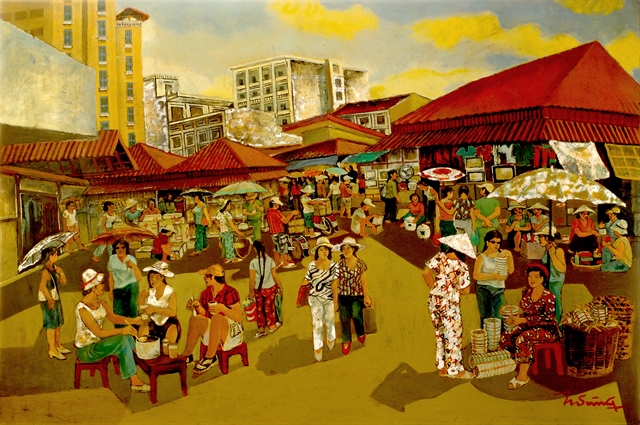 |
| A city market as depicted by Hoàng Sùng. Photo courtesy of the museum |
For the occasion, his family and the museum are also exhibiting nearly 70 works created in lacquer, silk and poonah paper, all deeply rooted in Vietnamese cultural identity.
Titled Hồn Quê (Soul of the Countryside), the exhibition introduces audiences to the ethereal hues of the Red River’s alluvial soil, highland markets and the enduring image of hardworking women in the northern delta.
The exhibition's title recalls a historic moment in 1991, when works by Sùng were first displayed in the town hall of Paris' first arrondissement near the Louvre, serving as a cultural bridge that brought the beauty of Vietnamese rural landscapes to international audiences.
It also marked the first time Vietnamese paintings were formally shown there. Within just five days, all 20 works on display were sold.
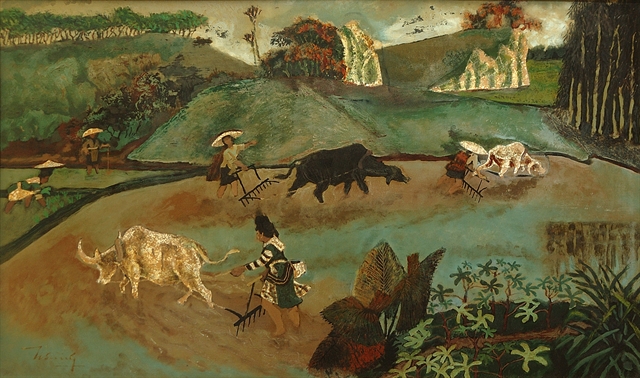 |
| A painting depicts farmers working in a field. Photo courtesy of the museum |
Artistic journey
"Hoàng Sùng holds an important place in the development of Vietnamese fine arts," said Vương Duy Biên, deputy chairman of the Việt Nam Union of Literature and Arts Associations.
"He belonged to a generation of artists who devoted their entire lives to artistic practice, leaving behind a rich legacy deeply imbued with the imprint of rural Việt Nam. In his works, viewers encounter a sincere creative spirit, a distilled visual language, and an emotional depth intimately bound to the lived experience of the Vietnamese people.
"Tracing back to the years of the war of resistance against the French, he asserted himself early on as a cultural soldier working as a publicist, journalist and artist. His works from this period not only carried aesthetic value, but also functioned as powerful spiritual weapons, inspiring patriotism through vivid information and illustrative paintings."
Selected by his family, the works on display represent some of his most distinctive creations, bearing the imprint of time across the places he once travelled. Together, they form an artistic journey that reveals the depth of Vietnamese culture through the artist’s singular perspective.
Born in 1926 in the northern province of Hưng Yên, Sùng was one of the prominent figures of 20th-century Vietnamese art, with a career spanning painting, animation and television.
At the age of 17, he took part in the August 1945 Revolution, actively engaging in publicity work and producing patriotic posters. He later worked at the Vietnam News Agency, before being sent to study painting at the Việt Nam College of Fine Arts from 1956 to 1958.
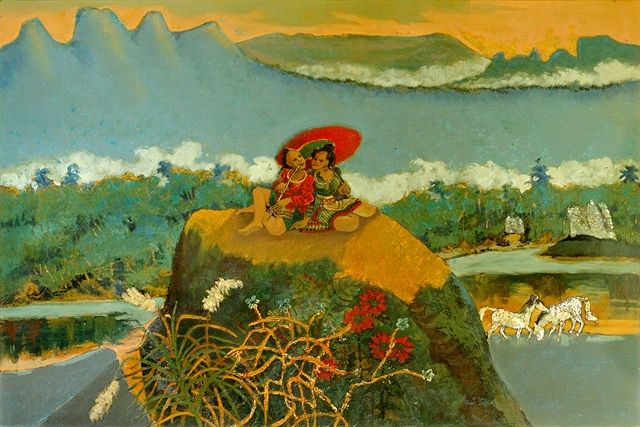 |
| A painting depicting a couple on a mountain. Photo courtesy of the museum |
In 2022, he was posthumously awarded the State Prize for Literature and Arts, the highest state award in the art and literature field.
The exhibition runs until March 31 at 66 Nguyễn Thái Học Street, Hà Nội. — VNS
Life & Style
 Life & Style
 Life & Style
 Life & Style
 Life & Style
 Life & Style
 Life & Style
 Life & Style
 Life & Style
 Life & Style
 Life & Style
 Life & Style
 Life & Style
 Life & Style
 Life & Style