 Economy

Railway investment boom must translate into domestic industrial capacity
1.
 |
| Shoppers at a WinMart supermarket in Hà Nội. Household spending decisions are influenced by inflation expectations and confidence in the economic outlook. — VNS Photo Mai Hương |
Mai Hương
HÀ NỘI — The 2026 Nobel Prize in Economic Sciences, awarded on October 12 to Robert E. Hall and Michael Woodford for their work on the microeconomic foundations of macroeconomic stabilisation, offers lessons for Việt Nam as it seeks to achieve high economic growth while maintaining macroeconomic stability.
The challenge is to understand how households and businesses respond to policy changes, how external shocks affect the economy and how monetary authorities can guide market expectations.
These issues were discussed at a seminar held on October 24, where economists examined how economic models and monetary policy lessons could be applied to Việt Nam’s development challenges.
Nguyễn Văn Phú, professor at the Centre National de la Recherche Scientifique and an affiliated researcher at the EconomiX research centre at Paris Nanterre University, France, said economic theories needed to be considered in their historical context, while their limitations should also be recognised.
For Việt Nam, one important question is whether policymakers adequately account for the behaviour of households, businesses and individuals.
According to Phú, differences in attitudes towards risk and willingness to postpone consumption can lead people to respond differently to the same economic conditions. Policies designed without considering these differences may therefore produce results that differ from those expected.
“When we have multiple objectives, the number of policy instruments must be at least equal to the number of objectives, and the instruments must be independent,” he said.
Reflecting the economy
Associate Professor Lê Quang Thanh of the University of Wollongong in Australia said the microfounded macroeconomic approach offered opportunities for further research in Việt Nam.
Rather than examining only aggregate indicators such as output, inflation and consumption, this approach studies how decisions made by households and businesses interact to shape the wider economy.
“When these basic units of the economy function well, the economy as a whole can function well,” said Lê Thanh.
He suggested extending existing models to account for differences between households and businesses and the characteristics of an open economy. This is particularly relevant to Việt Nam, where exports, foreign direct investment and exchange rate movements expose domestic economic activity to international developments.
 |
| Economists at an October 24 seminar discuss how economic models and monetary policy lessons could be applied to Việt Nam’s development challenges. — VNS Photo Mai Hương |
Trần Quang Thanh, a senior researcher at DEPOCEN and Tohoku University in Japan, emphasised the importance of applying economic models used by central banks to improve macroeconomic forecasting and support policy decisions.
“We cannot experiment with policy changes directly on the economy. We need models to assess how changes in interest rates, credit conditions or exchange rates would affect growth and other economic variables,” Trần Thanh said.
However, no single model can serve every purpose. Citing a survey of models used by central banks worldwide, Trần Thanh said semi-structural models accounted for more than 60 per cent of the models covered, while dynamic stochastic general equilibrium models – which examine how households, businesses and policymakers interact and how the economy responds to shocks – accounted for 2.9 per cent.
According to Trần Thanh, the choice of model for Việt Nam is particularly important because the State Bank of Vietnam (SBV) uses several policy instruments, including credit controls and exchange rate management, rather than relying on interest rates alone.
"Models need to reflect the instruments actually used by monetary authorities and the country’s exposure to external developments," Trần Thanh explained.
He also advocated using a core model for regular macroeconomic analysis alongside supplementary models for short-term forecasting and longer-term issues. The objective is to give policymakers a more comprehensive assessment of economic conditions and the likely consequences of different policy choices.
Guiding expectations
Nguyễn Tú Anh, PhD, of VinUniversity said Việt Nam’s experience following the economic shocks of 2009–10 offered useful lessons about the role of policy commitments in stabilising the economy.
He recalled that the SBV had consistently communicated its commitment to exchange rate stability and gradually reducing interest rates after bringing inflation under control.
"The clear direction helped shape market expectations and supported the subsequent stabilisation process," he said.
"The challenge today is to ensure that businesses and investors understand the authorities’ priorities when economic growth, inflation control and exchange rate stability must be pursued together."
He added that policymakers needed to clearly communicate how they would respond if inflation exceeded the 4.5 per cent target or exchange rate pressures intensified, so businesses and investors could form expectations and make informed decisions.
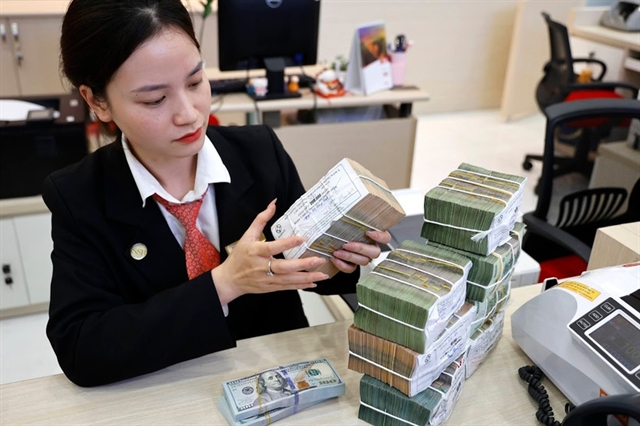 |
| A bank employee counts Vietnamese and US banknotes. Banks play a key role in maintaining monetary stability and guiding market expectations. — VNA/VNS Photo |
Anh said the discussion also highlighted a misunderstanding about the role of market expectations in monetary policy.
"The central bank should not simply follow what the market expects. Instead, it should take the lead in shaping expectations, using its own analysis and available information to communicate a coherent policy direction,” he said.
He recalled supporting the establishment of a communications unit at the SBV in 2016–17, arguing that communication should be treated as an instrument of monetary policy rather than simply a means of explaining decisions after they had been made.
The distinction is important because inconsistent signals can leave market participants with different expectations about future inflation, interest rates and exchange rates, according to Anh.
When businesses and investors cannot understand the authorities’ priorities, uncertainty may complicate investment and consumption decisions, weakening the effectiveness of policy.
Professor Lê Văn Cường, research adviser to Foreign Trade University’s research laboratory, stressed that sustainable growth depended on higher total factor productivity, driven by investment in technology, innovation and human capital.
"Public spending should prioritise these areas to improve productivity and strengthen Việt Nam’s long-term growth potential, rather than focus solely on increasing investment," said Cường.
National Assembly deputy Nguyễn Hải Nam agreed, stressing that the quality of growth mattered as much as its headline rate.
He highlighted the Government’s priorities of maintaining macroeconomic stability and protecting social welfare, while stressing the need to carefully assess how frequent changes to laws and regulations affected the country’s growth model.
He also called for further research into the effects of institutional changes on economic performance and ways to improve the effectiveness of public investment in attracting private capital.
“Public investment should serve as seed capital to attract private investment,” said Nam. — VNS
Economy
 Economy
 Economy
 Economy
 Economy
 Economy
 Economy
 Economy
 Economy
 Economy
 Economy
 Economy
 Economy
 Economy