 Economy


Gold buyers urged to prepare cashless payments under new rules
1.

|
| Trương Văn Cẩm, vice president of the Vietnam Textile and Apparel Association speaks at the conference. —VNA/VNS Photos |
HÀ NỘI — Data and artificial intelligence (AI) are expected to help Việt Nam's textile and garment industry improve productivity, reduce costs and increase value added as global buyers tighten requirements for quality, sustainability and supply chain transparency, a conference heard in Hà Nội on Wednesday.
Trương Văn Cẩm, vice president of the Vietnam Textile and Apparel Association (VITAS), said Việt Nam was among the world's three largest textile and garment exporters but faced mounting pressure from higher customer expectations, shorter product cycles, rising costs and stricter requirements for environmental protection, traceability and supply chain transparency.
Science and technology, digital transformation and innovation must become key drivers of productivity, product quality and added value, helping the industry strengthen its position in international markets, he said.
Digital transformation should go beyond investment in machinery and software to encompass changes in management, production organisation and business practices, Cẩm said. Data should underpin this process, enabling companies to track orders, optimise raw material use, improve labour productivity, cut costs and make faster, more accurate decisions.
The conference also covered technology and innovation to improve competitiveness, technical requirements for the European Union's Digital Product Passport (DPP) for textile and garment products, production data platforms, and the potential of AI in the industry and fashion e-commerce.
Participants also discussed practical solutions to improve productivity, lower operating costs and strengthen companies' competitiveness in global markets.
Dr Nguyễn Thu Phượng, vice rector of Hanoi Industrial and Trade University, said the industry needed to shift from a processing-based model towards higher value-added production to meet increasingly stringent international requirements for sustainability and traceability.
Experience at major manufacturers showed that investment in advanced equipment delivered stronger results when combined with management reform and workforce skills development, she said.
|
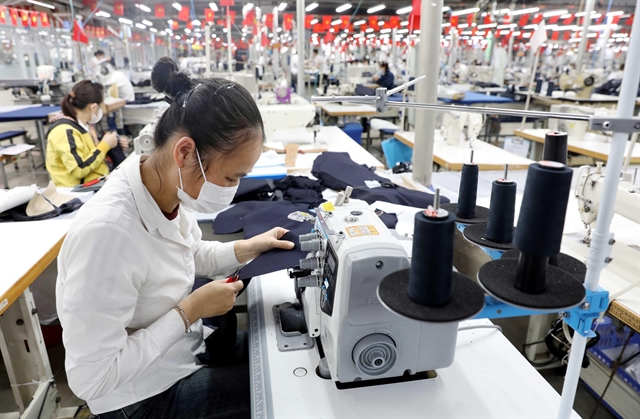
| Workers of Garment 10 Corporation JSC. |
Garment 10 Corporation JSC recorded a 52 per cent increase in labour productivity and an 8 per cent reduction in defects after implementing lean manufacturing, while cutting working time by one hour per day. At Duc Giang Corporation and its member companies, labour productivity rose by 8 per cent to 10 per cent, while production-line defect rates fell from 25 per cent to between 10 per cent and 12 per cent.
However, more than 70 per cent of businesses in the textile and garment industry are small- and medium-sized enterprises, limiting their access to advanced automation because of financial constraints and gaps in organisational expertise.
Phương said companies should prioritise digitising and standardising data and adopting lean management practices before moving to large-scale automation.
Support from the Government, regulatory agencies, industry associations and universities, alongside an enabling legal framework for science and technology, would help businesses test new technologies and manage associated risks, she said.
Vũ Đức Giang, chairman of VITAS, said the industry was entering a new phase in which international buyers expected more than fast delivery and competitive production costs, placing greater emphasis on product quality, social responsibility and sustainability.
Vũ Đức Giang, chairman of VITAS, said rising domestic production costs were eroding the industry's traditional advantage of low-cost labour, making the adoption of digitalisation, automation, robotics and artificial intelligence increasingly necessary.
Businesses should upgrade factory infrastructure to meet international standards and expand the use of automation to optimise production costs and improve labour productivity, he said.
Việt Nam's textile and garment exports reached US$35.72 billion in the first nine months of 2026, up 3.3 per cent from a year earlier, according to VITAS data.
The industry has set a full-year export target of $48 billion to $49 billion in 2026. —VNS
Economy
 Economy
 Economy
 Economy
 Economy
 Economy
 Economy
 Economy
 Economy
 Economy
 Economy
 Economy
 Economy
 Economy
 Economy



