 Economy


Vietnamese experimental theatre shines at AAPPAC 2026
1.
|
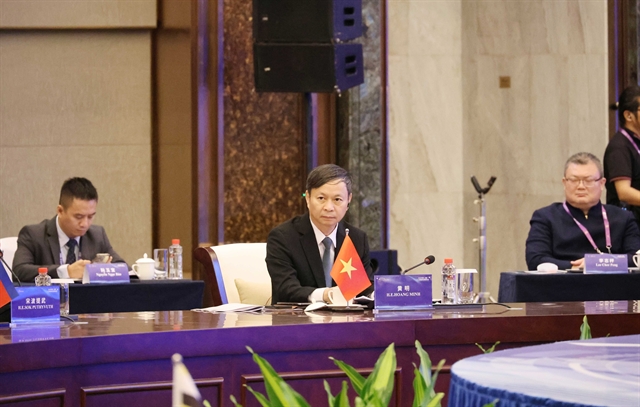
| Vietnamese Deputy Minister of Science and Technology Hoàng Minh attends the 2026 China–ASEAN Ministerial Roundtable on Artificial Intelligence in Nanning, China, on September 17. — VNA/VNS Photo Công Tuyên |
NANNING — Việt Nam has proposed ASEAN and China enhance cooperation in artificial intelligence (AI), focusing on policy dialogue, AI safety research and testing, and human resource development, Deputy Minister of Science and Technolog Hoàng Minh said at the 2026 China-ASEAN Ministerial Roundtable Conference AI in Nanning on September 17.
Bringing together officials from China's AI regulatory authorities and representatives from all 11 ASEAN member states, as well as leading AI businesses, research institutes and financial organisations, the meeting focused on AI governance, safety and security, applications of the technology in socio-economic development, and cooperation in research, innovation and AI capacity building.
Discussions also focused on balancing innovation with risk management, as well as strengthening cooperation on technical standards, testing, human resources and AI capabilities.
Speaking at the conference, Minh said effective AI governance is, for Việt Nam, a foundation for sustainable innovation and for ensuring that technological development benefits people and businesses.
“Technological progress should go hand in hand with protecting people and strengthening public trust,” Minh said.
The deputy minister stressed that Việt Nam's consistent approach is to put people at the centre. AI must serve people rather than replace human authority and responsibility, while AI development must protect human rights and privacy and ensure fairness, transparency and accountability.
Minh said that Việt Nam is promoting AI development alongside safe and responsible governance, with regulatory measures proportionate to the level of risk while allowing room for innovation and the testing of new solutions within appropriate frameworks.
He emphasized that China-ASEAN cooperation could leverage the strengths of participating countries, strengthen AI governance capabilities and expand opportunities for AI development.
On the basis of equality, mutual benefit, and respect for sovereignty and laws of each country, Minh said Việt Nam proposed three areas of cooperation.
The first is to strengthen policy dialogue and the sharing of AI governance experience, with the aim of improving mutual understanding and compatibility among approaches across the region.
The second is to promote cooperation in AI safety research, testing and assessment, while strengthening links among research institutes, universities and businesses. Vietnam proposed sharing risk-assessment methods and experience in technical standards, taking into account linguistic and cultural characteristics as well as data sovereignty.
The third is to expand cooperation in human resource development and narrow gaps in AI capabilities through training and expert exchanges.
Such cooperation would seek to strengthen the capabilities of AI developers, regulators and users, while helping people and businesses, particularly small and medium-sized enterprises, access and use AI safely and responsibly.
“A safe AI future should be built on the governance capacity of individual countries and trust among partners,” Minh said, stressing that Việt Nam wants to work with China and ASEAN countries to promote practical AI cooperation for the benefit of people and prosperity of the region.
The first China–ASEAN Ministerial Roundtable on AI was held in Nanning in September last year, aimed to promote exchanges and cooperation on AI between China and ASEAN member states. — VNS
Economy
 Economy
 Economy
 Economy
 Economy
 Economy
 Economy
 Economy
 Economy
 Economy
 Economy
 Economy
 Economy
 Economy
 Economy