 Economy
Việt Nam, Singapore promote cooperation through Party-to-Party channel
1.
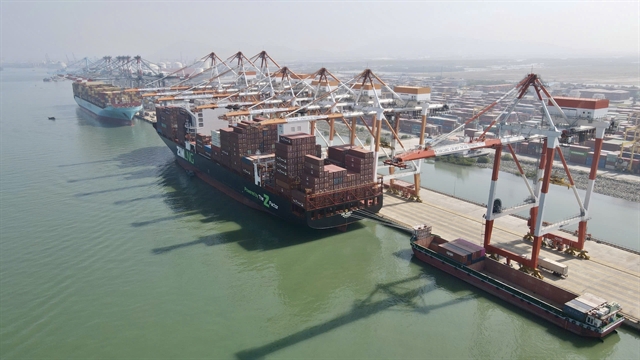 |
| Tân Cảng-Cái Mép Port, part of the Cái Mép-Thị Vải deep-water port complex that will be linked to HCM City's newly established free trade zone, is located in the former Bà Rịa-Vũng Tàu Province's Phú Mỹ Town, now part of HCM City. — VNA/VNS Photo |
HCM CITY — HCM City has officially established Việt Nam's first pilot free trade zone, a 4,174-ha development anchored by the Cái Mép Hạ port area, as the country seeks to strengthen its position in regional logistics and global supply chains.
The decision, signed by the municipal People's Committee on Saturday, establishes the Free Trade Zone (FTZ) in Tân Phước and Tân Hải wards, about 50 km from downtown HCM City and around 25 km from Long Thành International Airport.
The FTZ will cover about 4,174 hectares and comprise three main functional areas divided into eight contiguous sub-zones.
The development will integrate existing container terminals, the planned Cái Mép Hạ container port, an inland waterway port, the Cái Mép Hạ railway station on the Biên Hòa-Vũng Tàu railway, industrial parks, logistics centres and industrial-urban-service complexes.
The city said the FTZ would serve as a pilot model featuring special policy mechanisms to create an investment and trading environment aligned with international standards while supporting institutional reform.
Authorities expect the zone to become a new engine of economic growth, linking manufacturing, trade and services with regional and global markets while supporting HCM City's ambition to become a leading maritime economic centre in Southeast Asia.
The development will prioritise the digital, green and circular economies and be integrated with a green logistics hub.
It will connect the Cái Mép-Thị Vải deep-water port complex, the planned Cần Giờ international transhipment port and Long Thành International Airport, creating a major multimodal logistics network and strengthening Việt Nam’s role in global supply chains.
The FTZ is also expected to attract multinational companies in logistics, maritime services and international trade, while promoting high-value manufacturing and exports using advanced and environmentally friendly technologies.
Under the implementation roadmap, the city aims to complete the management framework, transport infrastructure, land clearance, detailed planning and the selection of strategic domestic and foreign investors by 2030.
Authorities will also propose additional investment incentives to enhance the FTZ's competitiveness.
Between 2031 and 2035, HCM City plans to complete the remaining infrastructure, attract further investment and develop a competitive maritime economic ecosystem before bringing all functional zones into operation.
After 2035, the FTZ is expected to become the core of the Southeast region's marine economy, centred on what the city envisions as Việt Nam's largest cargo transhipment port with regional and international competitiveness.
The HCM City Export Processing and Industrial Zones Authority (HEPZA) has been assigned to oversee the FTZ.
The agency will coordinate planning, infrastructure development, investment promotion and implementation in cooperation with relevant departments.
Free trade zones are widely used around the world to promote trade, logistics, manufacturing and exports through preferential customs, tax and investment policies.
HCM City is the first locality in Việt Nam authorised by the National Assembly to pilot the model under Resolution No. 260/2025/QH15, which allows the city to test new institutional mechanisms aimed at enhancing the country's competitiveness and attracting foreign investment. — VNS
Economy
 Economy
 Economy
 Economy
 Economy
 Economy
 Economy
 Economy
 Economy
 Economy
 Economy
 Economy
 Economy
 Economy
 Economy