 Economy


Việt Nam, Singapore promote cooperation through Party-to-Party channel
1.
|
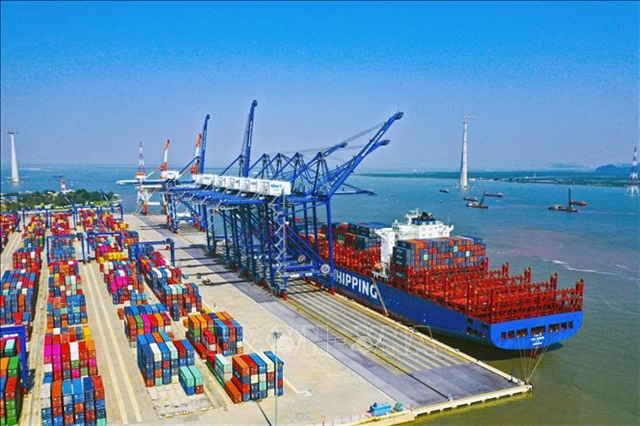
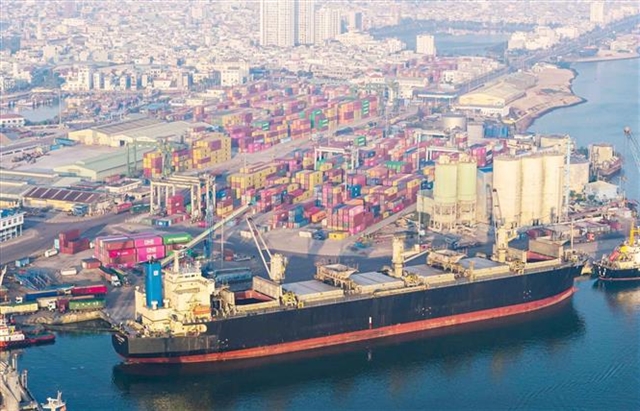
| Goods are loaded for exports at the Lạch Huyện International Port in Hải Phòng City. — VNA/VNS Photo |
HÀ NỘI — As Việt Nam reported a trade deficit in the first half of 2026 after many consecutive years of trade surplus, experts urged the need to enhance domestic production capacity and increase the localisation rate to gradually reduce dependence on imports, helping exports contribute substantially to the country’s economic growth.
According to data from the National Statistics Office, total import-export turnover in the first six months of this year surged by more than 27 per cent to nearly $550 billion, of which exports increased by about 21 per cent, and imports increased by 33.4 per cent, meaning the trade balance for the first six months of the year showed a deficit of $16.65 billion.
Nguyễn Anh Sơn, Director of the Ministry of Industry and Trade (MoIT)’s Import-Export Department, said that the growth rate of the total import-export turnover was very impressive, significantly exceeding the target set at the beginning of the year, reflecting the resilience and increasing adaptability of the economy to the fluctuations of global trade.
However, Sơn noted, the shift in the trade balance to a deficit after many years of surplus also requires a comprehensive assessment.
According to Sơn, a noteworthy point is that the majority of import turnover was still concentrated in machinery, equipment, raw materials, and components for production rather than consumer goods.
This shows that businesses have been proactively expanding their production capacity and preparing resources for upcoming orders, thereby creating room for exports to continue to surge in the final months of the year.
The MoIT reported that nearly 88 per cent of imports consisted of machinery, equipment, raw materials, energy and components for production. It showed that the economy is expanding its production capacity, preparing for a new growth cycle, rather than increasing imports to meet consumption needs.
Many large corporations such as Samsung, LG, Foxconn, Lenovo and BYD have continued expansion of investments, and increase imports of production lines, equipment, components and raw materials. The move has confirmed that Việt Nam remains an important destination in the restructuring of regional and global supply chains.
However, the fact that the rate of increase in input imports is faster than that of exports reflects the reality that, despite its deep involvement in the global supply chain, Việt Nam still primarily handles processing and assembly stages, while many core components, materials, and technologies remain dependent on imports.
The goal in the coming period is not only to maintain export growth but, more importantly, to enhance domestic production capacity, increase the localisation rate, and transform export growth into substantial economic growth.
|
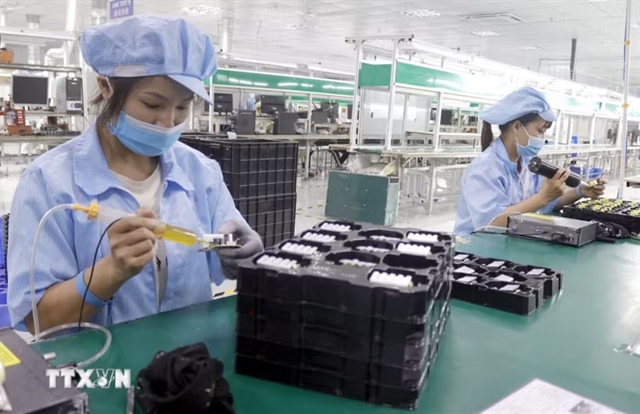
| Electronics is expected to continue playing a leading role in export growth in the second half of this year. VNA/VNS Photo |
Experts predict that in the second half of 2026, electronics will continue playing a leading role in export growth. The continuous expansion of investments by many large technology corporations has led to increased demand for imported machinery, equipment, and components for production.
When these projects operate at high capacity, the volume of exported goods is expected to increase accordingly. This also explains why import turnover has increased sharply, but the majority is imports of inputs for production and export, not an increase in consumer goods imports.
According to Đỗ Thị Thúy Hương, a member of the Executive Board of the Vietnam Electronics Business Association, the demand for products serving artificial intelligence (AI), data centres, and network equipment continues to grow strongly globally, creating more room for the electronics industry – a sector currently accounting for over 30 per cent of the country's total export turnover.
Many businesses have orders booked until the end of the third quarter, and even into the fourth quarter, while the wave of investment by international technology corporations in Việt Nam shows no signs of slowing down.
To maintain export growth momentum amidst increasing global trade barriers, Trần Thanh Hải, Deputy Director of the MoIT’s Import-Export Department, said that the core solution is to enhance the endogenous capacity of the manufacturing sector. The focus is on developing supporting industries, creating domestic raw material sources, increasing the added value of goods, and effectively exploiting FTAs by meeting rules of origin.
At the same time, the MoIT will continue to promote trade, expand markets, work alongside businesses to overcome difficulties, and support businesses in adapting to increasingly stringent requirements on green production, traceability, intellectual property and new trade barriers, thereby enhancing competitiveness and the ability to participate more deeply in the global value chain.
Assessing the prospects for the remaining months of the year, Sơn expects the international trade environment to gradually become more favourable as logistics costs cool down, raw material supplies stabilise, and businesses continue to participate more deeply in the global value chain.
This will serve as the foundation to strive to maintain export growth above 15 per cent, control the trade deficit reasonably, and aim to surpass the $1 trillion mark in total import and export turnover by 2026.
To realise this goal, Minister of Industry and Trade Lê Mạnh Hùng requested the entire sector to focus on improving the efficiency of foreign trade management, strengthening forecasting and early warning of market developments, expanding export markets, effectively utilising FTAs, and promoting digital transformation in import and export management.
In addition, the minister also emphasised the development of a production ecosystem linked to supporting industries, perfecting institutions, and improving governance capacity to both maintain export growth momentum and enhance the quality of growth and resilience of the economy. — BIZHUB/VNS
Economy
 Economy
 Economy
 Economy
 Economy
 Economy
.jpg) Economy
Economy
 Economy
 Economy
 Economy
 Economy
 Economy
 Economy
 Economy
 Economy