 Economy



Vietnamese scientist wins ASEAN-US Science Prize for Women
1.
By Ly Ly Cao
HÀ NỘI — Investors are reassessing their asset allocation strategies for the second half of 2026 as rising interest rates, persistent inflationary pressures and heightened global uncertainty weigh on major asset classes, while market experts continue to see selective opportunities in Vietnamese equities.
Global financial markets have experienced broad-based selling pressure this year as the stronger US dollar and the US Federal Reserve's decision to keep interest rates higher for longer dampened demand for riskier assets.
Domestically, the impact has been evident across multiple markets.
|
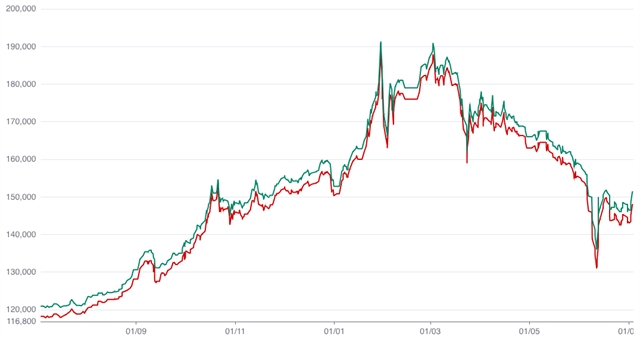
| SJC gold price movements from July 4, 2025 - July 4, 2026. Source: phuquy.com.vn |
Last month, domestic gold prices fell 23 per cent from their peak at the end of January, leaving investors who purchased gold on January 29 facing losses exceeding VNĐ44 million per tael.
Bitcoin has also declined sharply, falling by more than half from its October 2025 level and by 33 per cent since the beginning of this year.
Việt Nam's stock market has also lost momentum in the first half of the year. Average daily trading value even fell to just over VNĐ10 trillion in the third week of June, while the VN-Index hit the yearly bottom at 1,790.53 points, down significantly from 1,925.46 points recorded in mid-May 2025.
Meanwhile, the property market continues to recover unevenly. Liquidity has weakened across several segments, prompting some investors to sell at losses, while apartment prices have gradually cooled.
Nguyễn Minh Hoàng, head of research at VietFirst Securities, maintained a positive view on the equity market for the rest of the year.
"In the current context, I believe the stock market remains the most attractive investment channel through the end of the year, when considering expected returns relative to current valuations," Hoàng told Việt Nam News.
He identified several key drivers supporting the market, including Việt Nam's large-scale investment cycle, accommodative policy adjustments, stronger capital flows into priority sectors, financial market reforms and attractive valuations.
Hoàng noted that the VN-Index is currently trading at a price-to-earnings (P/E) ratio of around 11–12 times, while many sectors, excluding Vingroup-related stocks, remain attractively valued compared with their average valuations over the past five and ten years.
At the same time, he cautioned that investors should remain mindful of external risks, including the Federal Reserve's monetary policy, geopolitical tensions and rising trade protectionism, as well as valuation risks in stocks that have already posted strong gains.
For investors with a moderate risk appetite, Hoàng recommended allocating 50-60 per cent of assets to fundamentally strong equities with attractive valuations, 20-30 per cent to bank deposits or high-quality bonds, and the remainder to gold or other defensive assets to help reduce portfolio volatility.
Rather than attempting to predict short-term market movements, he said investors should focus on accumulating quality companies at reasonable valuations and holding them long enough for their intrinsic value to be reflected in share prices.
Director of Investment Banking at An Binh Securities Nguyễn Thế Minh said that since March, investment flows have become increasingly cautious, particularly toward stocks and bonds, amid growing concerns over inflation risks.
"Capital is now moving into defensive positions, waiting for the return of large institutional flows," Minh said.
"Bank deposits are gradually becoming attractive again as interest rates rise. Although gold prices have fallen, many investors continue accumulating the precious metal, while other investment channels remain in a wait-and-see mode."
Minh expects the stock market to move sideways over the next two months, before improving from August onwards.
"With current market valuations, this is an appropriate time to build a stock portfolio," he said, adding that equity investment requires not only market knowledge but also an investment strategy suited to each investor's risk tolerance.
He suggested exchange-traded funds as an option for investors seeking greater stability.
|
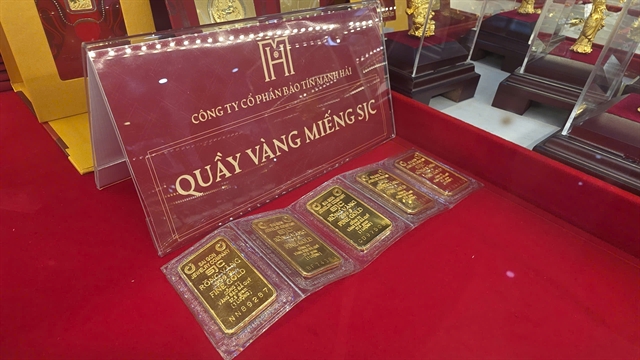
| SJC gold bars at a store in Hà Nội. In June, SJC prices fell 23 per cent from their peak at the end of January. — VNS Photo Ly Ly Cao |
Meanwhile, some experts continue to favour gold as a long-term store of value despite the recent correction.
Economist Phạm Xuân Hòe said continued purchases by central banks and ongoing global uncertainties could support a recovery in gold prices.
"If the objective is long-term wealth accumulation, this is an appropriate time to buy," Hòe said.
Financial expert Phan Dũng Khánh advised investors with an excessive allocation to gold, particularly those using leverage, to reduce the proportion to below 50 per cent of their portfolios.
Those with limited gold exposure need not react to short-term price fluctuations, while investors without existing holdings may consider accumulating gradually.
For the real estate market, experts believe recovery will remain selective. Projects with clear legal status, strong infrastructure connectivity and reputable developers, as well as social housing and rental housing developments, are expected to maintain better liquidity.
However, property is now viewed primarily as a capital preservation asset rather than one capable of generating the rapid price appreciation seen in previous cycles.
For most investors, experts said bank deposits remain one of the most attractive investment options this year as interest rates continue to rise.
Some banks are offering annual rates of more than 8 per cent for six-month deposits, supporting the case for allocating a significant portion of portfolios to savings products. — BIZHUB/VNS
Economy
 Economy
 Economy
 Economy
 Economy
 Economy
 Economy
 Economy
 Economy
 Economy
 Economy
 Economy
 Economy
 Economy
 Economy