 Economy


Int’l cooperation helps address nuclear power workforce shortages
1.
|
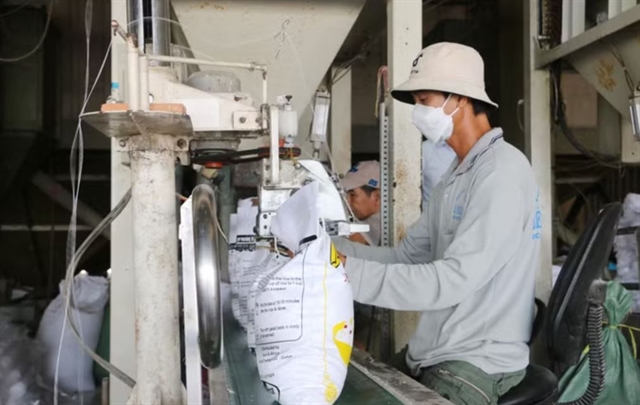
| Workers package export rice at the An Giang Agriculture and Foods Import-Export JSC. — VNA/VNS Photo Công Mạo |
AN GIANG — With green transition becoming an essential requirement, An Giang Province's private sector has been recognised as a key economic driver, contributing to green growth, job creation, innovation and global integration.
A seminar held last week by Tôn Đức Thắng Political School and other organisations discussed the current state of private sector development in An Giang and proposed solutions to refine institutional frameworks, improve the business and investment climate, promote innovation, drive digital and green transitions and strengthen regional linkages.
Hồ Ngọc Trường, principal of Tôn Đức Thắng Political School, said green transition is becoming a major requirement for local businesses to enhance their competitiveness, develop sustainably and expand exports.
He highlighted the province's advantages in numerous sectors, including high-tech and organic agriculture, aquaculture, the processing industry, the maritime economy, logistics, cross-border trade and eco-tourism.
However, Trường also outlined some challenges that the provincial private sector is facing, noting that many of these businesses are small and medium-sized enterprises (SMEs) with limitations in financial capacity, management and technological innovation.
Furthermore, they face difficulties in accessing land, credit, high-quality workforce and innovation support policies.
Many businesses also still view green transition only as an environmental protection requirement.
The province needs comprehensive policies to support businesses with digital transformation, technological innovation, circular economy development and skilled workforce training, they added.
An Giang should restructure its economy based on its ecological advantages, prioritising high-tech and organic agriculture, the circular economy, deep processing industries, logistics, eco-tourism and the maritime economy.
It should also support businesses in adopting digital technologies, developing smart agriculture, managing supply chains and ensuring traceability, thereby enhancing their competitiveness and allowing them to participate more deeply in green value chains.
An Giang Province aims to develop its private sector into a pioneering force of its green economy by 2030, contributing around 85 per cent of the province's Gross Regional Domestic Product.
The province also targets being among the country's top 15 localities in the Provincial Competitiveness Index as well as creating about 200,000 new jobs in the 2026-30 period. — VNS
Economy
 Economy
 Economy
 Economy
 Economy
 Economy
 Economy
 Economy
 Economy
 Economy
 Economy
 Economy
 Economy
 Economy