 Economy


VPS leads brokerage market share on HNX in Q3
1.
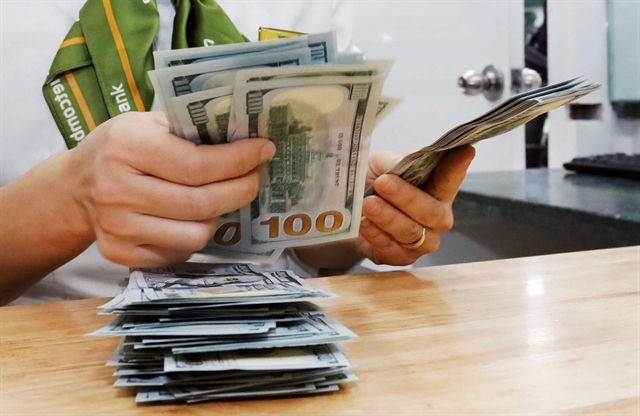 |
| US dollar banknotes are counted at Vietcombank. The Vietnamese đồng has remained relatively stable this year despite a widening trade deficit and external uncertainties. — VNA/VNS Photo |
HÀ NỘI — Việt Nam’s currency has remained surprisingly resilient this year despite a record trade deficit and growing uncertainty over the global outlook.
The USD/VND exchange rate traded between 26,291 and 26,372 during April and May, staying well within the State Bank of Vietnam (SBV)’s 5 per cent trading band.
The đồng has depreciated only marginally against the US dollar this year, outperforming expectations at a time when imports are surging and external risks remain elevated.
Việt Nam recorded a trade deficit of nearly US$14 billion in the first five months of 2026, the largest in more than a decade, as imports significantly outpaced exports.
For many economies, such a deficit would typically translate into stronger demand for foreign currency and a weaker exchange rate. Yet economists say several factors have helped cushion the impact.
According to Nguyễn Tú Anh, director of the Macroeconomic Policy Research Centre at VinUni, the composition of imports is an important part of the story.
Much of the increase came from computers, electronic products and components, with imports of the category reaching more than $88 billion in the first five months of the year, up 57 per cent year-on-year and accounting for 38 per cent of Việt Nam’s total imports.
Tú Anh said this suggests businesses are investing in production capacity and technology upgrades rather than fuelling a consumption boom.
"However, if imports are primarily tied to digital transformation, data centres and domestic value creation, foreign-currency earnings from exports may not return as quickly as in previous investment cycles," Tú Anh told diendandoanhnghiep.vn.
Another reason the exchange rate has remained resilient is the role of foreign-invested enterprises.
Trần Ngọc Báu, CEO of research firm WiGroup, said not all imports create the same pressure on the domestic foreign-exchange market.
Many foreign-invested manufacturers rely on funding from parent companies or overseas affiliates to pay for imported components and equipment.
As a result, a widening trade deficit does not necessarily translate into an equivalent increase in demand for US dollars in the domestic foreign-exchange market.
As a result, a widening trade deficit does not automatically translate into an equivalent increase in demand for foreign currency in the local market, Báu said.
Strong foreign capital inflows have provided an additional buffer.
According to experts, exchange-rate movements depend on the broader balance of payments, not only on trade flows.
 |
| Production of air-conditioning units at Daikin Vietnam’s factory in Thăng Long II Industrial Park, Hưng Yên Province. — VNA/VNS Photo Vũ Sinh |
During the first five months of the year, Việt Nam attracted nearly $10 billion in disbursed foreign direct investment, while remittance inflows remained substantial.
Together, these sources have helped offset a significant portion of the trade deficit and supported liquidity in the foreign-exchange market.
Interest rates have also played a key role.
Việt Nam’s interbank interest rates have remained higher than comparable US dollar rates across most maturities, making đồng-denominated assets relatively more attractive and reducing incentives to shift capital into dollars.
The exchange-rate outlook, however, remains closely tied to developments abroad.
Speaking at a recent investment forum, Nguyễn Xuân Thành, senior lecturer at the Fulbright School of Public Policy and Management, warned that a resilient US economy and persistent inflation could lead the Federal Reserve to keep interest rates elevated for longer than markets previously expected.
That would strengthen the US dollar and increase pressure on emerging-market currencies, including the đồng.
Thành said Việt Nam has so far maintained relative currency stability, but doing so requires a delicate balancing act.
Lower interest rates could support economic growth, yet they could also weaken the currency and encourage capital outflows. Maintaining higher rates, meanwhile, helps support the exchange rate but limits room for monetary easing.
Economists also caution that risks remain on the trade front.
Báu noted that the impact of import growth often appears with a delay because foreign-currency payments are typically made some time after contracts are signed. This means part of the pressure from recent import growth may not yet have fully emerged.
Potential US tariff measures against Vietnamese exports are another risk to watch.
Additional trade restrictions could affect export earnings, investment decisions and market sentiment, particularly in export-oriented industries such as electronics, garments and footwear.
Still, there are signs that some pressure may ease later this year. Manufacturing activity has strengthened, while recent trade data suggest the pace of import growth may be moderating.
According to customs officials, Việt Nam returned to a trade surplus of about $500 million in the second half of May, while the trade deficit recorded in early June was significantly smaller than in previous months.
Singapore-based UOB expects the đồng to remain under some pressure in the third quarter but maintains a broadly positive medium-term outlook, supported by stable monetary policy, continued foreign investment inflows and resilient economic growth. — VNS
Economy
 Economy
 Economy
 Economy
 Economy
 Economy
 Economy
 Economy
 Economy
 Economy
 Economy
 Economy
 Economy
 Economy