 Economy



Cambodian media give heavy coverage to Vietnamese PM’s visit
1.
|
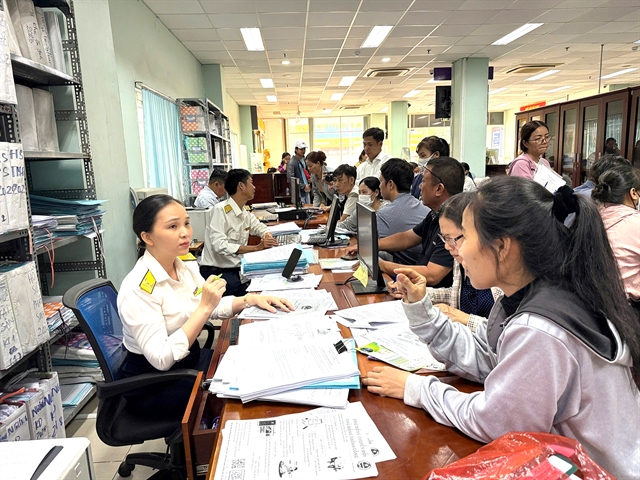
| Tax officials in HCM City provide guidance and address concerns raised by household businesses. — VNA/VNS Photo |
HCM CITY — State budget revenue in HCM City posted positive results in the first four months of 2026, reaching more than VNĐ328 trillion (US$12.9 billion), equivalent to 40.6 per cent of the annual target and up nearly 19 per cent year on year.
The result reflected the continued recovery of production and business activities, along with stronger investment inflows into the city.
According to the city Statistics Office, total State budget revenue in the January to April period was estimated at VNĐ328.1 trillion ($12.9 billion), up 18.8 per cent compared to the same period last year.
Domestic revenue remained the main source of collection, reaching an estimated VNĐ251.9 trillion ($9.9 billion), accounting for 76.8 per cent of total budget revenue.
The figure fulfilled 42.6 per cent of the yearly estimate and rose by 23.1 per cent year on year.
Several revenue sources recorded strong growth. Revenue from State-owned enterprises was estimated at VNĐ22.4 trillion, up 41.7 per cent, while revenue from the non-State sector reached VNĐ84.9 trillion, rising by 33.8 per cent.
Revenue from foreign direct investment enterprises totalled VNĐ61.8 trillion, an increase of 21.8 per cent.
Many tax categories also posted positive growth. Personal income tax collection reached VNĐ38.9 trillion, up 4.3 per cent, while revenue linked to housing and land amounted to VNĐ16.4 trillion, surging by 78.3 per cent from a year earlier.
The sharp increase suggested signs of recovery in the real estate market and reflected progress in resolving land related bottlenecks in recent years.
Meanwhile, crude oil revenue was estimated at VNĐ15.1 trillion, down 9.6 per cent year on year and equal to 38.3 per cent of the annual target.
Revenue from import and export activities reached around VNĐ61 trillion, up 11.1 per cent and fulfilling 34.6 per cent of the yearly plan.
The city’s positive budget performance came alongside encouraging economic indicators.
Industrial production index growth reached 11.2 per cent, while total retail sales of goods and consumer service revenue increased by 13.2 per cent.
Notably, newly registered FDI inflows into the city surged by 227 per cent compared to the same period last year.
Business activity also continued to improve. From January 1 to April 20, the city licensed 19,818 newly established enterprises with total registered capital of VNĐ122.2 trillion, up 35.3 per cent in number and 27.6 per cent in registered capital year on year.
In 2026, the central government assigned the city a State budget revenue target of more than VNĐ804.8 trillion, up 5 per cent from the 2025 result.
However, to support its goal of achieving double-digit economic growth in line with government direction, the city has set a higher target of increasing budget revenue by around 20 per cent and aims to surpass VNĐ1 quadrillion this year.
At a working session with Party General Secretary and State President Tô Lâm on April 27, Secretary of the municipal Party Committee Trần Lưu Quang reaffirmed the city’s determination to achieve double-digit growth and push budget revenue beyond the VNĐ1 quadrillion mark.
City leaders said HCM City would not rely solely on land related revenue, but would focus on expanding sustainable growth drivers from production, services, import and export activities, and the digital economy.
The municipal finance sector is currently implementing a range of measures to strengthen revenue management, prevent revenue losses and accelerate administrative reform.
The city Department of Finance identified public investment as a key driver for growth and sustainable revenue generation. Priority will be given to strategic infrastructure projects such as metro lines, ring roads and regional transport links, alongside investment in digital transformation and modern urban governance systems.
Faster disbursement of public investment capital, especially for feasible ODA and public-private partnership projects, is also expected to strengthen the city’s growth foundation and expand future budget revenue.
Recently, the city Tax Department held dialogues with several real estate firms to address difficulties related to land financial obligations.
The department said it would coordinate with relevant agencies to review specific cases and propose solutions to the municipal People’s Committee in order to support businesses, promote production and business activities, and contribute more to the State budget. — VNS
Economy
 Rikkeisoft ký kết MOU với LAC.Co, LTD - thúc đẩy hợp tác kinh doanh toàn diện trong lĩnh vực an ninh mạng.jpg) Economy
Economy
 Economy
 Economy
 Economy
 Economy
 Economy
 Economy
 Economy
 Economy
 Economy
 Economy
 Economy
 Economy
 Economy