 Economy



Lâm Đồng seeks stronger economic, tourism links with RoK
1.
|
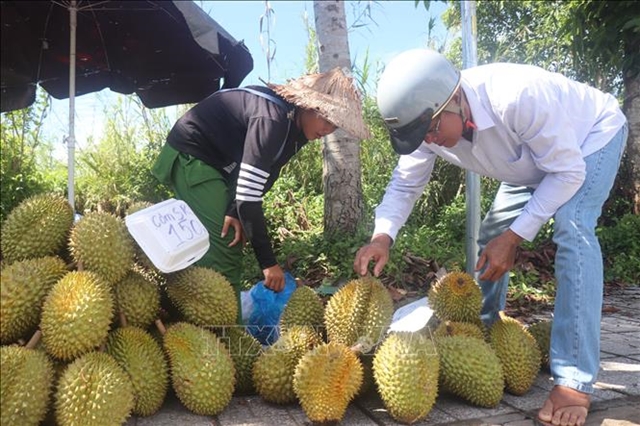
| Durians on sale along Nguyễn Văn Cừ Extension Street in the Mekong Delta city of Cần Thơ. — VNA/VNS Photo Thu Hiền |
CẦN THƠ — Durian prices in the Cửu Long (Mekong) Delta have dropped sharply ahead of the peak harvest season, sparking concerns among farmers and traders over a potential market surplus and logistical bottlenecks.
In recent days, the price of Thailand's Monthong durian has fallen from VNĐ90,000-100,000 (US$3.5-3.9) per kilo to nearly VNĐ75,000-80,000 ($2.9-3.1).
The situation is more dire for the Ri6 variety; bulk purchases at orchards are now fetching only VNĐ22,000-25,000 ($0.9-1) per kilo, down from VNĐ35,000-40,000 ($1.4-1.6) recorded just recently during the April 30-May 1 holiday.
In Cần Thơ City, the fruit is flooding pavements and local markets.
Low-quality or second-grade Ri6 durians are being sold from small trucks and makeshift stalls for as little as VNĐ35,000-45,000 ($1.4-1.8) per kilo.
“Prices have crashed at the very start of the season,” said Nguyễn Thế Hùng, a mobile vendor in Cần Thơ.
“We are terrified of how low they might go once we hit the peak harvest in a few days.”
While high-end segments like Monthong and Malaysia's Musang King remain relatively stable, the mass market is struggling.
Even on e-commerce platforms like TikTok, where shelled durians once commanded premium prices, rates are being adjusted downward to compete with the glut of street-side supply.
The price volatility is partly attributed to a massive surge in cultivation area.
In Cần Thơ alone, durian acreage skyrocketed from 2,500 hectares in 2022 to over 14,500 hectares by April, 2026.
However, quantity has outpaced quality.
Nguyễn Văn Mười, deputy secretary general of the Vietnam Fruit and Vegetable Association, noted a clear price divide.
While export-standard Monthong still fetches up to VNĐ90,000 ($3.5) per kilo, a large portion of the delta’s crop fails to meet these rigorous standards.
"The issue isn't just international competition; it's internal quality control," he said.
Low-grade fruit is being sold off cheaply on the streets, which doesn't represent the true market value of high-quality produce, but it does hurt the farmers' overall income, he added.
Export hurdles
The road to international markets, particularly China, remains arduous.
Huỳnh Thanh Lâm, director of the Tân Thành Durian Cooperative, identified two key drivers for the price decline: a market surplus from synchronised harvests and a pause in export testing due to laboratory maintenance.
Furthermore, a geographical bias in testing services has emerged.
Current laboratories are reportedly prioritising samples from the Southeast and Central Highlands regions, where growing zones and packaging codes are more established.
This leaves delta farmers in a "double squeeze," struggling to get the necessary certifications for export while facing fierce competition from Thai durians currently in their peak season.
According to experts, proactive intervention from the Ministry of Agriculture and Environment and local authorities to enhance cultivation standards and testing logistics will be key to ensuring stable pricing and sustainable prosperity for the region's farmers. — VNS
Economy
 Economy
 Economy
 Economy
 Economy
 Economy
 Economy
 Economy
 Economy
 Economy
 Economy
 Economy
 Economy
 Economy
 Economy