 Economy


Tighter controls on livestream sales
1.
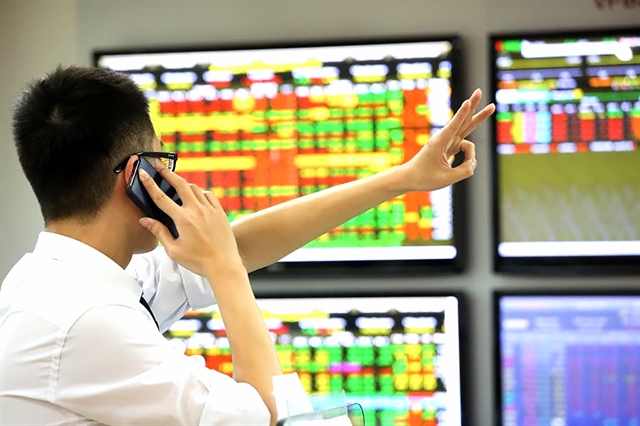 |
| An investor talks on the phone while watching the market movements. — VNA/VNS Photo |
HÀ NỘI — The domestic stock market closed last week with a fifth consecutive rebound. However, with trading taking place for only two sessions in the following holiday-shortened week, analysts said investors should be cautious about short-term volatility and any potential liquidity slowdown.
On the Hồ Chí Minh Stock Exchange (HoSE), the VN-Index was last traded at 1,853.29 points, up 1.98 per cent from the previous week. Despite the positive price movement, liquidity continued to ease.
Weekly liquidity fell to around 16 per cent below the average of the past 20 weeks.
Specifically, average trading volume on HoSE was about 798 million shares per session, down more than 10 per cent from the prior week. Average trading value reached VNĐ23.4 trillion (US$891 million) per session, down more than 6 per cent.
While the broader market closed higher, foreign flows remained a drag. Foreign investors continued to record net selling of more than VNĐ4.8 trillion, with activity focused on large-cap stocks, particularly in the banking sector.
Commenting on why foreign investors have persisted with net selling even amid prospects for an index upgrade, Nguyễn Duy Anh, portfolio manager at VCBF, said that an upgrade does not automatically translate into immediate inflows.
He added that for passive funds, only when the market is officially included in an index, will ETFs allocate capital according to their weightings and this process occurs gradually.
For active funds, he said that moving in early is still largely based on expectations, which may explain why some funds are taking profits, while those that have not previously invested typically need six months to one year to study the market before allocating capital.
The expert also pointed to a supply-side constraint, as the number of large, high-quality companies eligible for foreign investors remains limited.
He said that if the Government accelerates IPOs of major firms, new supply could help attract more foreign capital. Accordingly, VCBF’s outlook is that over the next 6–12 months, foreign flows may gradually return.
The end-of-April period is described as unusual because Việt Nam's stock market will open for only two sessions, April 28 and April 29, due to the extended holiday for April 30 and May 1.
From a technical perspective, Vietcombank Securities said buying momentum is weakening and that technical indicators are trending downward, signalling that the rally’s pace is slowing.
The firm assessed that in the short term, the VN-Index may retreat to a balance range of around 1,830–1,840 and potentially fall further to about 1,820. On the upside, if the market rebounds again, resistance is expected between 1,890 and 1,910.
ACB Securities (ACBS) said money flow is showing clear differentiation, focusing on a handful of large-cap stocks, especially those related to Vingroup and banking, while many other sectors face selling pressure.
In its assessment, the trend is not broken, but upside momentum depends on a limited number of pillars.
Meanwhile, Bình An Securities (ABS) said short-term adjustment risk remains as the VN-Index approaches 1,880 points.
ABS noted that capital has not broadened widely and that selling pressure appears to be increasing, making an accumulation phase more likely. However, the firm said any decline is expected to be not too deep.
Securities firms recommended that investors maintain an appropriate cash allocation during the long holiday period and avoid buying at peaks during upward spurts.
They said deployment can be tested during pullbacks, prioritising groups with solid accumulation bases or favourable business outlooks, including real estate, construction and banking.
Investors were also encouraged to prepare liquidity buffers to take advantage of opportunities if the market experiences deeper dips due to unexpected factors. — BIZHUB/VNS
Economy
 Economy
 Economy
 Economy
 Economy
 Economy
 Economy
 Economy
 Economy
 Economy
 Economy
 Economy
 Economy
 Economy
 Economy