 Economy

Lotte, Phát Đạt combine strengths in Thu Thiem project
1.
|
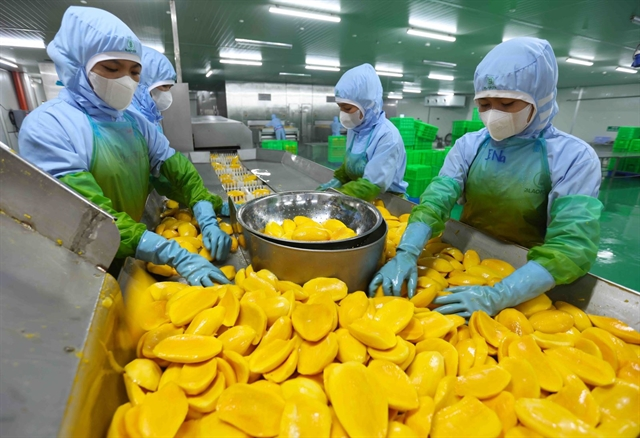
| Fresh mango being processed for export to Japan at the An Giang Food and Vegetables Joint Stock Company. — VNA/VNS Photo Vũ Sinh |
HÀ NỘI — Vietnamese businesses need to improve quality standards, management capacity and supply reliability to integrate more deeply into the supply chains of Japanese companies, a recent seminar on trade and investment promotion for the Japanese market heard.
Speaking at the event, Tạ Đức Minh, Việt Nam’s trade counsellor in Japan, noted that economic relations between the two countries were entering a new phase with strong momentum and significant potential.
Japan is currently the world’s third-largest economy, with a GDP of over US$4.3 trillion, a population of about 125 million and a per capita income of around $34,000.
Despite challenges such as an ageing population and slow growth, it remains a large, stable and high-value consumer market, Minh said.
Notably, Japanese consumers are known for their strict requirements regarding quality, safety, consistency and brand reputation. As a result, many companies view entering the Japanese market as a crucial step in elevating their global standing.
“However, the Japanese market does not evaluate businesses based solely on price, but also on quality management systems, production processes, supply stability and business credibility,” Minh said.
Bilateral trade reached over $51 billion for the first time last year, reflecting increasingly deep economic ties.
Việt Nam’s key exports include textiles, seafood, agricultural products and electronic components, while imports from Japan consist mainly of machinery, equipment and high technology.
In terms of investment, Japan remains one of the largest foreign investors in Việt Nam, with more than 5,000 companies operating in sectors such as manufacturing, electronics, automobiles, energy and services.
Investment trends are shifting from standalone projects to building integrated production ecosystems, increasing localisation and developing sustainable supply chains.
In this context, Việt Nam is considered a key destination in Japan’s supply chain restructuring strategy.
“Entering the Japanese market requires thorough preparation and a long-term strategy, particularly in meeting quality standards and ensuring stable supply capacity,” Minh said.
Based on practical experience, the representative of Việt Nam’s Trade Office in Japan highlighted supporting industries as a promising area of cooperation, given Japanese companies’ strong demand for mechanical components, moulds, auto parts and electronic components.
If Vietnamese firms can enhance production capabilities and quality management, they could integrate more deeply into Japanese supply chains while also benefiting from technology transfer and improved production standards, he said.
In addition, Japan is a major food importer, with 60–65 per cent of its demand met by imports. Vietnamese products such as seafood, fruit and coffee are already present in this market. However, to expand market share, businesses must focus on food safety standards, traceability and brand building.
The Việt Nam Trade Office in Japan will continue to act as a bridge, supporting businesses through trade promotion activities, market information provision, partner matchmaking and guidance on standards and import regulations, Minh said.
In practice, many Vietnamese firms have gradually entered the Japanese market through trade fairs, exhibitions and business matching programmes, enabling them to find partners and expand distribution channels.
Proactively participating in promotion activities, conducting market research and directly engaging with partners are seen as essential steps for turning opportunities into reality as Việt Nam–Japan economic relations enter a new development phase. — VNS
Economy
 Economy
 Economy
 Economy
 Economy
 Economy
 Economy
 Economy
 Economy
 Economy
 Economy
 Economy
 Economy
 Economy
 Economy