 Economy



Wuzhen Summit Puts Spotlight on Tongxiang’s Expanding AI Industry
1.
|
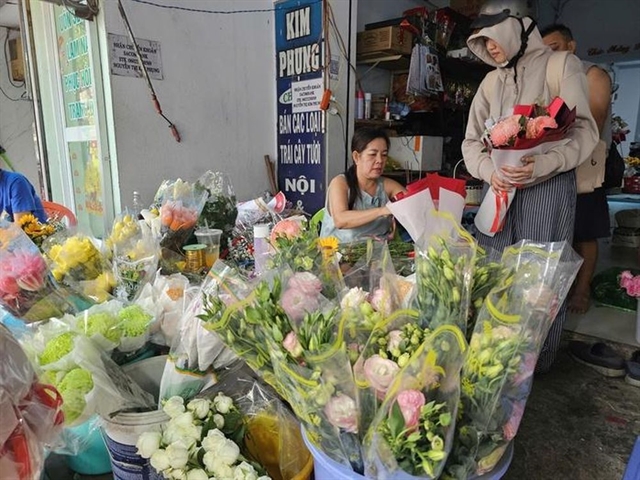
| A flower shop in Hà Nội. — VGP Photo |
HÀ NỘI — A draft decree on electronic invoices has sparked mixed reactions among small businesses after some local tax authorities have already issued notices asking household businesses with annual revenue below VNĐ500 million (US$19,000) to stop using e-invoices.
Although the decree remains in draft form, several local tax offices have already notified small household businesses to stop issuing electronic invoices and cancel previously registered invoice books. Businesses that continue issuing them could face penalties, according to the notices.
The move has surprised many business owners.
Nguyễn Thị Hương, who runs a small stationery business in Hà Nội's Tây Tựu Ward, said many of her customers are small enterprises, public agencies and organisations that regularly request invoices when purchasing office supplies.
If she is no longer allowed to issue e-invoices, she fears it could affect her ability to retain those customers, particularly business clients who require invoices for accounting purposes.
She added that the proposed rule does not fully reflect current market practices, as invoices have become increasingly common and in many cases are now a standard requirement in commercial transactions.
Some observers also warn that the regulation could inadvertently create barriers for household businesses seeking to expand, at a time when authorities are encouraging greater transparency and modern management methods.
From the perspective of e-invoice providers, one company director in HCM City said the proposed change may be due to the extremely large number of household businesses. Issuing invoices for each individual transaction could create difficulties for tax management and oversight while potentially increasing the risk of tax evasion.
The temporary suspension of e-invoices for businesses below the revenue threshold could also signal a return to the lump-sum tax method for this group, he said.
The director advised household businesses not to delete their e-invoice accounts prematurely, because regulations and guidance could still change and may vary between localities.
“In the short term, businesses should follow guidance from local tax authorities and temporarily suspend issuing invoices if requested, while keeping their systems in place until detailed instructions are released,” he said.
Revenue threshold
According to Nguyễn Gia Bảo Long, business development director at technology firm Haravan, electronic invoices are only one of the bases for determining tax obligations. Whether businesses use them or not, they must still declare taxes periodically under existing regulations.
Invoices that have already been issued will remain valid and do not need to be adjusted, he added.
Director of Linh Phong Tax Agency Nguyễn Hồng Trang said the current debate is less about the policy itself and more about using VNĐ500 million as a rigid threshold.
She noted that revenue alone does not fully reflect a company’s scale or its readiness to adopt modern management practices. Some businesses below the threshold operate professionally and frequently need invoices, while others above it may have simple operations and low profit margins.
“A rigid application of the threshold could lead to businesses deliberately keeping revenue below the limit or avoiding issuing invoices, which would run counter to the goal of improving transparency,” she said.
Frequent changes in obligations when revenue fluctuates around the VNĐ500 million mark could also create instability for business owners trying to build consistent management systems.
“Invoices are not only an obligation but also a right. They help record revenue transparently, protect transactions and enable businesses to participate in formal economic activities,” Trang said.
Nguyễn Ngọc Tịnh, vice chairman of the HCM City Association of Tax Consultants and Agents, agreed. Requiring all household businesses to issue invoices may be impractical due to limited resources and higher compliance costs for very small traders.
However, invoices remain an important basis for determining value-added tax and personal income tax liabilities, meaning authorities should develop policies that make invoice use easier and less costly for small businesses while maintaining financial transparency. — VNS
Economy
 Economy
 Economy
 Economy
 Economy
 Economy
 Economy
 Economy
 Economy
 Economy
 Economy
 Economy
 Economy
 Economy
 Economy
.jpg)