 Economy



Vietnamese community serves as important bridge in Việt Nam-India ties
1.
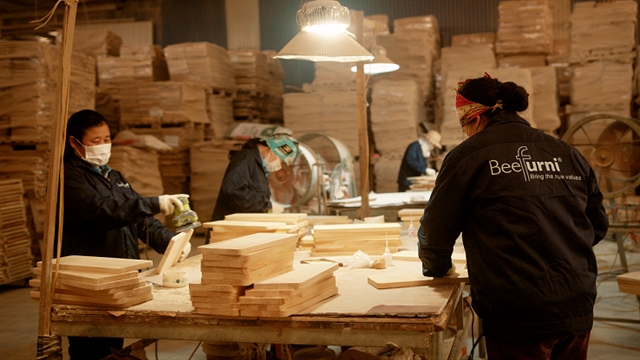 |
| Workers produce durable acacia products for export. Vietnamese exporters are implementing value transformation strategies to compete more effectively in global markets. — Photo courtesy of Amazon Global Selling Vietnam |
HCM CITY —Vietnamese exporters are moving beyond low-value shipments by adopting data-driven strategies and brand-led approaches to capture greater value in global markets.
For decades, Việt Nam has been an export-driven economy, with growth supported by sectors such as textiles and agricultural products including cashews, coffee and vegetables.
Annual export value of each of the above sectors reaches tens of billions of dollars, yet behind these impressive numbers lies a perspective worth pondering: exports remain weighted toward “selling resources” rather than “selling brand value”, causing businesses to miss out on the most valuable part of the global supply chain.
However, a new wave of Vietnamese enterprises is refusing to accept this paradox.
They are not just selling goods; they are rewriting the rules of the game by turning e-commerce exports into a strategic lever to reclaim the missed portion of value.
NEWBAM is a Vietnamese cashew brand founded by Nguyễn Huỳnh Thu Trúc. Instead of being just an agricultural trading unit, the company positions itself as a supplier of high-quality healthy snacks for the international market through e-commerce.
NEWBAM’s story is a typical example of breaking away from the shadow of “selling raw products”.
Rather than relying on the traditional model of exporting standardised 500g or 1kg packages with limited value capture, the company chose a separate path. Leveraging data tools from Amazon like the Product Opportunity Explorer, the company recognised a trend: American consumers, with a fast-paced lifestyle, needed a “healthy snack on-the-go” instead of raw products to serve cooking or processing.
From that mindset, NEWBAM moved beyond selling cashews as a commodity to offering a proposition centred on convenience and health. As a result, the brand introduced 42g and 54g small-pack formats — portion-sized for single consumption and designed to fit easily into a handbag or an office drawer.
Additionally, the company monitored customer reviews on Amazon and identified that the American taste demanded more sophistication than just salty or sweet. The R&D team developed bold flavours such as Wasabi, Tom Yum, and Sea Salt Caramel, while simultaneously reducing saltiness to fit the health trend of consumers.
Moreover, by leveraging Fulfillment by Amazon (FBA), NEWBAM ensured their cashew snacks could reach Prime customers with same-day and next-day delivery — critical for perishable food products competing in the "healthy snack" category.
Beyond raw
While agricultural products have long been a traditional strength for Việt Nam, the beauty industry is a far more competitive arena, historically dominated by global players from South Korea, Japan and France.
Against this backdrop, Abera — a Vietnamese beauty brand led by an all-male leadership team — identified a new opportunity by rethinking its value proposition, shifting from selling “natural ingredients” to selling "sustainable beauty solutions".
 |
| Convenient portable tea tables and handcrafted baskets are more than utensils — they convey a message of sustainable living in harmony with nature. — Photo courtesy of Amazon Global Selling Vietnam |
Việt Nam is rich in natural ingredients such as turmeric, ginger and aloe vera, which are widely recognised for their medicinal benefits. However, selling these ingredients in raw or semi-processed forms — such as turmeric powder or ginger extract — typically generates limited value.
Abera therefore took a more practical and intelligent approach. Instead of producing generic products like general whitening creams, the brand used Amazon data to identify specific, underserved consumer needs, including concerns such as keloid scars, back acne, dark circles and dental plaque.
Abera does not sell “turmeric roots”, they sell a “scar clearing solution”. They do not sell “coffee beans”, they sell a “bright white smile”. By focusing on a niche market with specialised treatment products, combined with a premium brand image and professional A+ content, Abera has persuaded demanding customers in the US market.
As a result, Abera reached million-dollar revenue within a year, with positive ratings of up to 95 per cent. The brand demonstrates that when Vietnamese expertise is effectively applied to local herbal resources, it can compete on equal footing with established global beauty players in the e-commerce arena.
Global branding
By developing acacia raw material zones (acacia wood and melaleuca wood) with farmers in the Mekong Delta, Green Mekong focuses on creating products that deliver a "lifestyle" and "aesthetic taste" to US consumers.
From durable acacia deck tiles and anti-slip bath mats to convenient portable tea tables and exquisite handcrafted baskets, these products are more than utensils, they convey a message of sustainable living in harmony with nature.
The strength of Green Mekong lies in the combination of the “production roots” of the previous generation and the “technology” of the next generation. A team of just four Gen Z entrepreneurs leverages AI tools to craft product descriptions, create advertising videos, and use the feedback of international customers to reverse-engineer the R&D process at the factory.
Within just a year, Green Mekong achieved the Top #1 "Amazon Most Wished For" and Top #2 Best Seller in the Decking category, directly proving that Vietnamese manufacturers can transform their product and value to become global brands.
The stories of NEWBAM, Abera, and Green Mekong are not random occurrences. They are signals of a major mindset shift within the Vietnamese business community.
The solution to the billion-dollar paradox lies not only in trying to increase export volume but in proactively upgrading the enterprise’s position in the global value chain through branding, product innovation, and data-driven insights into global market demand.
As more businesses shift from selling commodities to building brands, the challenge will be to sustain this transformation at scale. Turning data, innovation and creativity into consistent value will determine whether Vietnamese exporters can secure a stronger and more resilient position in the global market. — VNS
Economy
 Economy
 Economy
 Economy
 Economy
 Economy
 Economy
 Economy
 Economy
 Economy
 Economy
 Economy
 Economy
 Economy
 Economy