 Economy


Việt Nam, Switzerland to turn education, sci-tech, innovation into cooperation focus
1.
.jpg) |
| Goods being loaded for exports at Hải Phòng Port in the northern city of Hải Phòng. VNA/VNS |
For the first time in its history, Việt Nam is within striking distance of a $1 trillion annual trade milestone. What began four decades ago with a modest $1 billion in exports has evolved into a dynamic, high-tech economy powering global supply chains.
With record demand, expanded production, and a wave of industrial investment, Việt Nam is moving rapidly from an agricultural exporter to a manufacturing powerhouse – and the world is taking notice.
In the past 11 months of 2025, Việt Nam’s total trade reached $839.75 billion, up 17.2 per cent year-on-year. Forecasts suggest the economy could close the year with $910–920 billion in import–export revenue.
From an economy once reliant on agricultural and low-value goods, Việt Nam has transformed into a regional centre for manufacturing and high-tech exports. This shift has expanded trade at record speed, demonstrating not only rising production strength but also a major leap in competitiveness and value creation.
In 2024, Việt Nam’s trade turnover was projected to reach $780–800 billion – one of the strongest years in its modern trade history – thanks to recovering global demand, Government efforts to diversify markets, and the agility of domestic firms amid global volatility.
The steady upward trajectory has set the foundation for Việt Nam to potentially hit the $1 trillion mark, positioning it among the world’s 15 largest trading economies. The milestone is more than symbolic; it affirms Việt Nam’s emerging role in global supply chains.
A defining feature of this year’s performance is the dominance of high-tech exports, which now account for 70.3 per cent of total export value. This marks a clear transition from natural-resource-driven growth to value-added, technology-intensive industries.
Eight product groups exceeded $10 billion in export value: electronics, computers, mobile phones, machinery and equipment, textiles and garments, footwear, wood products, transport vehicles, and seafood.
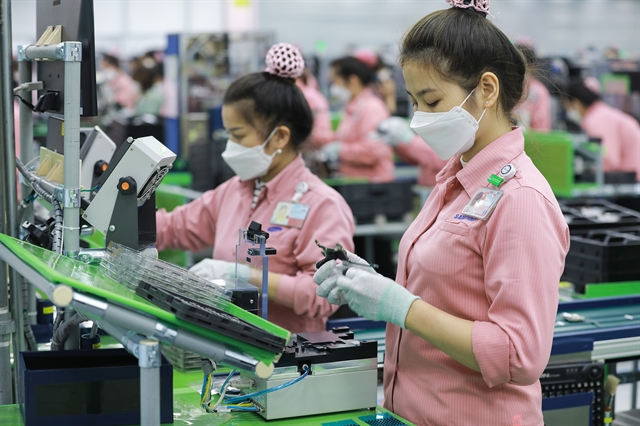 |
| Workers at a factory of Samsung Vietnam. Việt Nam has become a critical manufacturing hub for electronics, with companies like Samsung, Intel, LG and Foxconn now anchoring large-scale supply chains in the country. Photo courtesy of the firm |
These sectors have not only expanded in volume but have also penetrated global production networks. Việt Nam has become a critical manufacturing hub for electronics, with companies like Samsung, Intel, LG and Foxconn anchoring large-scale supply chains in the country.
The rising number of export categories surpassing the $10 billion threshold underscores Việt Nam’s evolution beyond low-cost assembly into a producer of sophisticated, deeply processed industrial goods.
Meanwhile, a network of free trade agreements has delivered substantial competitive advantages. Tariff preferences have enhanced the appeal of Vietnamese goods in key markets, while imports of machinery, inputs and technology have strengthened domestic manufacturing capacity.
.jpg) |
| Vietnamese high-quality OCOP products showcased at the 29th Artigiano International Handicraft Fair taking place at the Milan Exhibition Centre, Italy. VNA/VNS Photo |
A long road
Vietnamese firms have quickly adapted to cross-border e-commerce and data-driven supply chain management, opening new channels for online exports. Over 10,000 OCOP (One Commune, One Speciality Product) products – if upgraded in packaging, quality and digital readiness – could become strategic export lines, replicating the success of South Korea and Thailand in elevating their agricultural specialties.
In the last months of this year alone, trade turnover has surged past all previous projections. While the Ministry of Industry and Trade had expected total trade to reach roughly $800 billion for the year, the figure surpassed that level by mid-November.
Maintaining the current growth pace would place total trade for 2025 between $900 billion and $920 billion, and under favourable conditions, Việt Nam could even reach the $1 trillion benchmark.
Achieving this milestone would confirm Việt Nam’s status as a new manufacturing and export hub in Asia, further strengthening its ability to attract high-quality FDI in electronics, high-tech industries, green energy and logistics.
The near-$1 trillion moment stands in stark contrast to Việt Nam’s starting point. Four decades ago, the country’s total trade value was just around $1 billion, largely made up of rice, coffee, rubber, handicrafts and a limited selection of light industrial goods. Domestic production was fragmented, supply chains were almost nonexistent, and the concept of industrial exports had yet to take shape.
By the 1990s, as Việt Nam shifted to a socialist-oriented market economy, national trade statistics were gradually standardised. Though exports grew, they remained low compared with regional peers, dominated by agricultural and mineral products.
The real turning point came in the 2000s, when FDI capital began flowing strongly into Việt Nam, reshaping the industrial base and allowing local exporters to meet global standards.
In 2007, shortly after joining the WTO, Việt Nam surpassed the $100 billion trade milestone for the first time. By November that year, the total had reached $99.7 billion, and within days of December it crossed $100 billion, ending the year at $111.2 billion.
Despite the achievement, exports in 2007 were still primarily agricultural and low-value industrial goods. High-tech manufacturing had yet to emerge as a major driver.
Trade accelerated in the following years. Việt Nam hit the $200 billion mark in December 2011, reflecting the expansion of major FDI-powered industries such as electronics, textiles, footwear and food processing. The subsequent milestone of $300 billion was reached in November 2016, underscoring the growing technical and logistical demands of global competition.
Strong foundations
Viewed over the long term, Việt Nam’s trade journey resembles a parabolic curve: from $1 billion in the mid-1980s, to $100 billion in 2007, then rising steadily and now approaching the $1 trillion threshold.
The difference between the early years and today illustrates a profound economic reconfiguration – from exporting raw materials and basic goods to exporting advanced technology and deeply processed industrial products.
Today, high-tech goods make up over 70 per cent of total exports, showing that Việt Nam is not only expanding its trade volume but also climbing the global value chain.
Việt Nam has moved from a resource-dependent, low-income economy to a mid-industrial nation competing among the world’s major trading powers. Sustaining current momentum could usher in a new phase in which Việt Nam emerges as a modern, high-tech, export-driven economy capable of challenging the world’s largest manufacturing hubs.
With a dynamic growth model, Việt Nam is solidifying its position in regional and global supply chains. International institutions have increasingly revised their forecasts upward. Singapore’s UOB recently raised Việt Nam’s 2025 GDP growth projection from 7.5 per cent to 7.7 per cent, citing robust trade activity and strengthening industrial output.
According to UOB, Việt Nam will play an increasingly important role internationally over the next decade. Sustained growth is enhancing the country’s position as a key node in regional and global production networks, especially in manufacturing and emerging technologies.
As an active ASEAN member, Việt Nam is expected to contribute further to regional stability and economic cooperation, with its extensive free trade network and strategic geographic location providing strong advantages in global trade discussions.
“The manufacturing sector is expanding, and trade scale is rising. Việt Nam cannot continue selling cheap. We must move toward value creation, supply chain innovation and building a national brand,” said Võ Trí Thành, PhD, director of the Institute for Brand and Competitiveness Strategy.
He added that Việt Nam’s fundamentals remained strong thanks to steady industrial growth, increased FDI inflows into electronics and semiconductors, and new opportunities from free trade. However, the next stage of development would require deeper processing in agriculture and fisheries, greater investment in R&D, stronger branding efforts, and compliance with green standards in industrial production.
As trade expands, Vietnamese exporters would also face more trade-remedy measures from importing markets. Businesses must therefore remain proactive in adapting to global shifts, maximising the advantages of open trade while minimising risks. — VNS
Economy
 Economy
 Economy
 Economy
 Economy
 Economy
 Economy
 Economy
 Economy
 Economy
 Economy
 Economy
 Economy
 Economy
 Economy