 World

Vietnam International Awards marks fifth anniversary with landmark honours
1.
 |
| A Hà Nội-based member university of the UK-Viet Nam EmpowerTNE network established by the British Council. — VNA/VNS Photo |
MANILA — In an age when AI can design degree curricula, answer almost any question and do entry-level jobs, how can higher education stay relevant and help students find employment? Flexible programmes with industry involvement and the retention of ‘human skills’ might be the answers.
Representatives of Southeast Asian and British universities discussed these key points last week during the inaugural ASEAN-UK Higher Education Week in Manila, which aimed to advance higher education cooperation between the bloc and the UK.
With the overarching question, ‘Are our universities ready for 2035?’, a panel discussion prompted academics to think about the future of the partnership and how they should prepare students for a job market where AI is their direct competitor.
According to Paul Rowe, director of international partnerships at the University of Lancashire, with AI’s ability to design curricula and give study reminders, universities can only stay relevant if they can provide flexible, agile modules that allow students to study in different ways than in traditional classrooms.
"The curricula need to move quickly," he said. "Agility is the biggest problem for us as universities."
Rowe added that in transnational education, a model in which students in one country study and receive qualifications from an institution in another without relocating abroad, slow validation and quality-assurance processes are making it impossible for universities to be agile.
“There are programmes that we asked most of the partnered universities to deliver overseas,” he said.
“However, by the time we’ve got that programme validated, our industry partners say the curriculum needs amending immediately.”
This means that for the partnerships to be more efficient, overseas branch campuses and models must be given a lot more autonomy in developing curricula and programmes, Rowe said.
Dr Thakerng Wongsirichot, vice president for academic and international affairs at Thailand’s Prince of Songkla University, suggested a 'sandbox' alternative that has been implemented in Thailand, in which universities collaborate with industry partners to design the study programme, with plans for internships and post-graduation employment, then evaluate how they can improve it.
“We look at the learning outcomes and everything, and we say, 'Okay, within three years, in collaboration with the industry, how can we produce better [graduates]?'," said Wongsirichot. “We tried many programmes many times.”
The Hồ Chí Minh City University of Technology in Việt Nam has carried out a similar initiative, which recognises what students learn on the job as ‘micro-credentials’, according to Associate Professor Lại Quốc Đạt, head of the university’s external relations department.
“Over the course of eight semesters, we send students to the industry for at least one (six months),” he said.
“After this semester, if they can reach some of the learning outcomes, we recognise it by giving them micro-credentials that can make up the credits they need to pass the module."
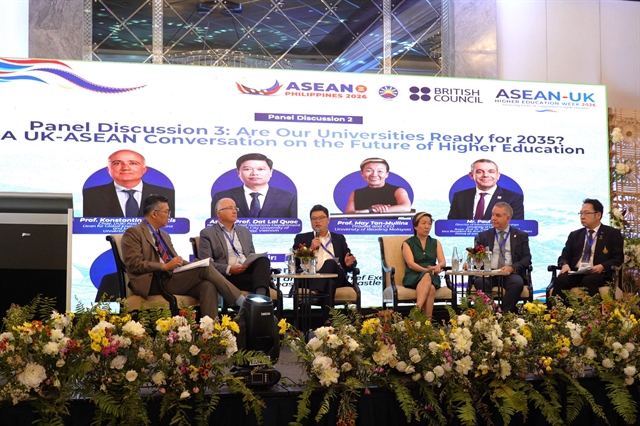 |
| Associate Professor Lại Quốc Đạt, head of Hồ Chí Minh City University of Technology’s external relations department, speaks at a panel discussion on the future of higher education cooperation between ASEAN and the UK, held as part of the ASEAN-UK Higher Education Week in Manila, the Philippines, on November 3-4. — VNS Photo Bảo Hoa |
‘Human’ skills retention
As AI becomes a tool to boost productivity, Professor May Tan-Mullins, provost at the University of Reading Malaysia, found that employers' expectations of graduates have changed 'tremendously'.
"There's a huge challenge for graduates at entry level to find jobs because employers have started to think, 'AI can do everything for me. Why do I need these fresh graduates?'" she said.
Industry leaders often gave 'very clear and very simple answers' about what they look for when hiring fresh graduates, she added.
"They want students who can communicate and not stare at AI and try to find AI answers," she said.
"Because at the end of the day, a lot in business, we need in-person engagement,” she added, stressing that such engagements are crucial to build relationships, trust and collaboration.
“Employers are really looking for, despite this AI technology, students who are confident, who can talk, who can communicate and who have other soft skills or life skills,” she said.
Wrapping up the discussion, Professor Dato' Elizabeth Lee, chief executive officer of Malaysia's Sunway Education Group, pointed out that many of the jobs graduates will hold in 2035 have yet to be created, and the skills they require will continue to evolve throughout their careers.
This means that universities can no longer define success by enrolment numbers, rankings or graduation rates but by graduate outcomes, which they can only achieve by collaborating more deeply with industries, she said.
“Universities must get off our high horses and truly work with industry, not just appoint adjunct professors and industry advisors, but to actually work furiously with them to inform curriculum design and to involve and immerse our students in experiential learning,” Lee said.
She added that employers must also invest in internships, apprenticeships, work-integrated learning and lifelong upskilling, and governments must create enabling policies to encourage these collaborations.
"The future workforce is a shared responsibility," she said.
Strengthening sustainable academic links through transnational education is among the priorities of the Plan of Action to implement the ASEAN-UK Dialogue Partnership from 2027 to 2031, adopted by UK Foreign Secretary Ed Miliband and ASEAN foreign ministers on July 22.
In 2024, the UK launched the Chevening ASEAN Scholarship Programme, which gives individuals from ASEAN member states the opportunity to pursue a one-year master’s degree in the UK, and the ASEAN-UK SAGE Women in STEM Scholarships, which aim to address gender disparities in access to science, technology, engineering and mathematics education and careers across ASEAN. — VNS
World
 World
 World
 World
 World
.jpg) World
 World
 World
 World
 World
 World
 World
 World
 World
 World