 Sci-Tech

Understanding skin ageing key to more effective rejuvenation, dermatologist says
1.
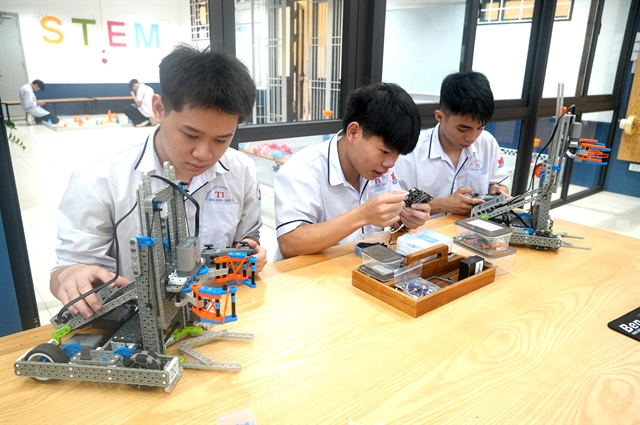 |
| Students at the Lam Sơn High School for Gifted Students are thrilled to participate in assembling robots and programming them to move in the school's STEM room. — VNA/VNS Photo Khiếu Tư |
THANH HÓA — Implementing the Politburo’s Resolution No. 71-NQ/TW on breakthroughs in education and training development, investment in modern teaching infrastructure linked to innovation has become an urgent requirement.
In that context, two STEM classrooms were launched last year at Lam Sơn High School for Gifted Students and Hàm Rồng High School in Thanh Hóa Province by the Việt Nam National Industry – Energy Group, opening a new approach to education and realising the goal of building a modern and humane learning environment for the future.
Promoting creation
The STEM classrooms are designed in a cohesive and flexible manner, integrating advanced technology to create open spaces where students can research, experiment and develop interdisciplinary science projects.
As a result, learning is no longer confined to theory but is closely tied to practice, fostering creative thinking and problem-solving skills – core competencies in the digital age.
At Lam Sơn High School for Gifted Students, the STEM classroom was invested in with a total budget of VNĐ3.3 billion (US$125,300).
Immediately after receipt, the school organised training for teachers of physics, chemistry, biology, informatics and technology.
It also disseminated the model to all other teachers to prepare for integrated teaching.
To date, around 350 students from grades 10, 11 and 12 have experienced the STEM room, including 10 students participating in weekly regular practice through the STEM Club.
In informatics, students apply Python and C++ programming knowledge to control autonomous robots, assemble robots, join school-level robotics competitions and build smart home models with facial recognition technology.
Three-dimensional (3D) design and printing are also effectively conducted, yielding creative products such as school logos and souvenirs for international exchange programmes.
Beyond technology, the STEM room supports students in conducting physics experiments such as measuring energy, wind and pH levels, contributing to enhancing scientific research skills.
Extracurricular activities are vigorously promoted, exemplified by the Road to Lam Sơn programme with a robotics competition held on March 26 this year, creating a beneficial playground that ignites students' passion for science.
For the first time participating and winning second place in the national science and technology competition, Mai Hoàng Đăng Sơn, a 12th grader, said the STEM classroom was immensely helpful for his practical project, enabling him to achieve a high prize in the recent competition.
In daily studies, Sơn and his friends in the school's STEM Club access modern equipment that makes knowledge more intuitive and easier to understand.
Also in the group of two students who won second place in the recent national science and technology competition, with the goal of studying engineering at Hà Nội University of Science and Technology, Lại Quốc Khánh is equally enthusiastic about experiencing the equipment and technology in the STEM classroom.
“Gaining early access to technology and engineering will help me tremendously in my future direction,” he said.
According to Hoàng Thị Thu Hằng, an informatics teacher at the school, the STEM classroom not only provides a modern learning space but also ignites the aspiration for innovation among teachers and students.
The investment is timely, especially in the context of implementing the 2018 General Education Programme and accelerating digital transformation.
Since coming into operation, the school has organised various club-based learning models on diverse themes such as robots, smart homes, smart agriculture, energy experiments and health monitoring devices.
Students not only learn knowledge but also develop practical skills and creative thinking.
However, operations still face certain limitations. Some high-tech equipment has not been fully exploited due to a lack of in-depth training; developing integrated teaching themes takes considerable time and lacks specific guidance materials. Additionally, financial mechanisms, maintenance and public asset management still face hurdles.
The school recommends that the Ministry of Education and Training promptly issue specific guidelines on teaching hour norms and STEM product evaluation criteria.
Educational innovation
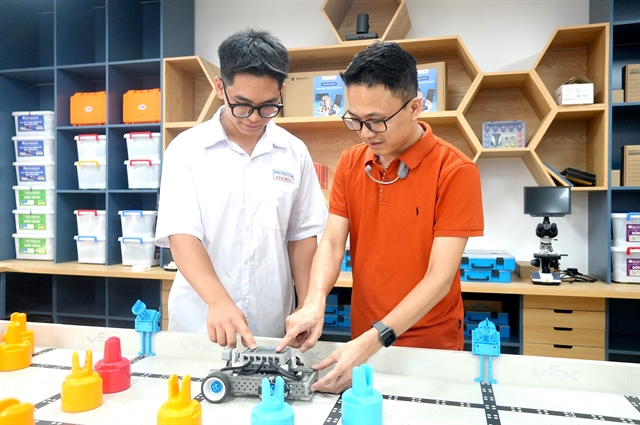 |
| Students at Hàm Rồng High School are eager to learn in a modern environment where they can explore, experiment and create. — VNA/VNS Photo Khiếu Tư |
The Hàm Rồng High School also received investment in a modern STEM classroom last year. The facility is designed to international standards, meeting requirements for interdisciplinary teaching, practice and scientific research.
The classroom is equipped with advanced devices such as an 86-inch interactive screen, an online conferencing system, AI-IoT programming computers, VEX robots, 3D printers, CNC cutters and experiment kits on energy and environment.
A digital learning resource system and modern classroom management tools are also integrated, creating a comprehensive learning environment.
This model aims to build an intuitive learning space where students directly engage in robot programming, 3D simulations, product design and experiments, thereby developing scientific and engineering thinking alongside creativity in a holistic manner.
Hoàng Đức Minh, a 12th grader, said the STEM classroom helped him realise ideas during regular class time, leading to deeper understanding and a clearer appreciation of how knowledge is applied.
Many other students also expressed excitement about studying in this modern environment, where they can explore, experiment and create.
According to Lê Nhất Trường Tuấn, a physics teacher, in the current context of educational reform, developing STEM education is an inevitable trend.
The modern classroom has helped shift teaching methods from knowledge transmission towards an emphasis on practice, experience and student-centred approaches.
Assessing initial effectiveness, Trịnh Trọng Nam, head of the General Education Division under the Thanh Hóa Province's Department of Education and Training, said the introduction of STEM classrooms has created positive changes in teaching methods, linking theory with practice and supporting students' comprehensive competency development.
This is a model that needs further refinement and scaling in the coming time.
To maximise its effectiveness, the department has prioritised integrating STEM education into teaching as a key task, requiring schools to proactively incorporate it into the core curriculum and experiential activities.
Alongside this, teacher training is being strengthened through specialised workshops, encouraging innovative teaching methods and enhancing STEM activity organisation skills.
The department encourages schools to organise STEM Day and academic playgrounds while creating conditions for students to participate in science and technology competitions at various levels.
These are important channels for students to showcase creative ideas, hone research skills and strengthen their ability to apply knowledge in practice.
Moreover, innovating student assessment towards a stronger focus on products, projects and practical skills, combined with greater application of digital technology in teaching, is gradually improving effectiveness.
Thus, STEM education is not merely a pilot model but a key driver of fundamental and comprehensive educational reform.
It can be affirmed that investing in and operating STEM classrooms in Thanh Hóa has yielded positive results, forming a modern, creative and experience-rich learning environment.
In the context of deepening digital transformation and international integration, this will be a crucial foundation for training high-quality human resources, meeting the sustainable development needs of both the locality and the nation. — VNS
Sci-Tech
 Sci-Tech
 Sci-Tech
 Sci-Tech
 Sci-Tech
 Sci-Tech
 Sci-Tech
 Sci-Tech
 Sci-Tech
 Sci-Tech
 Sci-Tech
 Sci-Tech
 Sci-Tech
 Sci-Tech
 Sci-Tech