 Society

AITO Looks Ahead to Europe, Building a Thriving Automotive Ecosystem
1.
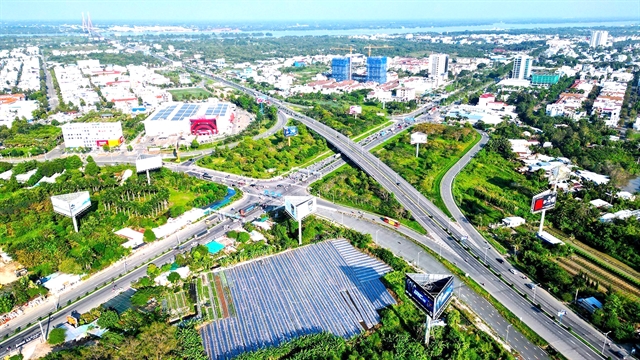 |
| The expressway connects National Highway 1A to Vĩnh Long Province. — VNA/VNS Photo Tuấn Anh |
Thu Trang
HÀ NỘI — Expressway systems have become the backbone of national transport, contributing to socio-economic development and strengthening regional connectivity.
However, alongside the rapid growth come significant challenges in operational management, safety assurance, and sustainable exploitation.
In the context of deep international integration, experts agree that learning from countries with developed transportation systems is an urgent requirement to improve governance quality and gradually build a safe, intelligent and sustainable expressway system for Việt Nam.
Strengthen management
The scientific workshop 'International experience in expressway management, operation, exploitation and proposals for application in Việt Nam' was organised recently by the Department for Roads of Việt Nam (DRVN), in coordination with the Hà Nội University of Civil Engineering (HUCE), as a forum for specialists in the sector to share their view.
Speaking at the event, Nguyễn Thanh Hoài, Deputy Director of the Department for Roads of Việt Nam (DRVN), stated that Việt Nam’s expressway network had become an economic and social development driver.
“But rapid expansion brings obstacles in safety, operational organisation and management,” he said.
The 2024 Law on Roads and its guiding decrees have established a new legal framework, shifting the focus from administrative management to a governance model based on standardised processes and digital data exploitation.
“This is an important transition, laying the foundation to improve efficiency and transparency in state management,” Hoài said.
“Standardising traffic safety management is a prerequisite. It is necessary to strengthen site inspections, risk assessments, identify black spots and potential safety hazards, then promptly address them.
"Each expressway must have an updated safety dossier that accurately reflects structural conditions and actual operational needs,” said Hoài.
Working towards intelligent operational management, the DRVN is implementing a shared data platform that connects information from management zones, toll stations, surveillance cameras, and sensors. This system helps monitor, detect incidents and make faster, more accurate decisions.
The DRVN sets four main directions: standardising traffic safety management; aiming for smart management based on shared data and the Internet of Things (IoT); building a safe and humane traffic culture; and strengthening maintenance management with accountability linked to investment efficiency.
 |
| Transport specialists gather at the scientific workshop 'International experience in expressway management, operation, exploitation and proposals for application in Việt Nam'. — VNS Photo Thu Trang |
Nguyễn Tiến Hồng, Deputy Head of the Traffic Management and Organisation Division under the DRVN, believes the expressway system was helping to reduce congestion on national highways, shorten travel time and cut logistics costs.
However, with an average annual traffic growth rate of 15–18 per cent, and over 30 per cent in some areas, new difficulties came.
Notably, localised congestion frequently occurs at major urban entry and exit points, toll booths and intersections with national highways, while the intelligent transportation system is yet to be deployed comprehensively.
Hồng said: "A unified institutional framework and technical infrastructure among management, operation, investment and supervision entities is needed to meet the rapid, safe and sustainable development requirements of Việt Nam's expressway network for the 2026–2035 period."
Also at the event, Associate Professor Hoàng Tùng, Principal of HUCE, stated that Việt Nam's transport infrastructure has made significant progress, particularly with the expressway network reaching nearly 3,000km by the end of this year and targeting 5,000km by 2030.
In this development flow, it is required that the administration and operation of expressways must achieve the criteria of 'safety – intelligence – sustainability'.
"It demands innovation in operational organisation, maintenance and work methods to modernise the transport system," he said.
Tùng emphasised that besides training and research, the university desires to collaborate with the DRVN and enterprises to assess realities and propose technology transfer solutions.
Notably, the HUCE participates in developing handbooks, basic standards, and eventually national standards for road construction management and exploitation.
International experience
Engineer Nguyễn Tiến Huy from the Việt Nam Traffic Safety Association analysed the US and China’s expressway signage systems, identifying clear differences from the one used currently in Việt Nam.
He noted that Việt Nam’s signage lacked uniformity, had low information recognition capability and insufficient support for drivers.
He proposed amending national technical regulation QCVN 41:2024/BGTVT on road signage, developing handbooks to shape expressway signage and line marking systems and implementing specialised training for traffic safety design and inspection.
From another angle, Associate Professor Vũ Hoài Nam from the HUCE analysed the UK's Smart Motorway model – an intelligent expressway integrated with advanced technology to optimise traffic flow.
The model utilises solutions such as Dynamic Hard Shoulder – an emergency lane that opens during peak congestion - and All Lane Running, which removes emergency lanes to open all lanes for traffic, replaced by refuge areas approximately 2.5km apart, thereby increasing capacity without requiring road widening.
Nam said that removing emergency lanes may increase collision risks if vehicles break down and recommended selective application in urban areas, especially given land and financial constraints.
Standardising processes
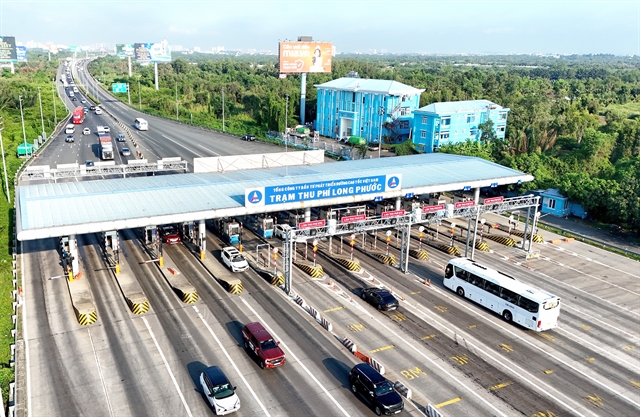 |
| A toll booth on the HCM City-Long Thành-Dầu Giây expressway. — VNA/VNS Photo Hồng Đạt |
From practical operation experience, Nguyễn Tiến Hồng from the DRVN emphasised that the key issue now was no longer construction but efficient operation management.
He proposed standardising operational processes, applying performance management models, promoting digital transformation and integrating nationwide traffic data.
The focus is on the mechanism of 'proactive safety, data-driven governance and performance based on outcomes', aiming for a modern, humane and sustainable traffic network by 2050.
Sharing the human-centred viewpoint, Trịnh Quang Mộng from the Hà Nội-Hải Phòng Expressway Management Company said: "Absolute safety must be the core value of all infrastructure policies."
Mộng suggested building a National Expressway Operation Centre that applies big data, artificial intelligence (AI), early-warning systems, and intelligent monitoring.
He also recommended institutional reforms to increase enterprise autonomy and apply a penalty points system for driving behaviour.
From a business perspective, Lê Châu Thắng, Deputy General Director of the Đèo Cả Group, presented the use of unmanned aerial vehicles (UAVs) for expressway operation management.
Thắng said that UAVs could automatically collect image data, create three-dimension (3D) digital maps, detect structural damages, landslides as well as safety risks, and integrate with the Digital Twin models for real-time maintenance decisions.
“This is a strategic step in the digital transformation of transport infrastructure management,” he said.
Regarding technology management, Nguyễn Thị Thu Ngà from the University of Transport Technology proposed key performance indicators (KPIs) including technical-infrastructure, operational efficiency, safety-risk and experience-sustainability groups.
Ngà noted that with Việt Nam’s road network exceeding 3,000km of expressways and targeting 5,000km by 2030 and over 9,000km thereafter, management, operation, exploitation and safety assurance must shift from condition-based maintenance to performance-based management, following advanced models from South Korea, Japan, the US and Europe.
As for toll collections, Associate Professor Đinh Văn Hiệp from the HUCE assessed that the electronic toll collection system had helped reduce station passing time and increase transparency.
However, he pointed out limitations like congestion risks with increasing traffic volumes. The report proposed upgrading the system for interconnectivity with urban areas and discussed legal aspects of technology transition.
Experts believe that sustainable development of the expressway system must be associated with investment efficiency, maintenance work needs to be considered as part of the project's lifecycle and management units and investors must take long-term responsibility for the quality of the works and exploitation effectiveness. — VNS
Society
 Society
 Society
 Society
 Society
 Society
 Society
 Society
 Society
 Society
 Society
 Society
 Society
 Society
 Society