 Politics & Law
Vietnamese community in China urged to stay united, contribute to homeland
1.
|
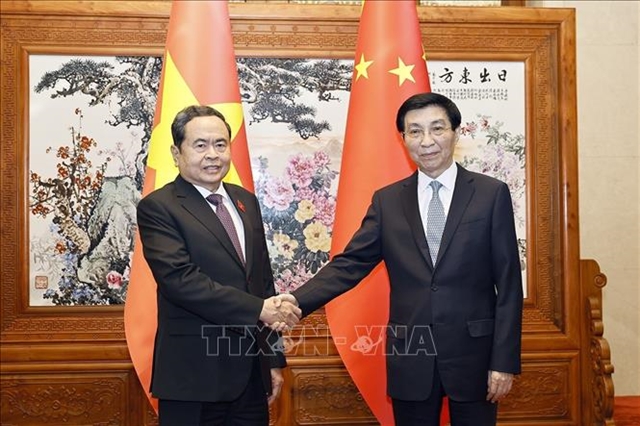
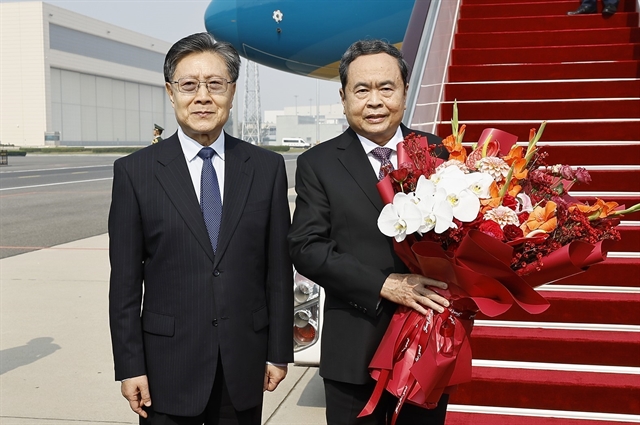
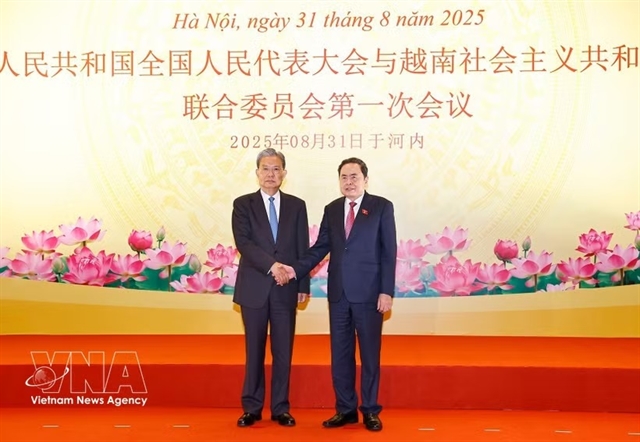
| National Assembly President Trần Thanh Mẫn (left) meets with Wang Huning, Chairman of the National Committee of the Chinese People's Political Consultative Conference, in Beijing on Sunday. — VNA/VNS Photo Doãn Tấn |
HÀ NỘI — National Assembly (NA) President Trần Thanh Mẫn has called on Việt Nam and China to promote the key roles of the Việt Nam Fatherland Front Central Committee and the National Committee of the Chinese People’s Political Consultative Conference (CPPCC) in consolidating public support for bilateral ties, stepping up exchanges and enhancing public awareness of the Việt Nam-China friendship.
He made the remarks during a meeting with Wang Huning, member of the Standing Committee of the Political Bureau of the Communist Party of China Central Committee and chairman of the National Committee of the CPPCC, at the Great Hall of the People in Beijing on Sunday afternoon.
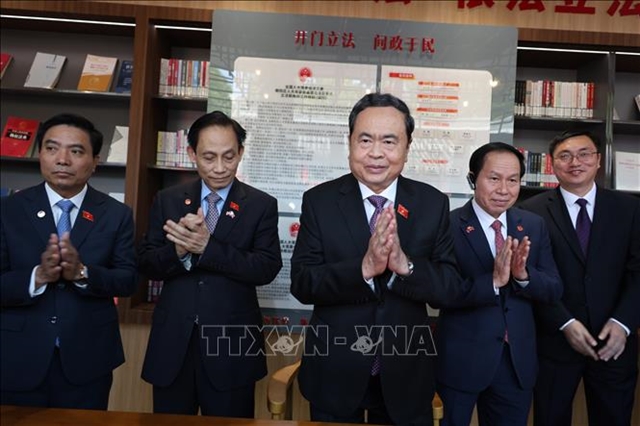
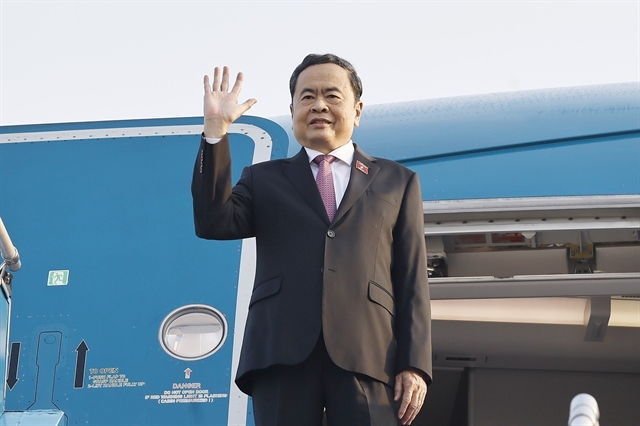
The meeting took place during Mẫn’s official visit to China, where he is also co-chairing the second meeting of the cooperation committee between the Vietnamese National Assembly and the National People’s Congress of China.
To further strengthen the political, material and social foundations of relations between the two Parties and countries, Mẫn called for continued high-level and other exchanges, stronger defence and security cooperation, and mutual support for national development and the elevation of the two countries’ international standing.
He also urged both sides to effectively implement cooperation in trade, investment and economic affairs, strengthen connectivity and deliver tangible benefits to the two peoples.
Priorities include accelerating the development of railway links between the two countries and international rail transport services, further opening the Chinese market to Vietnamese agricultural products, achieving more visible progress in science and technology cooperation and carrying out the Việt Nam-China Year of Tourism Cooperation.
For his part, Wang agreed with Mẫn’s proposals, calling for coordinated efforts to advance cooperation across all channels and at all levels and effectively carry out plans for high-level exchanges.
He also stressed the importance of making full use of the 3+3 strategic dialogue mechanism involving foreign affairs, defence and public security, as well as the bilateral cooperation steering committee.
Wang called for stronger exchanges of theoretical perspectives and experience in Party building and national governance, closer alignment of the two countries’ high-quality development strategies and faster progress on railway connectivity projects.
He also urged the two sides to make early, tangible progress in trade, investment, smart border gates, cross-border economic cooperation zones, science and technology, artificial intelligence, the digital economy and the green economy.
Wang confirmed that China was ready to facilitate further imports of Vietnamese agricultural products and support Chinese businesses in expanding investment in Việt Nam.
He also expressed his appreciation for Mẫn’s significant contributions to friendly cooperation between the CPPCC National Committee and the Việt Nam Fatherland Front Central Committee.
Wang said the CPPCC attached great importance to and supported friendly exchanges between people from all walks of life in the two countries, particularly younger generations, calling for the effective implementation of people-to-people exchange programmes, including the Red Journey initiative, and for the successful organisation of the China-Việt Nam Year of Tourism Cooperation.
The Chinese leader also encouraged broader cooperation in tourism, education and culture, as well as exchanges between localities.
Both sides agreed to strengthen multilateral coordination and support each other in successfully hosting the Asia-Pacific Economic Cooperation (APEC) forum in 2026 and 2027. They also agreed to better manage and resolve differences, contributing to peace and stability at sea and in the region.
During the meeting, Mẫn conveyed congratulations from Party General Secretary and State President Tô Lâm and other senior Vietnamese leaders on the 77th anniversary of the founding of the People’s Republic of China on October 1.
He also congratulated China on its major achievements in reform and national modernisation, highlighting the important contributions of the CPPCC.
Mẫn expressed confidence that, under the leadership of the Communist Party of China Central Committee, with General Secretary and President Xi Jinping at its core, China would achieve its goal of building a modern socialist country that is prosperous, strong, democratic and culturally advanced, while contributing positively to shared development in the region and the world.
Wang conveyed his cordial greetings to Lâm and other key Vietnamese leaders, congratulated Việt Nam on its significant theoretical and practical achievements, and said these reflected the vitality and bright prospects of the country’s socialist development.
He reaffirmed China’s support for Việt Nam in achieving its development goals in the new era.
Wang welcomed Mẫn and the high-level Vietnamese delegation, saying their visit would help translate the top leaders’ shared understandings into effective cooperation.
He reaffirmed that China attached great importance to relations with Việt Nam and stood ready to work in line with high-level consensus and the guiding principle of 'six mores' to advance the continued development of the Việt Nam-China Community with a Shared Future.
The 'six mores' refer to six main goals for Việt Nam-China relations: greater mutual trust, stronger security cooperation, deeper practical cooperation, a broader public support base, tighter multilateral coordination and cooperation, and better management and resolution of differences. — VNS
Politics & Law
 Politics & Law
 Politics & Law
 Politics & Law
 Politics & Law
 Politics & Law
 Politics & Law
 Politics & Law
 Politics & Law
 Politics & Law
 Politics & Law
 Politics & Law
 Politics & Law
 Politics & Law
 Politics & Law