 Politics & Law
Viên dives again to popularise swimming passion
1.
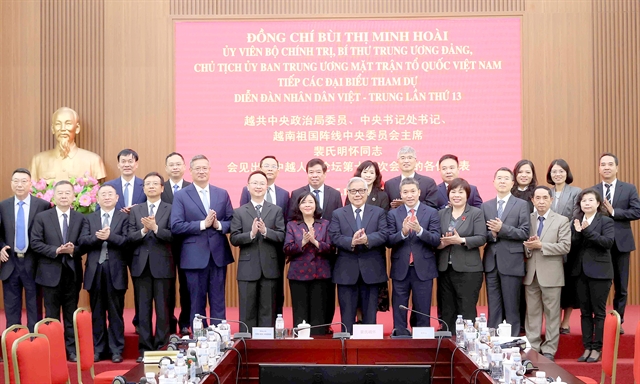 |
| Bùi Thị Minh Hoài (centre), president of the Central Committee of the Việt Nam Fatherland Front receives delegates attending the 13th Việt Nam-China People's Forum in November 2025. — VNA/VNS Photo An Đăng |
Nguyễn Hằng
HÀ NỘI — As Việt Nam enters a new phase of national development, diplomacy is being asked to reach deeper into societies, connect communities and turn goodwill between peoples into practical cooperation.
Led by the Việt Nam Union of Friendship Organisations (VUFO) under the Việt Nam Fatherland Front Central Committee, people-to-people diplomacy forms one of the three pillars of Việt Nam’s comprehensive diplomacy, alongside Party and State diplomacy.
In the new context, these channels are expected to reinforce each other, creating a stronger collective force in advancing the country’s foreign policy objectives.
The 14th National Congress of the Communist Party of Việt Nam in January 2026 underscored the need to “enhance the role of Party diplomacy, State diplomacy and people-to-people diplomacy” in creating a peaceful, stable, friendly and cooperative environment conducive to national development.
According to Đinh Công Sỹ, deputy chairman of the Committee on National Defence, Security and External Relations of the National Assembly (NA), the three pillars have their own positions and methods, but share a common strategic purpose of safeguarding national interests, maintaining a favourable international environment and contributing to national development and defence.
Within that broader framework, parliamentary diplomacy occupies a distinctive position. Through exchanges involving NA leaders and agencies, parliamentary friendship groups and multilateral parliamentary mechanisms, it helps strengthen political trust, deepen mutual understanding and develop legal and institutional frameworks for international cooperation and integration. People-to-people diplomacy brings a different but complementary strength.
While parliamentary diplomacy benefits from political standing and institutional representation, people-to-people diplomacy works more directly at the social level, nurturing affection, understanding and trust among peoples and building the social foundations for long-term relations between Việt Nam and other countries. The two channels, therefore, can reinforce one another.
“International commitments can only be effectively implemented in practice with the consensus and support of the people, while friendship between peoples becomes more sustainable when translated into concrete mechanisms of cooperation and appropriate policy and legal frameworks,” Sỹ said.
Strategic connection
The need for closer coordination is becoming more pronounced as strategic competition, conflicts, security challenges and economic volatility reshape the international environment.
For Việt Nam, diplomacy must therefore be closely linked with national defence, security and socio-economic development, while mobilising external resources to maintain peace and a favourable environment for development.
The implementation of Party and NA resolutions such as Resolution 6 on implementing the Party’s foreign policy orientations, Resolution 59 on international integration and Resolution 250 on specific policies for such integration has further highlighted the need to mobilise the strength of the entire political system and society for external relations.
Sỹ said coordination between parliamentary diplomacy and people-to-people diplomacy should move beyond individual activities towards regular, strategic and substantive cooperation.
Deputy Foreign Minister Ngô Lê Văn similarly stressed the importance of implementing diplomacy in a coordinated manner, while allowing each channel to maximise its distinctive strengths.
“People-to-people diplomacy plays an important role in nurturing mutual understanding, trust and friendship among peoples, thereby creating a social foundation for the country’s external relations,” Văn said.
He highlighted VUFO’s contribution to strengthening friendship and trust, expanding networks of international partners, mobilising international support for national development and defence, and connecting international non-governmental resources with development needs.
VUFO’s work with foreign non-governmental organisations (NGOs) has also evolved from aid mobilisation towards development partnerships, contributing to social welfare.
In a rapidly changing world, such social connections can have significance beyond cultural exchange. When state-to-state relations face new pressures, dialogue among peoples can help preserve communication, reinforce trust and keep channels of cooperation open.
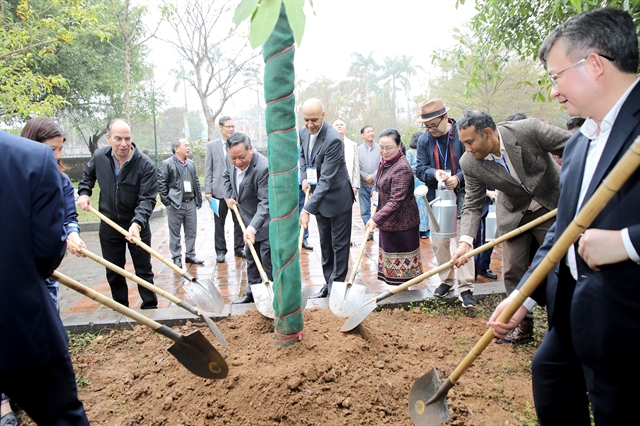 |
| Ambassadors and delegates plant a commemorative tree at Hai Bà Trưng Temple in Hà Nội as part of a friendship spring tour organised by the Hà Nội Union of Friendship Organisations in 2025. — VNA/VNS Photo Tuấn Việt |
Systematic cooperation
The next step is to turn this complementarity into systematic cooperation. Sỹ proposed that NA agencies and VUFO establish more regular mechanisms for consultation and information sharing, including exchanges on international partners, people’s organisations, foreign NGOs, intellectuals and individuals with positive sentiments towards Việt Nam.
Such exchanges could help identify emerging opportunities and potential partners while allowing the two sides to share experiences in addressing international and domestic issues relevant to external relations.
He also called for closer coordination around NA leaders’ and agencies’ overseas visits, including people-to-people exchanges and connections among parliamentarians, intellectuals, businesses, young people and social organisations.
The aim, he said, should be to link people-to-people exchanges with economic, cultural and educational diplomacy, as well as science, technology and innovation, creating more opportunities for practical cooperation.
Digital platforms offer another increasingly important space. Việt Nam’s image as a peaceful, dynamic, open and developing country can be communicated through multilingual content and new forms of digital engagement, particularly to younger generations.
The Vietnamese community abroad represents another bridge. Sỹ stressed the importance of mobilising the resources of overseas Vietnamese, listening to their aspirations and recommendations, and contributing to policies concerning nationality, economic and trade cooperation and citizen protection.
Such efforts can help overseas Vietnamese feel more secure in their lives and work while strengthening their connections with their homeland and their role as bridges between Việt Nam and other countries.
Văn proposed six areas for closer coordination between the ministry and VUFO. They include earlier coordination in major external-relations programmes; stronger international friendship networks with greater youth participation; closer research and strategic forecasting; linking friendship with cooperation in science and technology, education, digital transformation and the green transition; better coordination on foreign NGOs; and joint training and professional exchanges, particularly for younger officials.
Together, these areas point towards a shift in the way people-to-people diplomacy is viewed, not simply as a supporting activity after high-level diplomacy has taken place, but as a channel that can help sustain, broaden and translate diplomatic relationships into social and developmental connections.
A broader network
For VUFO, the shift is reflected in its 2026-31 plans. VUFO President Phan Anh Sơn said the organisation and its members would continue to play a core role in people-to-people diplomacy while working closely with Party and State diplomacy to fulfil the tasks set for the new term.
The union aims to develop 30-50 organisational and 50 individual partners annually, expand into three to five new international forums, and connect three to five pairs of Vietnamese and foreign localities and 15-20 overseas partners each year.
By 2030, it plans to organise three to five major international people-to-people exchange events and expand cooperation into trade, investment, science and technology.
Beyond these targets, VUFO plans to deepen international partnerships, strengthen multilateral engagement, mobilise international resources for development, enhance the role of overseas Vietnamese as bridges, modernise external communications and strengthen research and strategic advice on global and regional affairs.
The direction reflects a broader understanding of diplomatic strength. High-level meetings can open doors; parliamentary exchanges can build political and institutional connections; and government-to-government relations can establish frameworks for cooperation.
But relationships become more resilient when they are carried into universities, communities, businesses, localities, cultural institutions and civil society. That is the space where people-to-people diplomacy can make its distinctive contribution.
The strength of Vietnamese diplomacy, as Sỹ put it, ultimately comes from the alignment of objectives, coordinated action and mutual reinforcement among its different channels. — VNS
Politics & Law
 Politics & Law
 Politics & Law
 Politics & Law
 Politics & Law
 Politics & Law
 Politics & Law
 Politics & Law
 Politics & Law
 Politics & Law
 Politics & Law
 Politics & Law
 Politics & Law
 Politics & Law
 Politics & Law