 Politics & Law
European higher education week opens new opportunities
1.
|
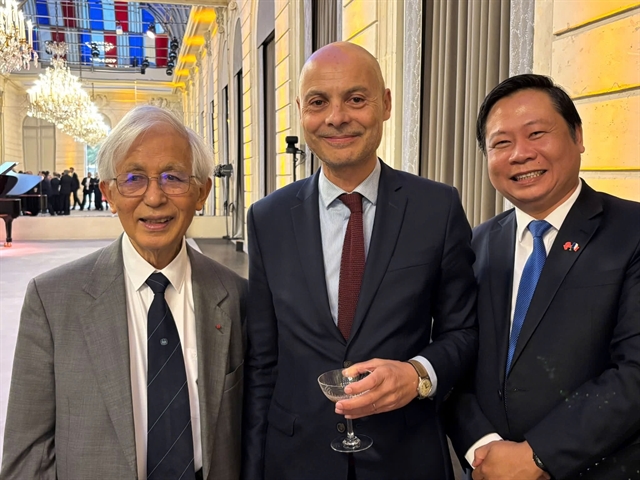
| Professor Trần Thanh Vân (first from left) met French Ambassador to Việt Nam Didier Le Bret (middle) at the state banquet hosted by French President Emmanuel Macron for General Secretary and President Tô Lâm at the Élysée Palace on September 10, 2026. — Photo courtesy of ICISE |
GIA LAI — The Quy Nhơn Dialogue on Climate and Transition taking place in the southern province of Gia Lai this weekend is inspired by the Shangri-La Dialogue format of in-depth discussions instead of negotiating communiqués, said French Ambassador to Việt Nam Didier Le Bret.
Themed 'Transitions Under Pressure: Energy Security, Financial Transformation and Climate Resilience,' the dialogue was developed by Rencontres du Vietnam and will be hosted by International Centre for Interdisciplinary Science and Education (ICISE), with the support of French Development Agency (AFD) as a founding partner, under the high patronage of the Vietnamese Ministry of Science and Technology and the People's Committee of Gia Lai Province.
The founding forum on October 10-11 will bring together around 100 participants from Việt Nam, Southeast Asia and international partner countries and institutions from Asia, Europe, Africa and Latin America to exchange on policy options, financing approaches and coalitions that can support a decisive second decade of climate action.
In an interview with the Viet Nam News Agency ahead of the dialogue, Ambassador Le Bret said Southeast Asia is one of the world's most dynamic regions and one of the most exposed to climate change. More than in many other regions, growth, security and the transition are closely interconnected.
The fact that the dialogue is being established in Việt Nam is highly significant as the country fully embraces its role as a host and as a bridge between Southeast Asia and the rest of the world. The Quy Nhơn Dialogue is also first and foremost a Vietnamese and regional initiative, he said.
France will bring its networks of researchers, universities, financial institutions and European partners, who are expected to become long-term participants in the dialogue, he said.
Researchers and policymakers must meet early and regularly, before decisions are finalised. This is the spirit of the Quy Nhơn Dialogue, which connects scientists, decision-makers and analysts specialising in energy and social systems together in one place, Ambassador Le Bret said.
The dialogue will combine three main types of sessions with high-level plenaries, parallel strategic dialogues, technical and action-oriented workshops.
It will also have closed-door exchanges, informal dinners and coalition-building moments.
Ambassador Le Bret emphasised that scientific knowledge must be translated into practical tools that policymakers can use, including climate-related economic policy scenarios, long-term investment frameworks and green public financial management. These are precisely among the topics on the dialogue's agenda.
The dialogue plans to explore the establishment of a network of research institutions that will support it across successive editions, building on the legacy of Rencontres du Vietnam and ICISE, he said.
|
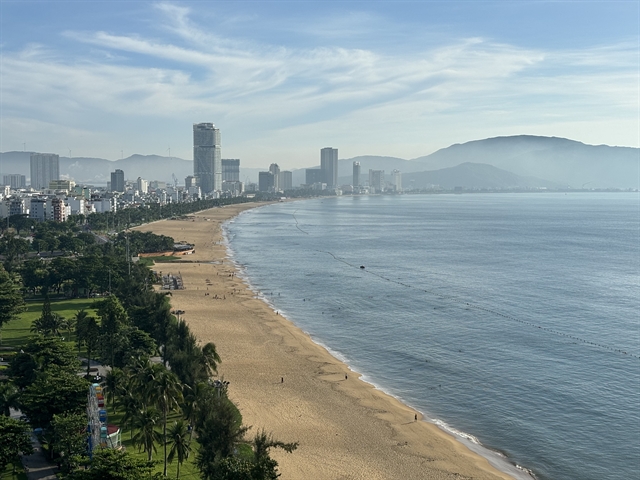
| Quy Nhơn area (known as Quy Nhơn City before provincial merging) seeks to become a science and innovation city and one of Việt Nam’s leading international science destinations. — VNS Photo Khánh Dương |
He hailed Professor Trần Thanh Vân, President of the Rencontres du Vietnam Association and ICISE director, for making Quy Nhơn a venue for high-level scientific gatherings for more than three decades.
The ambassador expressed his wish that France can extend that legacy into the realm of public decision-making.
“I hope this inaugural edition will foster trust and frank, constructive and useful exchanges. This is a version zero. It should lay the foundations, with an initial circle of countries and partners, for a regular high-level meeting starting in 2027,” he said.
He also expected it to send a political signal that Quy Nhơn can demonstrate cooperation and become a platform for dialogue between Asia and the rest of the world on climate issues.
The talks are not intended to replace the UN Climate Change Conferences. It operates separately from formal negotiations, but it can feed fresh ideas and practical coalitions into these processes ahead of COP31 and other major international gatherings, he said.
He said to translate the exchanges into projects, three elements are essential, including a roadmap expected to be presented at the closing session to set the course for future editions, a network of research institutions to support the dialogue over the long term and financial partners, including AFD, who are ready to follow up on the opportunities identified. — VNS
Politics & Law
 Politics & Law
 Politics & Law
 Politics & Law
 Politics & Law
 Politics & Law
 Politics & Law
 Politics & Law
 Politics & Law
 Politics & Law
 Politics & Law
 Politics & Law
 Politics & Law
 Politics & Law
 Politics & Law