 Politics & Law

Sovico and Hamburg Forge Partnership to Expand Vietnam-Germany Economic Ties
1.
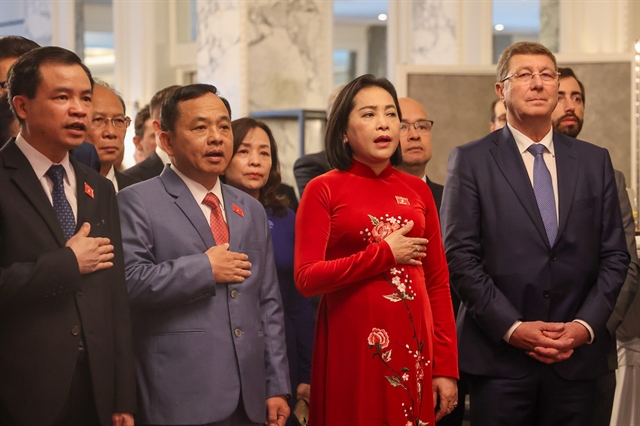 |
| National Assembly Vice President Nguyễn Thị Thanh and Swiss Senator Mauro Poggia along with delegates at the ceremony marking the 81st anniversary of Việt Nam's National Day and the 55th anniversary of Việt Nam–Switzerland diplomatic ties held in Bern. — VNA/VNS Photo |
GENEVA — Việt Nam always attaches importance to strengthening its traditional friendship with Switzerland, a country with strengths in innovation, finance, precision technology, pharmaceuticals, biomedicine and high-quality human resources, National Assembly Vice President Nguyễn Thị Thanh has said.
Addressing a ceremony marking the 81st anniversary of Việt Nam's National Day and the 55th anniversary of Việt Nam–Switzerland diplomatic ties held in Bern recently, Thanh highlighted the significance of September 2, 1945, when President Hồ Chí Minh read the Declaration of Independence, ushering in an era of independence and freedom for the Vietnamese nation.
She said Việt Nam has developed from a country that endured years of war into a peaceful, stable and dynamic nation with increasingly extensive international integration and growing stature and prestige.
In the new development period, Việt Nam is striving to build a prosperous and happy country, with science-technology, innovation and digital transformation identified as important drivers of rapid and sustainable development, she said. The Vietnamese NA is also continuing to renew legislative activities, improve institutions and remove bottlenecks to meet development requirements.
Regarding bilateral relations, Thanh expressed appreciation for Switzerland’s support during important periods in Việt Nam's history, from the 1954 Geneva Conference and the years of war to national reconstruction, the Đổi mới (Renewal) process and development.
She welcomed progress in bilateral ties across politics, diplomacy, economy, trade, investment, education and training, science-technology, innovation and people-to-people exchanges over more than five decades.
Looking ahead, Việt Nam wishes to work with Switzerland to further deepen bilateral relations, with traditional friendship and political trust as the foundation, economic cooperation as a pillar, and science-technology and innovation as drivers, she said, adding that the two sides should also expand cooperation in areas where Switzerland has strengths and Việt Nam has needs.
Thanh highlighted the role of the approximately 10,000 Vietnamese people living, studying and working in Switzerland as an important bridge between the two countries.
In his remarks, Swiss Senator Mauro Poggia highlighted the significance of the 55th anniversary of diplomatic relations, noting that exchanges between the two peoples began before official ties were established. He recalled the contributions of physician Alexandre Yersin to medicine, agriculture and science in Việt Nam.
Since Việt Nam embarked on its đổi mới process, bilateral cooperation has been increasingly consolidated, expanded and diversified, Poggia said, adding that Switzerland has supported Việt Nam's economic transformation and sustainable development efforts and stood alongside the country during difficult periods, including the COVID-19 pandemic.
Economic cooperation remains a bright spot, with bilateral trade exceeding US$2 billion annually. More than 100 Swiss companies in sectors including watchmaking, pharmaceuticals, food processing and precision machinery have invested and expanded operations in Việt Nam, he said.
Poggia said the depth of bilateral ties is also reflected in people-to-people connections, including Vietnamese students and researchers in Switzerland, Swiss tourists visiting Việt Nam and the Vietnamese community contributing to Swiss society.
Vietnamese Ambassador to Switzerland Châu Mai Anh highlighted key milestones in the 55-year diplomatic journey, particularly the establishment of a Comprehensive Partnership in 2025 and the recent conclusion of negotiations between Việt Nam and the European Free Trade Association (EFTA) on a free trade agreement.
She said these achievements provide an important basis for the two countries to tap their complementary economic strengths, particularly in innovation, digital transformation, sustainable development, finance and human resource development. — VNA/VNS
Politics & Law
 Politics & Law
 Politics & Law
 Politics & Law
 Politics & Law
 Politics & Law
 Politics & Law
 Politics & Law
 Politics & Law
 Politics & Law
 Politics & Law
 Politics & Law
 Politics & Law
 Politics & Law
 Politics & Law




