 Politics & Law
Vietnamese scientist wins ASEAN-US Science Prize for Women
1.
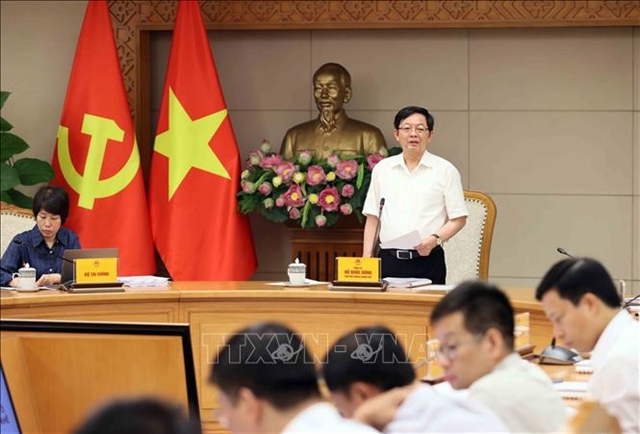 |
| Deputy Prime Minister Hồ Quốc Dũng speaks at the meeting to implement a pilot scheme to restore degraded, depleted and polluted water resources in the Bắc Hưng Hải, Nhuệ-Đáy and Ngũ Huyện Khê river systems. VAN/VNS Photo |
HÀ NỘI — Deputy Prime Minister Hồ Quốc Dũng on Friday called for coordinated mechanisms among localities and clear task assignments to implement a pilot programme to restore degraded, depleted and polluted water resources in the Bắc Hưng Hải, Nhuệ-Đáy and Ngũ Huyện Khê river systems.
Chairing a meeting on Friday, he said its goal should go beyond restoring water resources to creating new development spaces and a new look for urban areas along the rivers.
Deputy Minister of Agriculture and Environment Nguyễn Hoàng Hiệp told the meeting that the ministry had worked with other ministries, agencies, localities and leading experts to draft the pilot scheme.
The draft identifies three main objectives.
First, by 2035, surface water resources are expected to be regulated, distributed, restored and developed through solutions that prioritise gravity-fed water flows. These include bringing up to 120cu.m per second from the Red River into the Bắc Hưng Hải system, up to 28cu.m per second from the Đuống River into the Ngũ Huyện Khê system, and up to 200cu.m per second from the Đà River into the Nhuệ-Đáy system.
Second, pollution sources affecting surface water in the three river systems will be strictly controlled, while wastewater collection and treatment will be implemented before discharge into water bodies.
By 2035, the scheme aims for all industrial parks and industrial clusters in the area to have centralised wastewater collection and treatment systems meeting environmental technical standards. It also targets the collection and treatment of 70 per cent of urban domestic wastewater and the treatment of more than 45 per cent of rural domestic wastewater through appropriate centralised or decentralised systems.
Third, the pilot scheme will introduce mechanisms and policies to mobilise social resources, particularly private-sector participation, in water restoration and rehabilitation, with a focus on efficiency, cost-effectiveness and sustainability.
The proposed measures are strategic and designed to fundamentally improve the condition of the river systems by addressing water-resource issues across entire river basins in a comprehensive and sustainable manner.
Representatives from the localities broadly agreed on the need for the scheme, as well as its objectives, principles, tasks and solutions. They said local authorities had already been taking various measures and allocating resources to tackle pollution and improve water quality.
Bùi Duy Cường, Vice Chairman of the Hà Nội People’s Committee, said Hà Nội had proactively implemented a number of measures for the Bắc Hưng Hải system, including plans to address pollution in the Cầu Bây River.
The city’s People’s Council has approved an investment policy for the project, with total investment of VNĐ11 trillion (US$417 million) under a public-private partnership (PPP) model using a build-transfer (BT) contract. Construction is expected to begin in September 2026.
For the Nhuệ River, the city’s People’s Council has approved an investment policy for environmental rehabilitation, pollution treatment and landscape improvement. The project has an estimated investment of VNĐ75 trillion and is currently under preparation, with construction expected to begin in November 2026.
Trần Văn Quân, Vice Chairman of the Hải Phòng People’s Committee, said the city had implemented an ODA-funded wastewater collection and treatment project in the former Hải Phòng area, with funding of about VNĐ1.6 trillion.
The city is also implementing wastewater treatment projects in Vĩnh Bảo and Tiên Lãng communes and around hospitals, while completing investment procedures for an embankment system along the Sắt River.
A total of 25 projects are being implemented in the Bắc Hưng Hải river system, alongside a number of wastewater treatment plants in districts and concentrated residential areas, he said.
Concluding the meeting, Deputy PM Dũng stressed that the Bắc Hưng Hải, Nhuệ-Đáy and Ngũ Huyện Khê river systems play an important role in water security and in supporting daily life and production.
They are also decisive to the environmental carrying capacity and development space of the entire Red River Delta and Hà Nội, he said.
However, climate change, economic development pressures and shortcomings in management have pushed the river systems beyond their carrying capacity, creating serious environmental risks and leaving them with limited ability to naturally purify themselves.
The Deputy PM noted that the scheme covers a broad area involving five provinces and cities, requiring restoration efforts to be carried out under a comprehensive plan.
He asked the Ministry of Agriculture and Environment to clarify three major issues in the scheme: a prioritised list of projects; specific funding sources, including State investment and socialised capital; and operating mechanisms once the projects are completed.
For water-regulation projects, he called for feasible solutions linked to improving water flows and creating better landscapes. Monitoring systems should be modern, integrated and supported by advanced technology, he said.
Local authorities were asked to thoroughly review and assess relevant planning for the river systems to ensure consistency and coordination.
“This is an interconnected system, so planning and implementation arrangements in one locality cannot conflict or overlap with those in another,” he said.
Localities must also strictly manage and make effective use of land formed through the restoration of the river systems, estimated at about 2,100ha, preventing encroachment and inefficient use while generating additional resources for river restoration.
Alongside water rehabilitation, localities should develop plans to improve landscapes and reorganise development space along the rivers, he said.
Priority should be given to urban landscapes, green corridors, public spaces and riverside economic development, while improving residents’ quality of life.
The approach, Deputy PM Dũng said, should ensure that restoring the rivers is not only an environmental task but also an opportunity to reshape urban spaces and create new drivers of development for the region. — VNS
Politics & Law
 Politics & Law
 Politics & Law
 Politics & Law
 Politics & Law
 Politics & Law
 Politics & Law
 Politics & Law
 Politics & Law
 Politics & Law
 Politics & Law
 Politics & Law
 Politics & Law
 Politics & Law
 Politics & Law