 Politics & Law
Great National Unity Day in Europe: Youth build stronger, more united community
1.
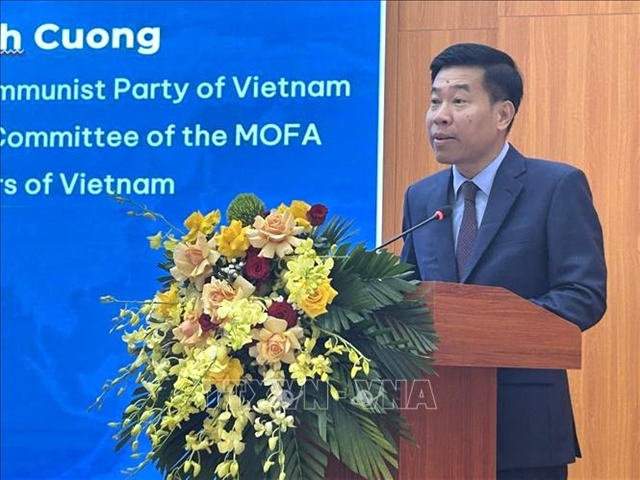 |
| Deputy Minister of Foreign Affairs Nguyễn Mạnh Cường speaks at a conference held in Hà Nội on Thursday to discuss collaboration directions for Việt Nam and India under the Enhanced Comprehensive Strategic Partnership. — VNA/VNS Photo Thanh Hương |
HÀ NỘI — New growth drivers for Việt Nam and India’s bilateral ties was discussed at an international conference in Hà Nội on Thursday.
The event was held to mark the 10th anniversary of the two countries’ Comprehensive Strategic Partnership and discuss further collaboration under the Enhanced Comprehensive Strategic Partnership, which was officially established on June 5 during a state visit by Party General Secretary and State President Tô Lâm to India.
The conference was organised by the Institute for South Asian, West Asian and African Studies under the Việt Nam Academy of Social Sciences (VASS), in collaboration with the Embassy of India in Việt Nam and the India-based Asian Confluence civil society initiative.
In attendance were VASS President Dr Lê Văn Lợi, Deputy Minister of Foreign Affairs Nguyễn Mạnh Cường and India’s Minister of State for External Affairs Pabitra Margherita.
Experts and scholars analysed the strategic convergence between the two nations in the Indo-Pacific region, focussing on maritime security and on driving the central role of the Association of Southeast Asian Nations (ASEAN), of which Việt Nam is a member state, in this region.
They also highlighted the potential contribution of bilateral cooperation to each country's development goals, and proposed recommendations to enhance academic and policy dialogue to support the implementation of key priorities across politics, economics, technology, sustainable development and people-to-people exchanges.
Speaking at the conference, Deputy Minister of Foreign Affairs Nguyễn Mạnh Cường stressed that Việt Nam and India not only share aspirations for national development and a vision for a peaceful, equitable and rules-based international order, but also face common challenges in an increasingly uncertain, fragmented and divided world.
“To implement the directives set by high-level leaders, the two countries need to achieve three key ‘transformations’”, he said.
They are turning political trust into joint action, upgrading the relationship framework to substantive cooperation, and converting strategic closeness into a space of connectivity linking Southeast Asia with South Asia, and the Pacific with the Indian Ocean, Cường said.
India’s Minister of State for External Affairs Pabitra Margherita also emphasised that the Enhanced Comprehensive Strategic Partnership reflects the shared, forward-looking vision of the two nations' leaders.
“Việt Nam is the first country in Southeast Asia with which India has elevated its relationship to this level,” he said.
“The 18 outcomes achieved during this visit serve as concrete drivers to propel our cooperative relationship forward.”
The Indian official added that two countries’ partnership is rooted in civilisational ties spanning over two millennia, citing archaeological evident in the sacred site of Mỹ Sơn and the Chăm heritage.
Last year, the sacred Buddha relics from India drew the attention of more than 14 million Vietnamese Buddhists, and tourism has continued to deepen the connections between their people, he said.
“The ancient bond finds modern expression in the convergence of our respective visions: India’s ‘Viksit Bharat’ (Developed India) 2047 and Việt Nam’s Vision 2045, which reinforces the momentum that will propel the Việt Nam-India relationship into its next phase,” Margherita said.
VASS President Lê Văn Lợi stressed that the Việt Nam-India diplomatic relations are built upon a foundation of history, culture and deep political trust and have been continuously strengthened and elevated since in 1972.
“This is a favourable time for Việt Nam and India to transition from strategic trust to strategic cooperation, from a convergence of visions to joint action, and from potential to real development outcomes,” he said.
The initiatives and recommendations from the conference will be conveyed to policymakers, the business community and research partners so they can be turned into action programmes, projects and collaborative initiatives that would make a practical contribution to the enhanced partnership, Lợi said. — VNS
Politics & Law
 Politics & Law
 Politics & Law
 Politics & Law
 Politics & Law
 Politics & Law
 Politics & Law
 Politics & Law
 Politics & Law
 Politics & Law
 Politics & Law
 Politics & Law
 Politics & Law
 Politics & Law
 Politics & Law