 Politics & Law

HKSTP Partners with Leading Science and Technology Company Merck to Open a New Chapter in I&T Collaboration
1.
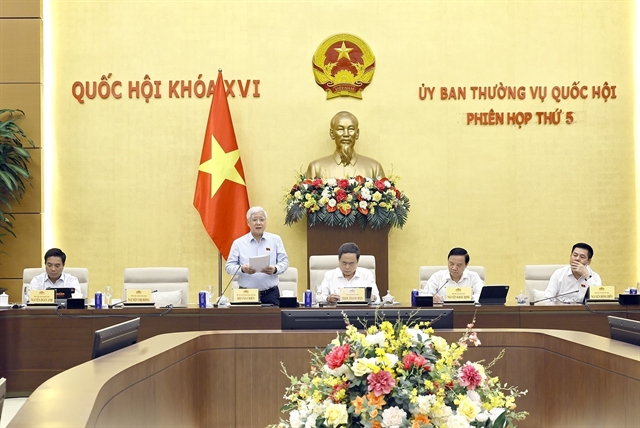 |
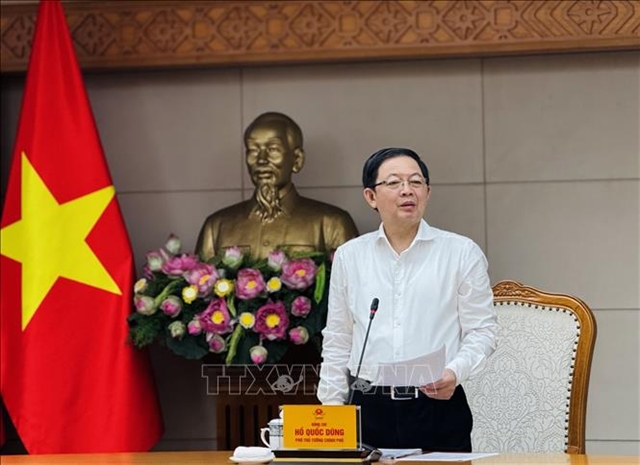
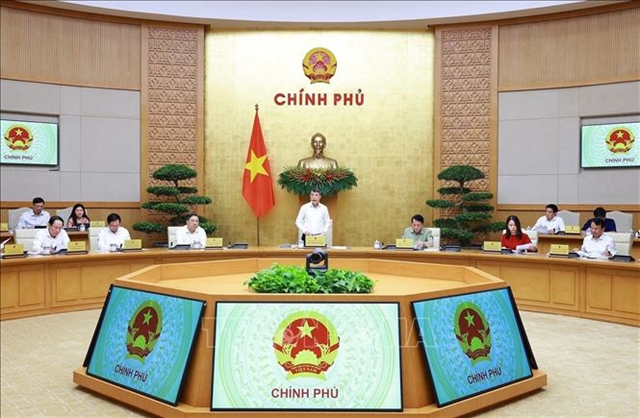
| NA Standing Committee members discuss the four-law amendment bill on Thursday. — VNA/VNS Photo |
HÀ NỘI — An omnibus draft law reviewed by the National Assembly (NA) Standing Committee on Thursday would require the Government to publish a full list of goods and services subject to State monopoly, with each entry justified under sector-specific law.
The requirement is part of a wider bill amending four statutes at once – the Commercial Law, the Competition Law, the Law on Foreign Trade Management and the Law on Protection of Consumers' Rights.
Phan Văn Mãi, chairman of the NA Committee for Economic and Financial Affairs, said his panel backed the requirement that any State monopoly designation be grounded in sector-specific law, with the list of covered goods and services made public.
He asked drafters to clarify which ministry – the Ministry of Industry and Trade or other sector regulators – would be responsible for compiling the list, and to keep the process within the NA's constitutional authority.
Some members went further, proposing that State monopolies be explicitly barred from creating de facto monopolies for individual companies, except when the regulators have specifically approved it.
Phan Chí Hiếu, chairman of the NA Committee for Legal and Legislative Affairs, pressed for a more thorough review rather than surface-level fixes.
He asked for clearer language on which laws qualify as 'specialised' for monopoly designation and a firmer legal basis for the monopoly list itself.
Hiếu also called for a review of how monopoly-related authority is divided in the draft, to ensure provisions assigning that power to the Government and sector ministries are consistent with separate provisions granting the ministers of defence and public security direct decision-making authority in their own fields.
Presenting the six-article draft, Deputy Minister of Industry and Trade Trương Thanh Hoài said it is meant to streamline decision-making authority between the Government and relevant ministries and to fix rules that have proven unworkable.
He pointed to overlapping and sometimes contradictory provisions on prohibited or restricted business activities across the Commercial Law, the Investment Law, the Civil Code and the Law on Property Auctions, and on competition rules that have not kept pace with newer forms of market conduct, including practices that facilitate anti-competitive behaviour.
On foreign trade, he pointed to gaps in the Law on Foreign Trade Management covering the re-importation of goods a company has manufactured and previously exported, trade rules for separate customs zones and how origin certificates are issued and verified.
As for consumer protection, he cited friction with personal data protection rules and technical adjustments needed following the recent restructuring of State agencies.
Committee members raised several other concerns. They called for a fuller assessment of how promotional discount caps would apply to online platforms, vouchers, loyalty point schemes and cross-border promotions, warning that vague wording could invite inconsistent enforcement.
In terms of the Competition Law, committee members urged clearer definitions of 'relevant markets' and 'significant market power' that reflect the realities of the digital economy, along with a sharper line between what belongs in the law itself and what can be left to Government decrees.
They also asked for sharper definitions of terms such as 'affiliated enterprise groups', and for dominant-position rules narrow enough to avoid unnecessary interference in business freedom, that would apply only to conduct that causes clear, significant harm to consumers.
As for foreign trade, the committee members said any devolution of authority to certify or verify product origin must align with Việt Nam's international commitments and run through a single database and point of contact, to avoid inconsistencies between localities that could jeopardise exporters' access to preferential tariffs and damage the credibility of Vietnamese-made goods abroad.
Committee members asked drafters to clarify how a proposed system for registering standard-form contracts would interact with contract rules already written into laws governing real estate and telecommunications.
Hiếu also raised concerns about competition law enforcement, recommending that rules on the statute of limitations, maximum fines and penalty authority be folded into the Law on Handling of Administrative Violations, which is undergoing separate revision, rather than left scattered across multiple statutes. — VNS
Politics & Law
 Politics & Law
 Politics & Law
 Politics & Law
 Politics & Law
 Politics & Law
 Politics & Law
 Politics & Law
 Politics & Law
 Politics & Law
 Politics & Law
 Politics & Law
 Politics & Law
 Politics & Law
 Politics & Law