 Politics & Law

Wuzhen Summit Puts Spotlight on Tongxiang’s Expanding AI Industry
1.
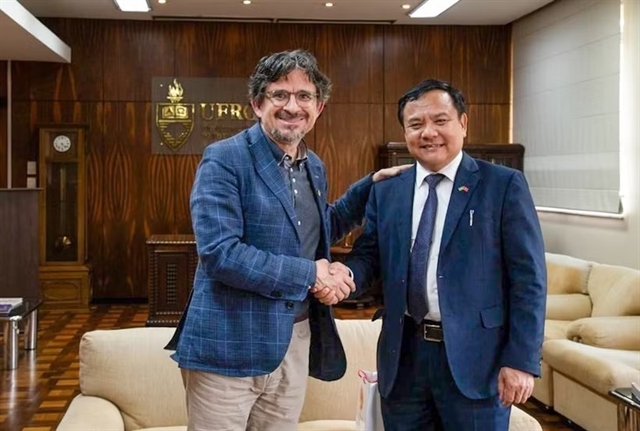 |
| Vietnamese Ambassador to Brazil Bùi Văn Nghị (R) and Vice Rector of the Federal University of Rio Grande do Sul (UFRGS) Prof. Dr. Pedro de Almeida Costa. VNA/VNS Photo |
HÀ NỘI — Vietnamese Ambassador to Brazil Bùi Văn Nghị led a delegation on a working visit to Porto Alegre, capital of Rio Grande do Sul state, from August 17-19, seeking to advance the Việt Nam-Brazil Strategic Partnership, expand cooperation between localities, and promote links among agencies, universities, research institutes and businesses of the two countries.
The visit focused on areas with significant cooperation potential, including semiconductor industry, artificial intelligence (AI), digital transformation, high-tech agriculture and human resource development.
On August 17, the delegation met Leandro Borges Evaldt, state secretary for economic and social development. On this occasion, Nghị briefed him on Việt Nam's socio-economic achievements and highlighted the country's priorities in science and technology, innovation and international cooperation.
The two sides discussed opportunities to connect businesses, particularly in semiconductor manufacturing, AI, educational technology and agro-processing. The ambassador asked the state authorities to help introduce Vietnamese partners to research centres and investors interested in the Vietnamese market and coordinate business-matching activities.
The delegation also visited CEITEC, a microelectronics and semiconductor technology centre headed by Director Augusto Cesar Gadelha Vieira. Following a briefing on CEITEC's research and chip-design capabilities and its role in Brazil's semiconductor ecosystem, the two sides discussed cooperation in engineer training, expert exchanges and links between CEITEC and Vietnamese universities and technology companies.
Nghị said Việt Nam is seeking deeper participation in global semiconductor supply chains and that CEITEC's experience could provide a foundation for practical cooperation programmes.
On August 18, the delegation explored Rio Grande do Sul's innovation ecosystem and opportunities for local-level cooperation. At the Fernando Ferrari Administrative Centre, the ambassador met Lisiane Lemos, state secretary for innovation, science and technology, who shared the state's policies on science and technology development and startup support.
The two sides identified microelectronics, innovative startups, precision agriculture and high-tech human resources as priority areas.
The delegation also visited Caldeira Institute, a prominent hub for business networking and startup support in Porto Alegre. The ambassador expressed his wish to connect Vietnamese startups and innovation centres with the institute's network.
Later that day, Nghị met Porto Alegre Deputy Mayor Betina Worm to discuss establishing a friendly relationship between Porto Alegre and a Vietnamese locality. Potential areas of cooperation include smart urban planning, administrative digital transformation, education, culture, tourism and sustainable development.
The delegation subsequently visited the Interdisciplinary Centre for New Technologies in Education under the Federal University of Rio Grande do Sul (UFRGS), where the Vietnamese ambassador held talks with Vice Rector Prof. Dr. Pedro de Almeida Costa on joint research, faculty and student exchanges, and science and technology training.
A highlight of the visit was the Việt Nam-Latin America Forum on Innovation and Digital Transformation, jointly organised by the Vietnamese Embassy and UFRGS on August 19.
In his opening remarks, Nghị affirmed that science and technology are a key driver of Việt Nam's development, with digital infrastructure and the semiconductor industry receiving particular attention.
UFRGS Rector Márcia Barbosa hailed the forum as a valuable opportunity for local partners to better understand Việt Nam's needs and strengthen links between scientific research and businesses.
Three discussion sessions examined Việt Nam's role in the Global South, AI's impact on education and human resource development, and the use of big data in precision agriculture. — VNA/VNS
Politics & Law
 Politics & Law
 Politics & Law
 Politics & Law
 Politics & Law
 Politics & Law
 Politics & Law
 Politics & Law
 Politics & Law
 Politics & Law
 Politics & Law
 Politics & Law
 Politics & Law
 Politics & Law
 Politics & Law
.jpg)