 Politics & Law

Four killed in collision between two motorbikes in northern city
1.
|
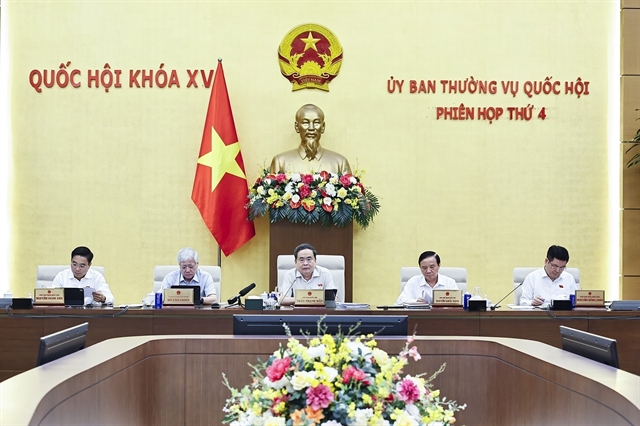
| NA Chairman Trần Thanh Mẫn (centre) speaks at the legislative session on the proliferation of weapons of mass destruction on Thursday. — VNA/VNS Photo |
HÀ NỘI — The nation's top legislative body discussed a draft law on Thursday that would regulate and help prevent the proliferation of weapons of mass destruction (WMDs), a measure officials say is critical to deepening Việt Nam's integration with the global economy and strengthening its anti-money-laundering credentials.
During its ongoing fourth session on Thursday, the National Assembly (NA) Standing Committee weighed in on the draft Law on Preventing and Combating the Proliferation of Weapons of Mass Destruction.
The legal draft consists of four chapters with 37 articles, setting out principles, measures and resources for agencies, organisations and individuals responsible for countering WMD proliferation. It would apply to Vietnamese citizens and entities, as well as to foreign organisations and individuals operating or residing in the country.
Deputy Prime Minister and Defence Minister Phan Văn Giang said the legislation would enact defence and foreign policy priorities set by the Party and the State, including Việt Nam's bid to join multilateral non-proliferation mechanisms.
Writing the rules into statute, rather than leaving them in a Government decree, would position Việt Nam to fully meet its obligations under the UN Charter and related treaties, he said.
He added that it would also create a more favourable environment for Vietnamese firms expanding investment, trade and technology ties abroad, particularly with the US and the EU.
The defence chief noted that the draft is meant to complement, not replace, existing specialised laws.
It would not introduce new licensing, declaration or inspection requirements; special measures would apply only where authorities identify a specific risk, and only to the degree necessary, so as not to burden businesses with unnecessary compliance costs.
Lê Tấn Tới, chairman of the NA's Defence, Security and Foreign Affairs Committee, said his committee broadly supports the draft but wants clearer boundaries drawn with existing specialised laws, particularly where jurisdictions overlap. The committee also wants more detailed rules on technology, data and cross-border transactions, he said.
On Article 11, which sets criteria for assessing national risk of WMD proliferation, the committee said the risk-based approach is consistent with international practice, but urged drafters to add quantifiable indicators, clarify the role businesses play in assessing vulnerability, and spell out which agencies are responsible for updating the criteria over time.
Meanwhile, for Article 23 covering suspicious transactions linked to proliferation financing, the committee said the rules align with the anti-money-laundering framework and help meet its obligations under UN Security Council resolutions. To keep the provision workable and prevent abuse, it recommended clearer rules on how agencies coordinate once a suspicious-transaction report is filed.
Chairman of the NA's Legal and Judicial Affairs Committee Phạm Chí Hiếu praised the quality of the drafting process, but noted the draft's unusually broad scope touches on fields – including foreign trade, customs, anti-money laundering, chemicals and atomic energy – already governed by other laws, urging continued review for consistency across the legal system.
NA Chairman Trần Thanh Mẫn said upgrading non-proliferation rules from Government Decree 81 into a law is a necessary step. The legislation matters for defence and security, he said, but would also help Việt Nam deepen international integration, improve its standing on global anti-money-laundering and counter-terrorism financing benchmarks, and reassure foreign investors that their capital is safe.
Once passed, the law would demonstrate the country's commitment to global peace and security, he said.
|
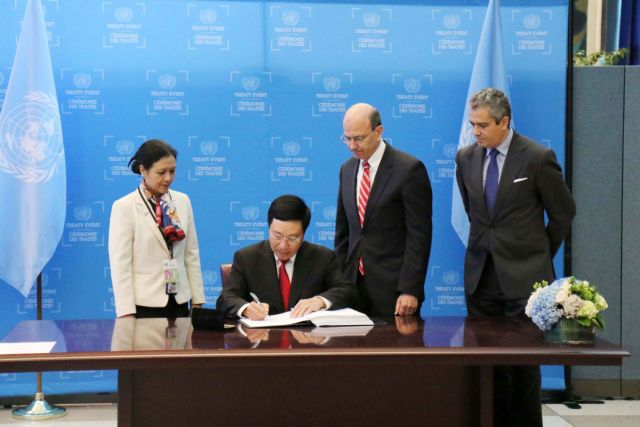
| The then-Deputy Prime Minister and Foreign Minister Phạm Bình Minh signs the Treaty on the Prohibition of Nuclear Weapons at UN headquarters in New York on September 22, 2017. — VNA/VNS Photo |
The top legislator also pushed drafters to fix the fragmented oversight of dual-use goods – items with civilian uses that could also be diverted to build chemical, biological or nuclear weapons – that are currently regulated piecemeal across several ministries.
He called for provisions to tighten coordination between agencies and to avoid a situation in which jurisdiction overlaps, but no single agency is held accountable.
Separately at the same session, the NA Standing Committee also reviewed a draft law amending four pieces of legislation at once: the Law on Technology Transfer, the Law on Telecommunications, the Law on Electronic Transactions, and the Law on Radio Frequencies.
Science and Technology Minister Vũ Hải Quân said the amendments aim to cut administrative procedures and ease conditions for industries that require special business licences.
The Law on Radio Frequencies would drop licensing conditions deemed unnecessary and lower compliance costs for businesses while revising how bands are allocated to State-owned enterprises serving national defence.
Under the telecommunications amendments, several licensing conditions for operators would be scrapped and application paperwork simplified.
Nguyễn Thanh Hải, chairman of the NA's Science, Technology and Environment Committee, said his panel broadly supports the changes, but warned that replacing pre-approval checks with after-the-fact inspections only works with adequate monitoring tools, and asked the Government to specify how that follow-up oversight would work. — VNS
Politics & Law
 Politics & Law
 Politics & Law
 Politics & Law
 Politics & Law
 Politics & Law
 Politics & Law
.jpg) Politics & Law
Politics & Law
 Politics & Law
 Politics & Law
 Politics & Law
 Politics & Law
 Politics & Law
 Politics & Law
 Politics & Law