 Politics & Law

Education gets smarter
1.
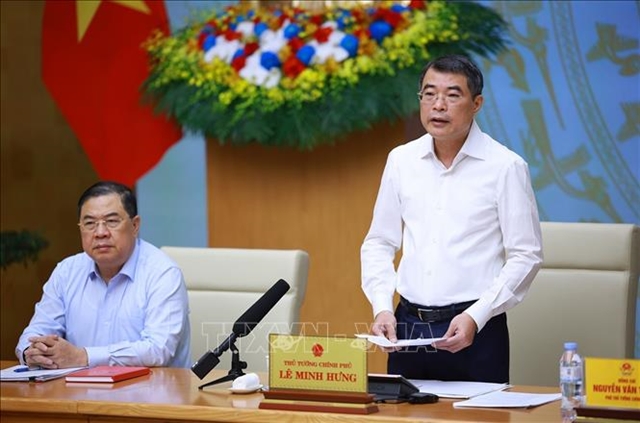 |
| Prime Minister Lê Minh Hưng chairing a conference on accelerating the allocation and disbursement of public investment capital on April 24. — VNA/VNS Photo |
HÀ NỘI – Prime Minister Lê Minh Hưng on April 24 called for stronger action against fragmented public investment, while stressing greater accountability among leaders to ensure one hundred per cent disbursement of public investment capital as planned, helping support the Government’s double-digit growth target.
He made the remarks while chairing a conference on accelerating the allocation and disbursement of public investment capital this year. The nationwide event linked the Government headquarters in Hà Nội with provinces and centrally run cities across the country.
According to the Ministry of Finance, the total public investment plan funded by the state budget for 2026 exceeds VNĐ1 quadrillion (US$38 billion), including more than VNĐ363 trillion from the central budget and over VNĐ650 trillion from local budgets.
As of April 15, more than VNĐ127.39 trillion had been disbursed nationwide, equivalent to only 12.6 per cent of the target assigned by the PM. Among them, 28 ministries and central agencies, along with 18 localities, recorded disbursement rates below the national average.
Concluding the conference, PM Hưng underlined that the Government considers public investment a particularly important political task for the year and the entire term, describing it as a macroeconomic management tool and a major driver for achieving double-digit growth. It is also crucial for developing modern, synchronised infrastructure and opening up new development space for the country.
To accelerate disbursement, the PM stressed that faster capital allocation must go hand in hand with ensuring project quality, occupational safety, anti-corruption measures, and waste prevention.
All investment decisions and capital allocations, he said, must be assessed based on their socio-economic efficiency and overall investment effectiveness.
He called for greater accountability among leaders at all levels, with specific assignments for each leader and official responsible for individual projects, ensuring responsibilities are clearly defined as a basis for performance evaluation.
The leader also ordered the immediate replacement of underperforming project management boards, consultants, contractors, and officials lacking professional capacity or responsibility, while insisting on strict action against violations and misconduct in managing and using public investment funds.
The PM further instructed ministries and localities to improve project preparation, particularly project selection, and to eliminate those registered merely to “reserve space” or cases in which capital is allocated without projects being ready for implementation.
Detailed disbursement plans must be prepared for each project, with timely capital transfers from projects unable to disburse effectively to those with stronger implementation capacity and additional funding needs.
He also urged agencies to proactively inspect, supervise and resolve obstacles directly at worksites and implementing units.
The Ministry of Finance was assigned to work with relevant agencies to study and draft a consolidated law of the Law on Public Investment and the Law on the State Budget, while also amending the Law on Bidding for submission to the 16th National Assembly at its second session.
The Ministry of Construction and local authorities were tasked with removing obstacles and speeding up major national transport projects, particularly preparations for the North–South high-speed railway and railway links connecting Việt Nam with China.
Meanwhile, the Ministries of Agriculture and Environment, Ethnic and Religious Affairs, Health, Education and Training, Public Security, and Culture, Sports and Tourism, along with other ministries and localities, were instructed to finalise legal documents and implementation guidance for national target programmes and complete the 2026 capital allocation plans for each programme.
In April, the Ministry of Finance and the Ministry of Science and Technology are expected to finalise guidance on criteria and procedures for budget spending on science, technology, innovation and digital transformation projects. In May, financial mechanisms for strategic technology development must also be completed.
Provincial leaders were urged to step up efforts to clear bottlenecks related to site clearance, compensation and resettlement, while strengthening communication efforts and properly addressing legitimate public complaints and recommendations.
PM Hưng also stressed that capital allocation must remain focused and prioritised, with firm action against fragmented and scattered investment. He set a target of reducing the total number of projects in the 2026–30 period by at least 30 per cent compared with the previous period. — VNS
Politics & Law
 Politics & Law
 Politics & Law
 Politics & Law
 Politics & Law
 Politics & Law
 Politics & Law
 Politics & Law
 Politics & Law
 Politics & Law
 Politics & Law
 Politics & Law
 Politics & Law
 Politics & Law
 Politics & Law