 Economy


SHARP and ALPRO Pharmacy Introduce MIRAI Living to Champion Healthier Lifestyles for Malaysians
1.
|
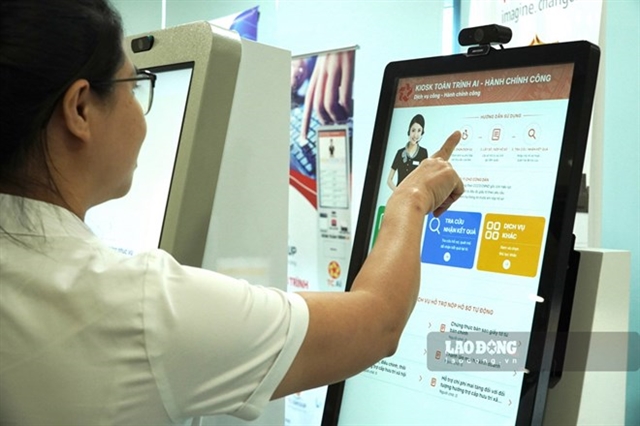
| The city has developed, piloted or put into operation seven shared digital platforms: HanoiWork, iHanoi, HanoiCheck, the shared data warehouse, Digital Twin, Hanoi Smart Police and HanoiGo. —Photo laodong.vn |
HÀ NỘI — Hà Nội has allocated VNĐ9.09 trillion (US$345 million) for science, technology, innovation and digital transformation in 2026, including VNĐ5.56 trillion in capital investment and VNĐ3.53 trillion in recurrent expenditure.
The funding supports the city's implementation of Politburo Resolution No 57-NQ/TW on breakthroughs in science, technology, innovation and national digital transformation.
A report on implementation in the first nine months of 2026 shows the city is shifting from simply carrying out science and technology tasks to applying technology to practical challenges, generating economic value and improving services for residents and businesses.
The 2026 allocation is about 10.7 times the revised 2024 estimate and 15.4 times the initial budget estimate for 2025.
The municipal People's Council has issued 10 resolutions and the municipal People's Committee three regulatory decisions under the Capital Law No 02/2026/QH16 to establish a legal framework for the sector.
Science, technology and digital transformation are estimated to have contributed 22.85 per cent of the city's gross regional domestic product (GRDP), equivalent to VNĐ295.9 trillion, in the first nine months. The city has commissioned a model to measure the sector's contribution to GRDP growth during 2026–35, as the current measure does not fully capture innovation.
The digital economy is estimated to account for 16.7 per cent of GRDP, with value added rising 13.25 per cent year-on-year at current prices. Growth accelerated to 14.49 per cent in the third quarter, from 12.58 per cent in the first half.
Technology targets practical challenges
Hà Nội has announced 30 major challenges to guide research commissioning during 2026–30. By October, it had received 160 proposals for research and funding addressing issues faced by residents, businesses and urban management.
Proposed research areas include treating and reusing soil and sludge from underground construction, assessing bridge structural safety and forecasting the health effects of air pollution.
Co-operation among the State, universities and businesses is also being encouraged, with some projects involving companies committing to cover around 50 per cent of the funding. For strategic technologies, the city has directly assigned tasks to capable businesses, including the development of a new-generation multifunctional edge AI camera platform. State funding provides initial support, while businesses co-invest and develop the technology.
The city has developed, piloted or put into operation seven shared digital platforms: HanoiWork, iHanoi, HanoiCheck, the shared data warehouse, Digital Twin, Hanoi Smart Police and HanoiGo.
It has approved plans to restructure 1,557 (90.5 per cent) of its 1,721 administrative procedures and integrated 1,991 procedures into digital systems, including 1,608 fully online procedures.
If 25 key procedures are implemented comprehensively, they are expected to save around VNĐ1.73 trillion in annual compliance costs, a reduction of 72.4 per cent on average.
The iHanoi platform, which enables residents to access services and monitor local government performance, has 6.63 million accounts and 106.7 million visits. It has received and processed 263,395 reports and petitions, averaging around 25,000 a month.
In education, HanoiCheck has connected 403 suppliers and 4,672 educational institutions covering 6,617 school sites and 1.49 million students, recording 56,425 orders. Parents can check school menus, trace food origins, pay tuition fees electronically and submit feedback by phone.
In healthcare, all 42 public hospitals have implemented electronic medical records. Artificial intelligence has supported the analysis of more than 24,000 patient cases at three hospitals, while cashless payments for social welfare benefits have reached 99.49 per cent.
Implementation challenges remain
Despite the progress, the report points to uneven use of new legal mechanisms, funding and digital platforms. As of October 6, budget disbursement had reached only 40.33 per cent, requiring faster implementation in the fourth quarter.
Although data connectivity has expanded, the city needs to make greater use of shared data to replace paper-based records and support governance and economic development. Market-based mechanisms have also been established but are only beginning to generate transactions.
The report attributes some difficulties to ongoing work to finalise guidance on commissioning and acceptance based on output, the valuation of data and intellectual property, and procurement of new technology products. Some agencies remain cautious about applying the mechanisms, while local-level data and information security personnel need further training and support.
The city plans to complete remaining tasks for its shared data warehouse before October 30 and continue the second phase of data connection and collection through December 31. It also aims to complete the remaining administrative procedure restructuring plans to reach 95 per cent by year-end.
Hà Nội's funding strategy reflects its broader goal of using science, technology, innovation and digital transformation to address bottlenecks in management, production and daily life. Progress is to be measured not only by the number of research tasks or digital platforms developed, but also by their practical applications, economic value and improvements in public services. — VNS
Economy
 Economy
 Economy
 Economy
 Economy
 Economy
 Economy
 Economy
 Economy
.jpg) Economy
 Economy
 Economy
 Economy
 Economy
 Economy