 Economy

General Secretary and President Tô Lâm witnesses exchange of Việt Nam-Denmark cooperation agreements
1.
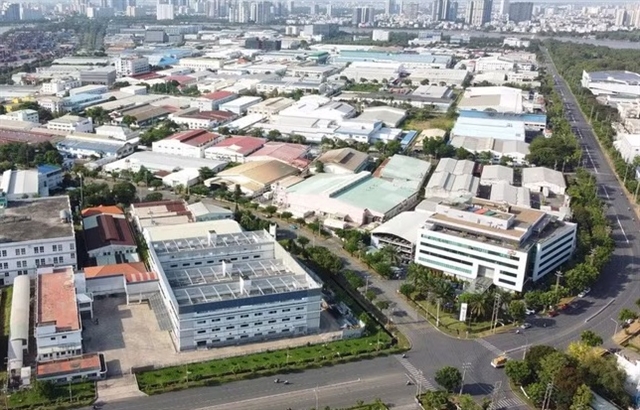 |
| An aerial view of Tân Thuận Export Processing Zone in HCM City. — VNA/VNS Photo Trung Tuyến |
HCM CITY — HCM City is adjusting growth scenarios for lagging sectors and removing key bottlenecks in manufacturing and industrial land pricing to achieve a 13.23 per cent expansion in the fourth quarter of 2026.
This sharp fourth-quarter acceleration is required to secure the city's full-year double-digit targets, following a 9.06 per cent GRDP growth recorded in the first nine months.
Local authorities are shifting focus towards supporting high-value processing industries, streamlining land lease procedures for industrial park investors, and accelerating the conversion of industrial zones into high-tech, eco-friendly hubs.
According to the city Statistics Office, the economic structure continues its positive transition towards high-value services and industry.
The service sector leads with a 51.8 per cent share of the economy, followed by industry and construction at 35.8 per cent, net product taxes at 11 per cent, and agriculture, forestry, and fishery at 1.4 per cent.
Supporting high-value manufacturing and export growth
Industrial production continues to serve as an indispensable driver of local growth.
The processing and manufacturing sector maintained a leading role, driving the Index of Industrial Production (IIP) to grow by around 11 per cent between March and September, with processing and manufacturing alone expanding by 11.3 per cent.
Overall, the industrial sector’s added value expanded by 9.06 per cent in the nine-month period, contributing 31.9 per cent to total GRDP growth and making up nearly a third of the city's overall economic scale.
However, Nguyễn Khắc Hoàng, head of the HCM City Statistics Office, said that while the industrial expansion is positive, it showed signs of cooling compared to early 2026 and has yet to deliver a breakthrough matching its full potential.
To invigorate industrial output in the final quarter, municipal agencies are helping manufacturers boost plant capacity, secure new orders, and navigate operational obstacles regarding land, capital, and labour.
Industry experts emphasise the need for credit policies aligned with corporate capital absorption capacity.
They also recommend bolstering regional supply chain linkages, holding trade promotion events, and lowering logistics costs to help exporters adapt to changing global trade trends and diversify away from over-reliant traditional markets.
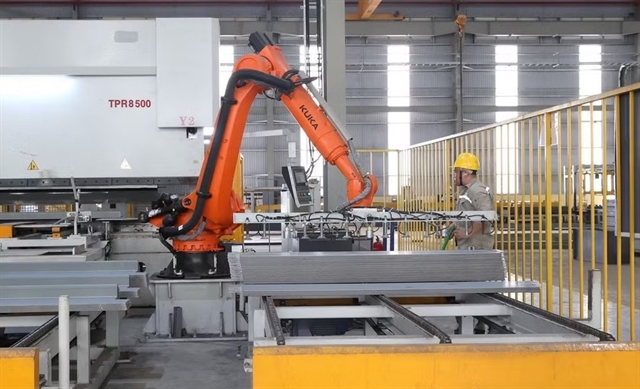 |
| Float glass manufacturing at Phú Mỹ Ultra-Clear Glass Plant in the expanded Phú Mỹ II Industrial Zone in HCM City. — VNA/VNS Photo Hoàng Nhị |
Resolving industrial land and cost bottlenecks
Unlocking capacity in industrial parks (IPs) and export processing zones (EPZs) is regarded as critical for long-term manufacturing growth.
According to the HCM City Export Processing and Industrial Zones Authority (Hepza), investment attraction into EPZs and IPs achieved strong results, surpassing $5.8 billion by October 8, 2026 – exceeding the full-year target by 36.6 per cent.
Foreign Direct Investment (FDI) accounted for $4.33 billion, while domestic capital reached VNĐ38.4 trillion ($1.47 billion).
Realised investment in these zones reached $4.25 billion in the first nine months and is projected to touch $5.37 billion by the end of 2026, representing a 15 per cent year-on-year increase.
Despite these figures, the number of new projects remains limited due to relatively high industrial land rental fees, land valuation disputes, financial deduction issues, and an ununified power pricing structure, which affect the city’s competitiveness for large-scale investments, according to Hepza.
To address these hurdles in the last quater of the year, Hepza has asked the municipal People’s Committee to direct the Department of Agriculture and Environment, the Department of Finance, and the Tax Authority to resolve land pricing and lease procedures conclusively, paving the way for faster site clearance and secondary project arrivals.
Hepza is also pushing forward its master plan to convert traditional EPZs and IPs into eco-friendly, smart, and high-tech industrial ecosystems.
Concurrently, the city’s Department of Finance is coordinating with local authorities to attract selective private and foreign direct investment into high-tech sectors, digital infrastructure, supporting industries, and green production.
Hoàng Vũ Thảnh, director of the city’s Department of Finance, said the city will set up dedicated contact points to support investors with workforce recruitment and streamline procedures for foreign experts.
The city will also step up investments in international education, healthcare, worker housing, and transport links to create an attractive living and working environment for high-quality human resources. — VNS
Economy
 Economy
 Economy
 Economy
 Economy
 Economy
 Economy
 Economy
 Economy
 Economy
 Economy
.jpg) Economy
 Economy
 Economy
 Economy