 Economy


Swiss President to visit Việt Nam on October 17–18
1.
|
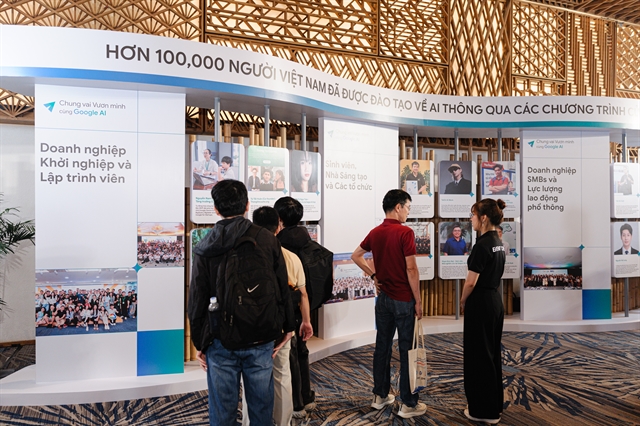
| Young people join an event sharing about AI by Google. Universities, businesses and students in HCM City are working together to develop AI tools. — Photo courtesy of Google. |
HCM CITY — Collaboration between global technology companies, local institutions and Vietnamese talent is helping turn artificial intelligence (AI) research into practical applications, experts said.
Universities, businesses and students in HCM City are working together to develop AI tools for everyday use and promote the safe and effective use of the technology.
Trương Minh Huy Vũ, vice chairman of the HCM City People’s Committee, said the city aimed to create an attractive environment to bring together talent and resources for key industries, including AI.
The city is building a range of datasets, starting with information on land, land parcels, taxes and finance. These could provide a basis for developing large-scale AI research challenges, he said. Such challenges could be proposed not only by the public sector, but also by businesses and social organisations.
The city’s efforts align with Resolution No. 57-NQ/TW, which identifies science and technology, innovation and digital transformation as key drivers of national development.
Google recently showcased 10 projects by Vietnamese developers at Demo Day for its AI Riser Vietnam 2026 initiative. The programme received more than 750 submissions and engaged over 10,000 participants, according to the company.
Launched in August in collaboration with local Google Developer Groups and other partners, AI Riser Vietnam was designed to make app development more accessible through prompt-based tools. Using natural-language prompts, Gemini models and Google AI Studio, participants developed prototypes in 10 priority areas, including digital safety, economic empowerment and education.
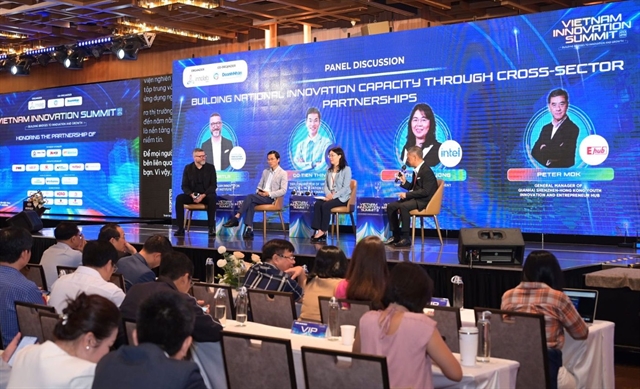
Đỗ Tiến Thịnh, deputy director of the National Innovation Centre under the Ministry of Finance, said equipping the workforce and younger generation with digital skills was vital to the country’s socio-economic development.
“When global technological enablers collaborate with local institutions and talent, we see rapid translation of AI from abstract concepts into concrete applications that serve our classrooms, small businesses and citizens nationwide,” he said.
Marc Woo, country director of Google Vietnam, said the initiative aimed to make advanced technology accessible to developers so they could create solutions for their communities. The submissions showed how Vietnamese talent could use new technologies to address practical needs, he said.
Separately, the Applied AI Lab, a joint initiative between the Google AI Futures Fund and Saigon AI Hub (SAIH), has completed its first cohort. SAIH is an open AI research and development hub established by VNG Group and Việt Nam National University-HCM City.
The first cohort brought together 10 teams of nearly 60 researchers from HCM City universities. Their projects covered healthcare and cancer detection, Vietnamese-language technologies, multimodal AI, computer vision, and human-robot interaction in extended- and mixed-reality environments.
The teams received early access to Google’s AI technologies and technical support from experts at Google Labs and Google DeepMind during their research and prototype development.
Building on the first cohort, SAIH is launching a second with a new approach. It will identify and select real-world challenges, then match them with research teams across the country to jointly develop, test and evaluate solutions.
Google has also expanded programmes with strategic partners, including Government agencies and industry associations, reaching more than 100,000 Vietnamese citizens through foundational and advanced training. — BIZHUB/VNS
Economy
 Economy
 Economy
 Economy
 Economy
 Economy
 Economy
 Economy
 Economy
 Economy
 Economy
 Economy
 Economy
 Economy
 Economy