 Economy


Int’l cooperation helps address nuclear power workforce shortages
1.
|
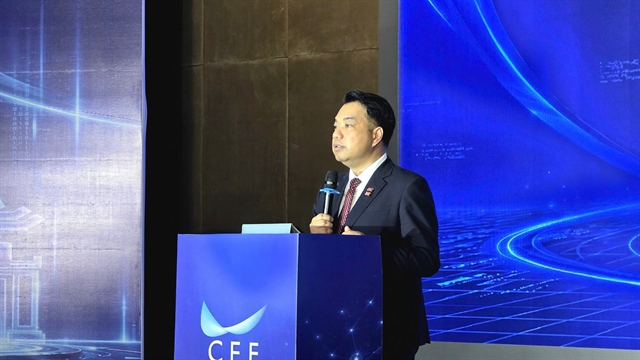
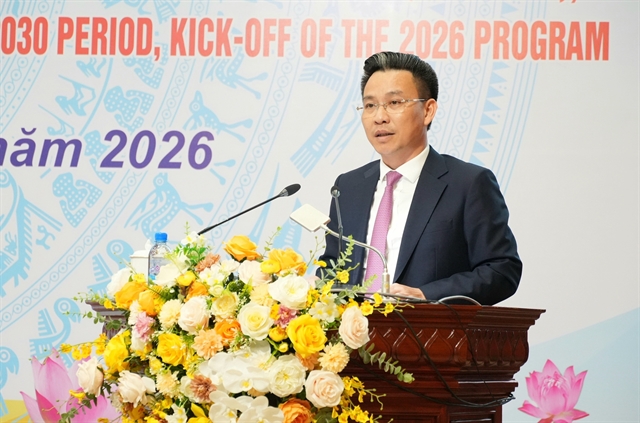
| Dr Mạc Quốc Anh, vice president and general secretary of HANOISME, delivers a speech at the event on October 8 — VNS Photo Ly Ly Cao |
HÀ NỘI — Strengthening high-quality human resources, from management and finance to technology and skilled production, is being placed at the centre of efforts to improve productivity and growth capacity among Hà Nội enterprises.
The issue was highlighted at the third Capital Economic Forum (CEF III), held in Hà Nội on October 8 under the theme "Growth Impetus from High-Quality Human Resources".
In his opening remarks, Dr Mạc Quốc Anh, vice president and general secretary of the Hanoi Association of Small and Medium Enterprises (HANOISME), said the discussion on human resources should go beyond qualifications, titles or management positions and focus on employees' ability to generate productivity, added value and competitiveness for businesses.
High-quality human resources, he said, should become a direct driver of productivity, innovation, competitiveness and new growth.
The forum connected the human-resource issue with the broader challenges facing Hà Nội businesses, including technology adoption, capital mobilisation, market expansion, supply-chain participation and business restructuring.
Sharing a similar opinion, Kazakhstan Ambassador to Việt Nam Kanat Tumysh said technology alone could not create prosperity, as people's knowledge, judgement, creativity and determination were needed to put technology to work.
"It is people - their knowledge, judgement, creativity and determination - who give it purpose and put it to work," he said.
He said Kazakhstan was seeking closer links between education, research and the needs of a changing economy, while strengthening digital and technical skills.
The ambassador also highlighted cooperation opportunities between Kazakhstan and Việt Nam through exchanges among educational institutions, businesses, young professionals and scientists, as well as technical training and digital innovation.
|
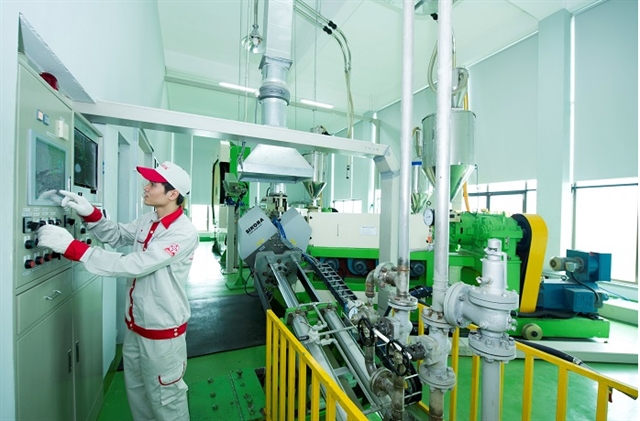
| A worker operates equipment at a plant of CADI-SUN. — Photo hanoisme.vn |
The challenge is particularly relevant as Hà Nội seeks stronger growth.
Dr Bùi Phương Đình, vice director of the Academy of Public Administration and Governance, noted that the capital has a workforce of about 4.2 million people, with 74.3 per cent having received training and 30.19 per cent holding university-level qualifications or higher.
However, about 25 per cent of graduates and engineers are working in low-skilled jobs, while the city faces a serious shortage of highly skilled technical workers.
She also pointed to difficulties in attracting specialised talent. Of six groups eligible for talent-attraction policies, only three had been successfully attracted, while 12.95 per cent of recruited personnel had left or transferred before completing their seven-year commitment.
No leading experts in priority areas such as AI and semiconductors had been attracted under the cited mechanism.
For businesses, the forum also focused on the need to develop management and financial capabilities alongside technical skills.
Phạm Thị Thùy Dương, vice chairwoman and secretary general of the Vietnam Members of Association of Accountants and Auditors (VMAA), identified four levels of corporate financial capability, ranging from tax compliance and management accounting to cash-flow forecasting, capital proposals and preparation for M&A due diligence.
She emphasised that enterprises need transparent financial data, long-term financial planning and the ability to prepare verifiable documentation before seeking capital or undertaking transactions.
Dương also highlighted organisational capacity as businesses expand.
While founders often benefit from direct customer knowledge, rapid decision-making and close quality control, excessive concentration of information and decision-making can become a constraint as companies grow.
Enterprises therefore need clearer delegation of authority, accountability, verified data and mechanisms for coordination and handover.
Human-resource development was also linked to the ability of enterprises to absorb external expertise.
Rather than treating M&A simply as the transfer of shares or assets, Dương proposed a shift towards capability absorption, involving the integration of processes, technology and talent and preparing for post-M&A integration from the due-diligence stage. — BIZHUB/VNS
Economy
 Economy
 Economy
 Economy
 Economy
 Economy
 Economy
 Economy
 Economy
.jpg) Economy
Economy
 Economy
 Economy
 Economy
 Economy